



 Chat with AI
Exam 7: How Molecules Mix

Exam 1: About Science65 Questions
Exam 2: Particles of Matter104 Questions
Exam 3: Elements of Chemistry116 Questions
Exam 4: Subatomic Particles146 Questions
Exam 5: The Atomic Nucleus128 Questions
Exam 6: How Atoms Bond153 Questions
Exam 7: How Molecules Mix157 Questions
Exam 8: How Water Behaves140 Questions
Exam 9: How Chemicals React150 Questions
Exam 10: Acids and Bases in Our Environment135 Questions
Exam 11: Oxidations and Reductions Charge the World138 Questions
Exam 12: Organic Compounds162 Questions
Exam 13: Nutrients of Life138 Questions
Exam 14: Medicinal Chemistry85 Questions
Exam 15: Optimizing Food Production115 Questions
Exam 16: Protection Water and Air Resources147 Questions
Exam 17: Capturing Energy93 Questions
Select questions type


Passing arsenic contaminated water through a long pipe filled with sand and iron powder leads to removal of the arsenic by ________.
(Multiple Choice)
4.8/5  (75)
(75) Describe what usually happens to a hot solution that is saturated with a solid as it cools.
(Multiple Choice)
4.8/5 (74)
(74) Allowing water to cascade or bubble in a fountain during the purification process is an example of ________.
(Multiple Choice)
4.9/5 (78)
(78) Chlorine,  , is a gas at room temperature, but bromine,
 , is a liquid. Explain.
, is a gas at room temperature, but bromine, , is a liquid. Explain. (Multiple Choice)
4.7/5 (86)
(86) Which of the following picture might best describe a soap or detergent? 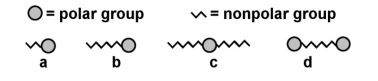
(Multiple Choice)
4.9/5 (78)
(78) Which of the following solutions is the most concentrated?
(Multiple Choice)
4.8/5 (78)
(78) Phosphate ions,  3-, were once added to detergents to assist in cleaning. What function did they serve?
 (Multiple Choice)
4.8/5 (79)
(79) How many grams of sugar (sucrose)are there in 5.0 liters of sugar water that has a concentration of 0.50 grams per liter of solution?
(Multiple Choice)
4.8/5 (77)
(77) How many molecules of sucrose are in 0.500 L of a 1.00 molar solution of sucrose?
(Multiple Choice)
4.9/5 (80)
(80) Why might a solvent like turpentine be better for removing grease and grime than water?
(Multiple Choice)
4.8/5 (85)
(85) What is the main difference between a dipole-dipole interaction and a dipole-induced dipole interaction?
(Multiple Choice)
4.7/5 (80)
(80) Deuterium oxide,  O, and water,
 O, have the same chemical structure and differ only in that
 O possesses the deuterium isotope of hydrogen, whereas water possesses the protium isotope. Deuterium oxide, also known as "heavy water," is 11 percent heavier than water. Might you expect its boiling temperature also to be about 11 percent greater? Why or why not?
O, and water, O, have the same chemical structure and differ only in that O possesses the deuterium isotope of hydrogen, whereas water possesses the protium isotope. Deuterium oxide, also known as "heavy water," is 11 percent heavier than water. Might you expect its boiling temperature also to be about 11 percent greater? Why or why not? (Multiple Choice)
4.8/5 (74)
(74) Treating water with chlorine or ozone during water purification is an example of ________.
(Multiple Choice)
4.7/5 (72)
(72) 
Filters
- Essay(0)
- Multiple Choice(0)
- Short Answer(0)
- True False(0)
- Matching(0)