



 Chat with AI
Exam 7: How Molecules Mix

Exam 1: About Science65 Questions
Exam 2: Particles of Matter104 Questions
Exam 3: Elements of Chemistry116 Questions
Exam 4: Subatomic Particles146 Questions
Exam 5: The Atomic Nucleus128 Questions
Exam 6: How Atoms Bond153 Questions
Exam 7: How Molecules Mix157 Questions
Exam 8: How Water Behaves140 Questions
Exam 9: How Chemicals React150 Questions
Exam 10: Acids and Bases in Our Environment135 Questions
Exam 11: Oxidations and Reductions Charge the World138 Questions
Exam 12: Organic Compounds162 Questions
Exam 13: Nutrients of Life138 Questions
Exam 14: Medicinal Chemistry85 Questions
Exam 15: Optimizing Food Production115 Questions
Exam 16: Protection Water and Air Resources147 Questions
Exam 17: Capturing Energy93 Questions
Select questions type


Which of the above might best describe how soap behaves in a nonpolar solvent like turpentine?
(Multiple Choice)
4.8/5  (85)
(85) Red blood cells have a high concentration of dissolved ions. When placed into pure water they rupture. Why?
(Multiple Choice)
5.0/5 (82)
(82) What is the difference between a dipole-dipole interaction and an ion-dipole interaction?
(Multiple Choice)
4.9/5 (89)
(89) Which of the following might have the best solubility in water?
(Multiple Choice)
4.9/5 (80)
(80) Two chemical structures are shown, one of a typical gasoline molecule and the other of a typical motor oil molecule. Which is which? 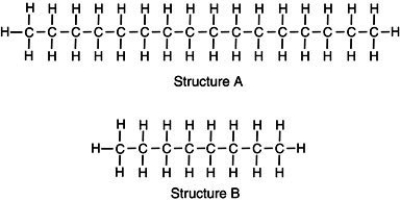 Base your reasoning not on memorization but rather upon what you know about molecular interactions and the various physical properties of gasoline and motor oil.
 (Multiple Choice)
4.9/5 (95)
(95) If you need 10. moles of sucrose, how many liters of a 4.0 molar solution would you need?
(Multiple Choice)
4.9/5 (77)
(77) A sealed plastic bottle is filled with enough sand so that the bottle floats just beneath the surface in ocean water. Some sand is then removed and the bottle is then placed in some fresh water where it floats just beneath the surface. What is true about the amount of sand that was removed from the bottle?
(Multiple Choice)
4.9/5 (67)
(67) Which of the following is the weakest form of interatomic attraction?
(Multiple Choice)
4.9/5 (81)
(81) In a solution made from one teaspoon of sugar and one liter of water, which is the solute?
(Multiple Choice)
4.8/5 (78)
(78) Consider the boiling points of the following compounds and their solubilities in room-temperature water. Why does the solubilities in water go down as the boiling points of these alcohols go up. 
(Multiple Choice)
4.8/5 (69)
(69) Why is calcium fluoride, Ca  , a high melting point crystalline solid while tin (IV)chloride,
 , is a volatile liquid?
, a high melting point crystalline solid while tin (IV)chloride, , is a volatile liquid? (Multiple Choice)
5.0/5 (76)
(76) Fish don't live very long in water that has just been boiled and brought back to room temperature. Suggest why.
(Multiple Choice)
4.9/5 (65)
(65) How can you tell whether a sugar solution is saturated or not?
(Multiple Choice)
4.9/5 (64)
(64) If an ionic bond is stronger than a dipole-dipole interaction, how can water dissolve an ionic compound?
(Multiple Choice)
4.9/5 (76)
(76) What happens when the molecule-to-molecule attractions in the solute are comparable to those in the solvent?
(Multiple Choice)
4.8/5 (74)
(74) Why do red blood cells, which contain an aqueous solution of dissolved ions and minerals, burst when placed in fresh water?
(Multiple Choice)
4.8/5 (74)
(74) What is the molarity when water is added to 2 moles of sodium chloride to make 0.5 liter of solution?
(Multiple Choice)
4.7/5 (91)
(91) Why is a large quantity of water used in industrial processes in the U.S. purified by desalinization?
(Multiple Choice)
5.0/5 (75)
(75) 
Filters
- Essay(0)
- Multiple Choice(0)
- Short Answer(0)
- True False(0)
- Matching(0)