



 Chat with AI
Exam 10: Structure Determination: Mass Spectrometry,infrared Spectroscopy,and Ultraviolet Spectroscopy

Exam 1: Structure and Bonding30 Questions
Exam 2: Polar Covalent Bonds: Acids and Bases35 Questions
Exam 3: Organic Compounds: Alkanes and Their Stereochemistry32 Questions
Exam 4: Organic Compounds: Cycloalkanes and Their Stereochemistry18 Questions
Exam 5: Stereochemistry at Tetrahedral Centers33 Questions
Exam 6: An Overview of Organic Reactions32 Questions
Exam 7: Alkenes and Alkynes34 Questions
Exam 8: Reactions of Alkenes and Alkynes37 Questions
Exam 9: Aromatic Compounds36 Questions
Exam 10: Structure Determination: Mass Spectrometry,infrared Spectroscopy,and Ultraviolet Spectroscopy41 Questions
Exam 11: Structure Determination: Nuclear Magnetic Resonance Spectroscopy37 Questions
Exam 12: Organohalides: Nucleophilic Substitutions and Eliminations37 Questions
Exam 13: Alcohols,phenols,and Thiols: Ethers and Sulfides19 Questions
Exam 14: Aldehydes and Ketones: Nucleophilic Addition Reactions30 Questions
Exam 15: Carboxylic Acids and Nitriles23 Questions
Exam 16: Carboxylic Acid Derivatives: Nucleophilic Acyl Substitution Reactions42 Questions
Exam 17: Carbonyl Alpha-Substitution and Condensation Reactions84 Questions
Exam 18: Amines and Heterocycles28 Questions
Exam 19: Biomolecules: Amino Acids,peptides,and Proteins36 Questions
Exam 20: Amino Acid Metabolism34 Questions
Exam 21: Biomolecules: Carbohydrates42 Questions
Exam 22: Carbohydrate Metabolism41 Questions
Exam 23: Biomolecules: Lipids and Their Metabolism31 Questions
Exam 24: Biomolecules: Nucleic Acids and Their Metabolism23 Questions
Select questions type


Instructions: Select the most reasonable formula for the compounds with the following mass spectral data.
Refer to instructions.M+ at m/z = 101
(Multiple Choice)
4.9/5  (79)
(79) Instructions: Select the most reasonable formula for the compounds with the following mass spectral data.
Refer to instructions.M+ at m/z = 216
(Multiple Choice)
5.0/5 (82)
(82) Which of the following statements best describes the base peak in a mass spectrum?
(Multiple Choice)
4.8/5 (90)
(90) What are the masses of the charged fragments produced by the dehydration of the following compound?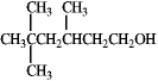
(Essay)
4.8/5 (90)
(90) At what approximate positions might the compound below show IR absorptions?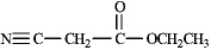
(Essay)
4.8/5 (73)
(73) Instructions: Refer to the mass spectrum of 2-methylbutane shown below to answer the following question(s).
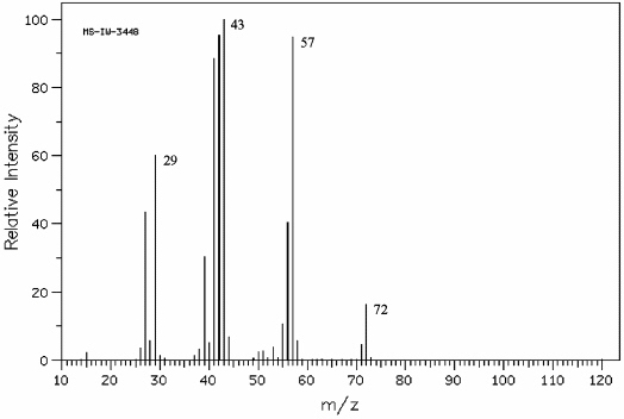 (Spectrum obtained from:SDBSWeb:http://www.aist.go.jp/RIODB/SDBS/)
-Refer to instructions.What peak represents the base peak?
(Spectrum obtained from:SDBSWeb:http://www.aist.go.jp/RIODB/SDBS/)
-Refer to instructions.What peak represents the base peak? (Essay)
4.9/5 (86)
(86) Instructions: Refer to the mass spectrum of 2-methylbutane shown below to answer the following question(s).
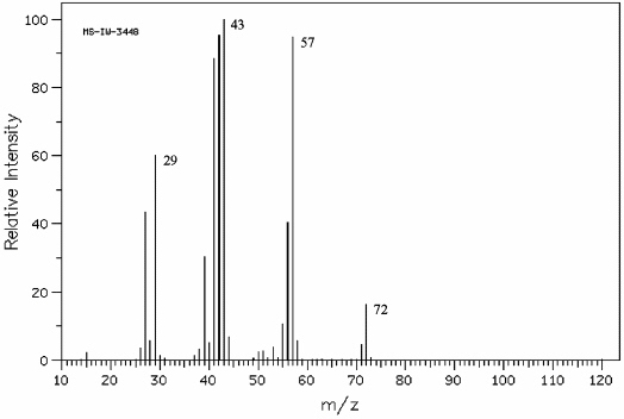 (Spectrum obtained from:SDBSWeb:http://www.aist.go.jp/RIODB/SDBS/)
-Refer to instructions.Propose structures for fragment ions at m/z = 57,43,and 29.
(Spectrum obtained from:SDBSWeb:http://www.aist.go.jp/RIODB/SDBS/)
-Refer to instructions.Propose structures for fragment ions at m/z = 57,43,and 29. (Essay)
4.9/5 (82)
(82) Which of the following does not involve the interaction of molecules with electromagnetic energy?
(Multiple Choice)
4.9/5 (84)
(84) A 3.42 ´ 10-5 M solution of dibenzalacetone in ethanol produced an absorbance of 0.753 in a 1.00 cm cell.Based on this data,what is e for this compound?
(Multiple Choice)
4.7/5 (84)
(84) Consider the compound below: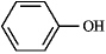 a)At what approximate positions might the compound show IR absorptions?
b)How would this spectrum differ from that of cyclohexanol?
a)At what approximate positions might the compound show IR absorptions?
b)How would this spectrum differ from that of cyclohexanol?
(Essay)
4.8/5 (84)
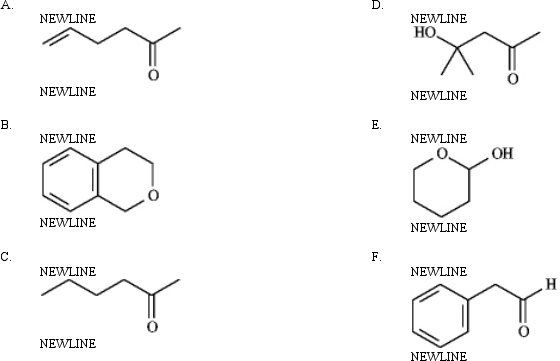
(84) Which of the following compounds gives an infrared spectrum with a peak at ~1750 cm-1,but no significant peaks at 3000-3500 cm-1 or 1050-1250 cm-1?
(Multiple Choice)
4.8/5 (76)
(76) Cyclohexene and hex-2-yne both have the molecular formula,C6H10.
a)How would you use infrared spectroscopy to distinguish between the two compounds?
b)How could the mass spectrum be used to distinguish between the two compounds?
(Essay)
4.9/5 (81)
(81) 
What are the units for electromagnetic radiation used in infrared spectroscopy?
(Multiple Choice)
4.8/5 (77)
(77) Which of the following regions in the electromagnetic spectrum corresponds to the radiation with the highest energy?
(Multiple Choice)
4.9/5 (75)
(75) Which of the following bonds undergoes stretching at the highest frequency?
(Multiple Choice)
4.8/5 (84)
(84) Which of the following peaks is not prominent in the mass spectrum of 2-methylbutan-2-ol?
(Multiple Choice)
4.8/5 (78)
(78) Which of the following bonds gives rise to a strong absorbance near 1700 cm-1 in the infrared spectrum?
(Multiple Choice)
4.7/5 (90)
(90) 
Filters
- Essay(0)
- Multiple Choice(0)
- Short Answer(0)
- True False(0)
- Matching(0)