



 Chat with AI
Exam 11: Structure Determination: Nuclear Magnetic Resonance Spectroscopy

Exam 1: Structure and Bonding30 Questions
Exam 2: Polar Covalent Bonds: Acids and Bases35 Questions
Exam 3: Organic Compounds: Alkanes and Their Stereochemistry32 Questions
Exam 4: Organic Compounds: Cycloalkanes and Their Stereochemistry18 Questions
Exam 5: Stereochemistry at Tetrahedral Centers33 Questions
Exam 6: An Overview of Organic Reactions32 Questions
Exam 7: Alkenes and Alkynes34 Questions
Exam 8: Reactions of Alkenes and Alkynes37 Questions
Exam 9: Aromatic Compounds36 Questions
Exam 10: Structure Determination: Mass Spectrometry,infrared Spectroscopy,and Ultraviolet Spectroscopy41 Questions
Exam 11: Structure Determination: Nuclear Magnetic Resonance Spectroscopy37 Questions
Exam 12: Organohalides: Nucleophilic Substitutions and Eliminations37 Questions
Exam 13: Alcohols,phenols,and Thiols: Ethers and Sulfides19 Questions
Exam 14: Aldehydes and Ketones: Nucleophilic Addition Reactions30 Questions
Exam 15: Carboxylic Acids and Nitriles23 Questions
Exam 16: Carboxylic Acid Derivatives: Nucleophilic Acyl Substitution Reactions42 Questions
Exam 17: Carbonyl Alpha-Substitution and Condensation Reactions84 Questions
Exam 18: Amines and Heterocycles28 Questions
Exam 19: Biomolecules: Amino Acids,peptides,and Proteins36 Questions
Exam 20: Amino Acid Metabolism34 Questions
Exam 21: Biomolecules: Carbohydrates42 Questions
Exam 22: Carbohydrate Metabolism41 Questions
Exam 23: Biomolecules: Lipids and Their Metabolism31 Questions
Exam 24: Biomolecules: Nucleic Acids and Their Metabolism23 Questions
Select questions type


Instructions: Predict the splitting patterns you would expect for each proton in the molecules below:
Predict: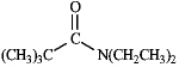

Free
(Essay)
4.9/5  (89)
(89) Correct Answer: Verified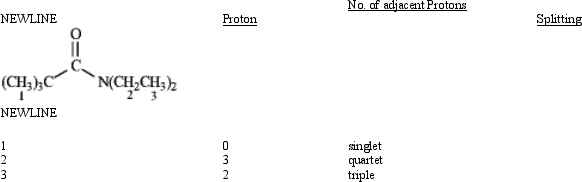
Which of the following combinations of peaks appears in the 1H NMR spectrum of 2-methylpropane?
Free
(Multiple Choice)
4.8/5 (79)
(79) Correct Answer:Verified
VerifiedD
Which of the following combinations of peaks appears in the 1H NMR spectrum of diethyl ether,CH3CH2OCH2CH3?
Free
(Multiple Choice)
5.0/5 (77)
(77) Correct Answer:Verified
VerifiedD
How many positive and negative peaks appear in the DEPT-135 and in the DEPT-90 spectrum of 2-methylpentane?
(Multiple Choice)
4.8/5 (84)
(84) Which of the following compounds gives a 1H NMR spectrum consisting of only two singlets?
(Multiple Choice)
4.9/5 (83)
(83) Instructions: For each of the compounds below tell how many signals you would expect the molecule to have in its normal,broadband decoupled 13C NMR spectra.
-Number of signals:

(Essay)
4.8/5 (72)
(72) Which of the following would produce only singlets in an 1H NMR spectrum? 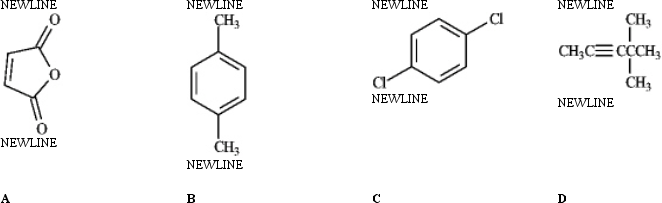
(Multiple Choice)
4.9/5 (87)
(87) How many signals appear in the broadband-decoupled 13C NMR spectrum of 1,3-dibromobenzene?
(Multiple Choice)
5.0/5 (84)
(84) Instructions: Predict the splitting patterns you would expect for each proton in the molecules below:
Predict: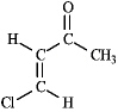
(Essay)
4.8/5 (93)
(93) Instructions: Refer to the structure of 3-methylbutan-2-one below to answer the following question(s). 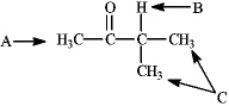 -Refer to instructions.What is the splitting pattern for the hydrogens in 3-methylbutan-2-one labeled A,B,and C,respectively?
 (Multiple Choice)
4.9/5 (80)
(80) Instructions: For each of the compounds below tell how many signals you would expect the molecule to have in its normal,broadband decoupled 13C NMR spectra.
-Number of signals: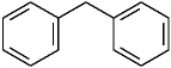
(Essay)
4.8/5 (72)
(72) Instructions: For each of the compounds below tell how many signals you would expect the molecule to have in its normal,broadband decoupled 13C NMR spectra.
-Number of signals: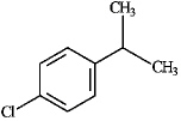
(Essay)
4.9/5 (79)
(79) Nuclear magnetic resonance spectroscopy provides information about a molecule's:
(Multiple Choice)
4.8/5 (88)
(88) Explain why all protons in a molecule do not absorb rf energy at the same frequency.
(Essay)
4.8/5 (95)
(95) A compound with the molecular formula C5H12O produces only two singlets in the 1H NMR spectrum.
a)Propose a structure for this compound.
b)How many signals would be present in the 13C NMR for this structure?
(Essay)
5.0/5 (64)
(64) Which of the following compounds would produce the most downfield signal in a 13C NMR spectrum? 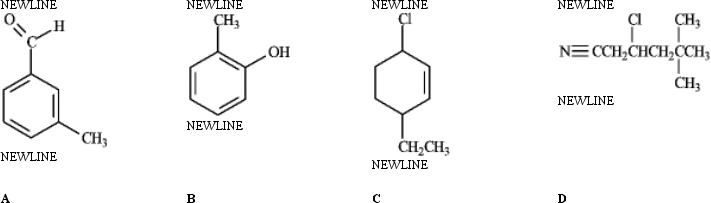
(Multiple Choice)
4.7/5 (79)
(79) Treatment of tert-butyl alcohol with hydrogen chloride yields a mixture of tert-butyl chloride and 2-methylpropene.
 a)After chromatographic separation, how would you use 1H NMR to help you decide which was which?
b)How would the 13C NMR for the two compounds differ?
a)After chromatographic separation, how would you use 1H NMR to help you decide which was which?
b)How would the 13C NMR for the two compounds differ?
(Essay)
4.9/5 (81)
(81) Instructions: To answer the following questions,consider the data and 1H NMR spectrum below.
The mass spectrum of this compound shows a molecular ion at m/z = 113,the IR spectrum has characteristic absorptions at 2270 and 1735 cm-1,and the 13C NMR spectrum has five signals.
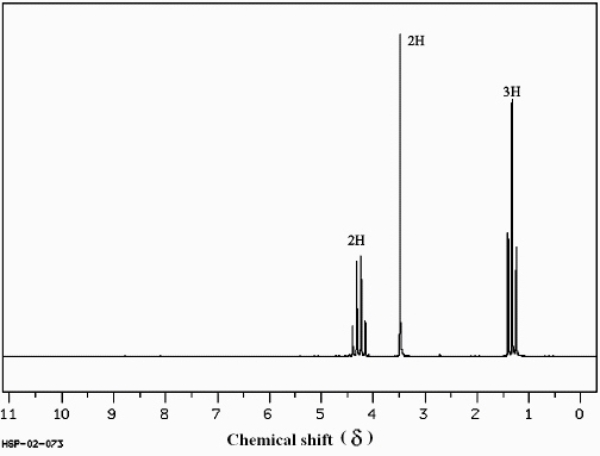 (Spectrum obtained from:SDBSWeb:http://www.aist.go.jp/RIODB/SDBS/)
-Refer to instructions.How many types of nonequivalent protons are there in this molecule?
(Spectrum obtained from:SDBSWeb:http://www.aist.go.jp/RIODB/SDBS/)
-Refer to instructions.How many types of nonequivalent protons are there in this molecule? (Essay)
4.9/5 (76)
(76) How many sets of equivalent protons are there in hexane,2-methylhexane,and 3-methylhexane,respectively?
(Essay)
4.8/5 (89)
(89) If the proton attached to C2 in 1,1,2-tribromopropane is coupled with the protons on C1 (J = 3.5 Hz)and C3 (J = 6.8),draw the tree diagram of the C2 proton and predict the splitting pattern.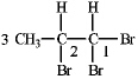
(Essay)
4.7/5 (70)
(70) 
Filters
- Essay(0)
- Multiple Choice(0)
- Short Answer(0)
- True False(0)
- Matching(0)