



 Chat with AI
Exam 15: Carboxylic Acids and Nitriles

Exam 1: Structure and Bonding30 Questions
Exam 2: Polar Covalent Bonds: Acids and Bases35 Questions
Exam 3: Organic Compounds: Alkanes and Their Stereochemistry32 Questions
Exam 4: Organic Compounds: Cycloalkanes and Their Stereochemistry18 Questions
Exam 5: Stereochemistry at Tetrahedral Centers33 Questions
Exam 6: An Overview of Organic Reactions32 Questions
Exam 7: Alkenes and Alkynes34 Questions
Exam 8: Reactions of Alkenes and Alkynes37 Questions
Exam 9: Aromatic Compounds36 Questions
Exam 10: Structure Determination: Mass Spectrometry,infrared Spectroscopy,and Ultraviolet Spectroscopy41 Questions
Exam 11: Structure Determination: Nuclear Magnetic Resonance Spectroscopy37 Questions
Exam 12: Organohalides: Nucleophilic Substitutions and Eliminations37 Questions
Exam 13: Alcohols,phenols,and Thiols: Ethers and Sulfides19 Questions
Exam 14: Aldehydes and Ketones: Nucleophilic Addition Reactions30 Questions
Exam 15: Carboxylic Acids and Nitriles23 Questions
Exam 16: Carboxylic Acid Derivatives: Nucleophilic Acyl Substitution Reactions42 Questions
Exam 17: Carbonyl Alpha-Substitution and Condensation Reactions84 Questions
Exam 18: Amines and Heterocycles28 Questions
Exam 19: Biomolecules: Amino Acids,peptides,and Proteins36 Questions
Exam 20: Amino Acid Metabolism34 Questions
Exam 21: Biomolecules: Carbohydrates42 Questions
Exam 22: Carbohydrate Metabolism41 Questions
Exam 23: Biomolecules: Lipids and Their Metabolism31 Questions
Exam 24: Biomolecules: Nucleic Acids and Their Metabolism23 Questions
Select questions type


What is the major organic product obtained from the following reaction? 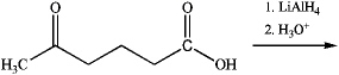

Free
(Multiple Choice)
4.7/5  (80)
(80) Correct Answer: Verified
C
Which of the following would represent the correct reaction conditions for the following conversion? 
Free
(Multiple Choice)
4.7/5 (76)
(76) Correct Answer:Verified
VerifiedC
Instructions: Carboxylic acids are synthesized from alkyl halides via Grignard reagent carboxylation or nitrile hydrolysis.Choose the best method for affecting each of the following conversions.Explain each of your choices.If neither method is appropriate,explain.
Choose best method: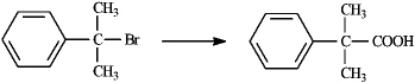
Free
(Essay)
5.0/5 (76)
(76) Correct Answer:Verified
VerifiedSince SN2 displacements do not occur at tertiary alkyl halides,the Grignard reagent carboxylation is the best method for carrying out this conversion.
Instructions: Give the major organic product(s)for each of the following reactions or sequences of reactions.Show all relevant stereochemistry.
-Refer to instructions and answer the following questions.
a) Give major product(s):
 b) Draw the stucture of the intermediate procuct(s) that form(s).
 (Essay)
4.9/5 (75)
(75) Instructions: Give the major organic product(s)for each of the following reactions or sequences of reactions.Show all relevant stereochemistry.
-Give major product(s):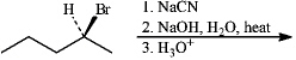
(Essay)
4.8/5 (73)
(73) Instructions: Consider the following 1H NMR to answer the following question. 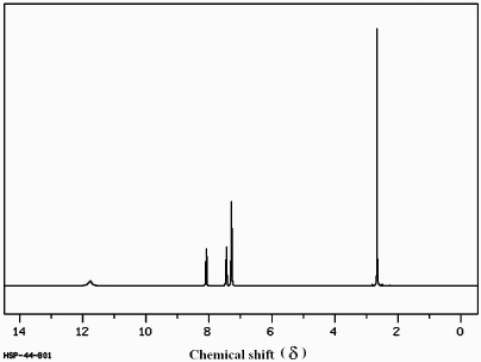 Spectrum obtained from: SDBSWeb : http://riodb01.ibase.aist.go.jp/sdbs/ (National Institute of Advanced Industrial Science and Technology,11-07-08)
-Refer to instructions.This compound is known to contain both a -C=O group and an -OH group.Based on this spectrum,this compound would be classified as:
Spectrum obtained from: SDBSWeb : http://riodb01.ibase.aist.go.jp/sdbs/ (National Institute of Advanced Industrial Science and Technology,11-07-08)
-Refer to instructions.This compound is known to contain both a -C=O group and an -OH group.Based on this spectrum,this compound would be classified as: (Multiple Choice)
4.9/5 (76)
(76) What is the order of increasing reactivity for the following compounds in electrophillic aromatic substitution reactions? (least to most reactive) 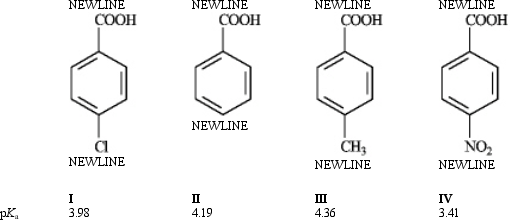
(Multiple Choice)
4.9/5 (81)
(81) Instructions: Give the major organic product(s)for each of the following reactions or sequences of reactions.Show all relevant stereochemistry.
-Give major product(s):
(Essay)
4.8/5 (72)
(72) Based on the following IR spectrum,this compound would be classified as: 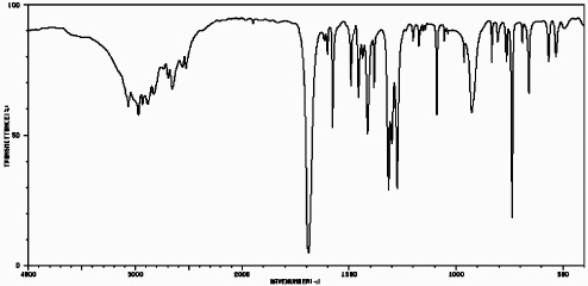 Spectrum obtained from: SDBSWeb : http://riodb01.ibase.aist.go.jp/sdbs/ (National Institute of Advanced Industrial Science and Technology,11-07-08)
 (Multiple Choice)
4.7/5 (82)
(82) The product shown can be synthesized by two different pathways as shown by the reaction conditions.Draw the structure of starting materials that should be placed in each of the boxes.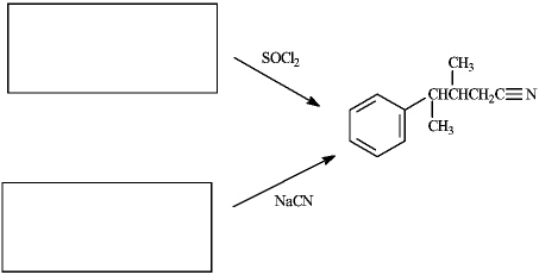
(Essay)
4.7/5 (59)
(59) 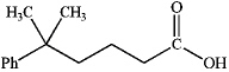
What is the major organic product obtained from the following reaction? 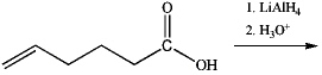
(Multiple Choice)
4.9/5 (87)
(87) What is the major organic product obtained from the following reaction? 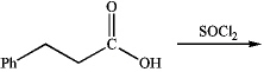
(Multiple Choice)
4.8/5 (75)
(75) Instructions: Give the major organic product(s)for each of the following reactions or sequences of reactions.Show all relevant stereochemistry.
-Give major product(s):
(Essay)
4.8/5 (75)
(75) Which of the following is the correct order of decreasing acid strength (more acidic > less acidic)?
(Multiple Choice)
4.9/5 (94)
(94) What is the order of increasing acidity for the following compounds? (least to most) 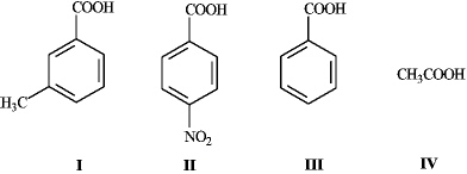
(Multiple Choice)
4.9/5 (78)
(78) Instructions: Carboxylic acids are synthesized from alkyl halides via Grignard reagent carboxylation or nitrile hydrolysis.Choose the best method for affecting each of the following conversions.Explain each of your choices.If neither method is appropriate,explain.
Choose best method:
(Essay)
4.9/5 (74)
(74) Which of the following does not represent a similarity between nitriles and carboxylic acids?
(Multiple Choice)
4.9/5 (72)
(72) 
Filters
- Essay(0)
- Multiple Choice(0)
- Short Answer(0)
- True False(0)
- Matching(0)