



 Chat with AI
Exam 11: Structure Determination: Nuclear Magnetic Resonance Spectroscopy

Exam 1: Structure and Bonding30 Questions
Exam 2: Polar Covalent Bonds: Acids and Bases35 Questions
Exam 3: Organic Compounds: Alkanes and Their Stereochemistry32 Questions
Exam 4: Organic Compounds: Cycloalkanes and Their Stereochemistry18 Questions
Exam 5: Stereochemistry at Tetrahedral Centers33 Questions
Exam 6: An Overview of Organic Reactions32 Questions
Exam 7: Alkenes and Alkynes34 Questions
Exam 8: Reactions of Alkenes and Alkynes37 Questions
Exam 9: Aromatic Compounds36 Questions
Exam 10: Structure Determination: Mass Spectrometry,infrared Spectroscopy,and Ultraviolet Spectroscopy41 Questions
Exam 11: Structure Determination: Nuclear Magnetic Resonance Spectroscopy37 Questions
Exam 12: Organohalides: Nucleophilic Substitutions and Eliminations37 Questions
Exam 13: Alcohols,phenols,and Thiols: Ethers and Sulfides19 Questions
Exam 14: Aldehydes and Ketones: Nucleophilic Addition Reactions30 Questions
Exam 15: Carboxylic Acids and Nitriles23 Questions
Exam 16: Carboxylic Acid Derivatives: Nucleophilic Acyl Substitution Reactions42 Questions
Exam 17: Carbonyl Alpha-Substitution and Condensation Reactions84 Questions
Exam 18: Amines and Heterocycles28 Questions
Exam 19: Biomolecules: Amino Acids,peptides,and Proteins36 Questions
Exam 20: Amino Acid Metabolism34 Questions
Exam 21: Biomolecules: Carbohydrates42 Questions
Exam 22: Carbohydrate Metabolism41 Questions
Exam 23: Biomolecules: Lipids and Their Metabolism31 Questions
Exam 24: Biomolecules: Nucleic Acids and Their Metabolism23 Questions
Select questions type


Which structure of molecular formula C4H8Cl2 fits the 1H NMR and 13C NMR spectra shown below? 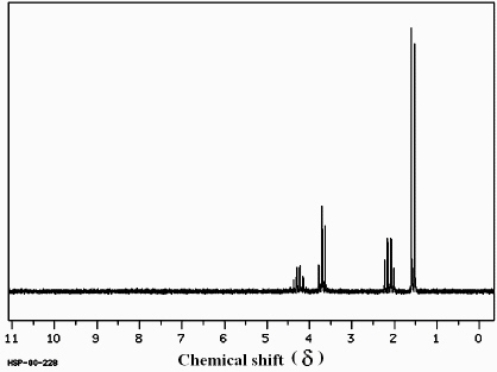
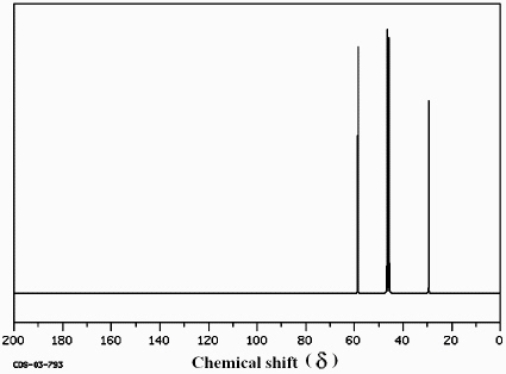 (Spectrum obtained from: SDBSWeb: http://www.aist.go.jp/RIODB/SDBS/)
 (Multiple Choice)
4.8/5  (88)
(88) Which of the following compounds gives a 1H NMR spectrum consisting of only a singlet and two signals in the 13C NMR?
(Multiple Choice)
4.8/5 (74)
(74) Which feature in the 1H NMR spectrum provides information about the relative numbers of hydrogen atoms of each type found in a compound?
(Multiple Choice)
4.9/5 (96)
(96) Instructions: Refer to the structure of 3-methylbutan-2-one below to answer the following question(s). 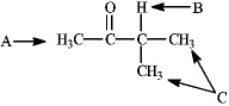 -Refer to instructions.What is the ratio of peak areas upon integration of the spectrum for A,B,and C respectively?
 (Multiple Choice)
4.8/5 (81)
(81) A compound with the molecular formula C6H4ClBr produces only two doublets in the 1H NMR spectrum.
a)Propose a structure for this compound.
b)How many signals would be present in the 13CNMR for this structure?
(Essay)
4.8/5 (69)
(69) Instructions: Answer the following question(s)for the compound whose 1H NMR spectra is shown below.
C4H8O
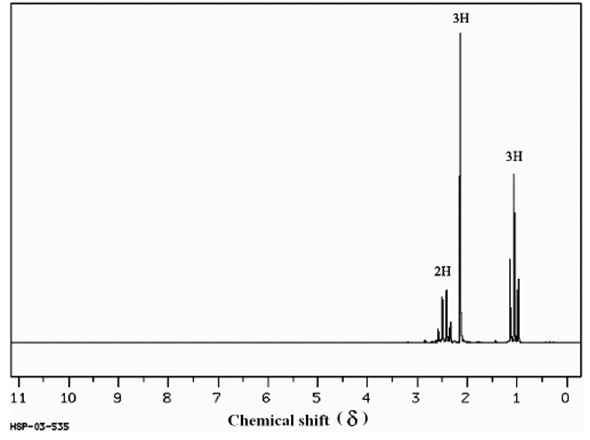 (Spectrum obtained from:SDBSWeb:http://www.aist.go.jp/RIODB/SDBS/)
-Refer to instructions.Describe each signal in terms of its integration,splitting and chemical shift.
(Spectrum obtained from:SDBSWeb:http://www.aist.go.jp/RIODB/SDBS/)
-Refer to instructions.Describe each signal in terms of its integration,splitting and chemical shift. (Essay)
4.8/5 (70)
(70) Instructions: For each of the compounds below tell how many signals you would expect the molecule to have in its normal,broadband decoupled 13C NMR spectra.
-Number of signals: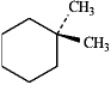
(Essay)
4.8/5 (81)
(81) Which of the following would not produce nuclear magnetic resonance?
(Multiple Choice)
4.9/5 (69)
(69) Instructions: To answer the following questions,consider the data and 1H NMR spectrum below.
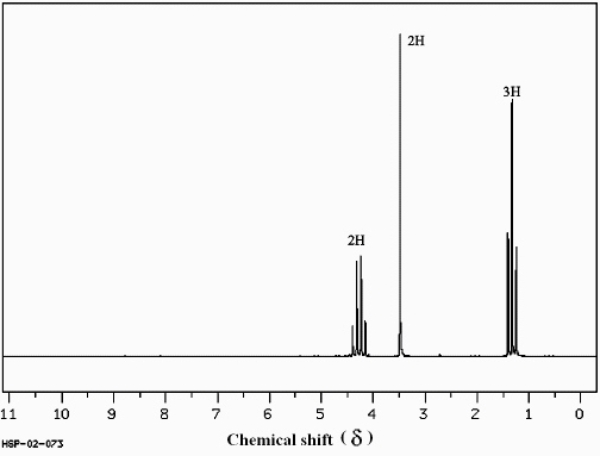 (Spectrum obtained from:SDBSWeb:http://www.aist.go.jp/RIODB/SDBS/)
The mass spectrum of this compound shows a molecular ion at m/z = 113,the IR spectrum has characteristic absorptions at 2270 and 1735 cm-1,and the 13C NMR spectrum has five signals.
-Refer to instructions.Based on the mass spectral data and the IR data,what functional groups are present in this compound?
(Spectrum obtained from:SDBSWeb:http://www.aist.go.jp/RIODB/SDBS/)
The mass spectrum of this compound shows a molecular ion at m/z = 113,the IR spectrum has characteristic absorptions at 2270 and 1735 cm-1,and the 13C NMR spectrum has five signals.
-Refer to instructions.Based on the mass spectral data and the IR data,what functional groups are present in this compound? (Essay)
4.9/5 (84)
(84) Instructions: Answer the following question(s)for the compound whose 1H NMR spectra is shown below.
C4H8O
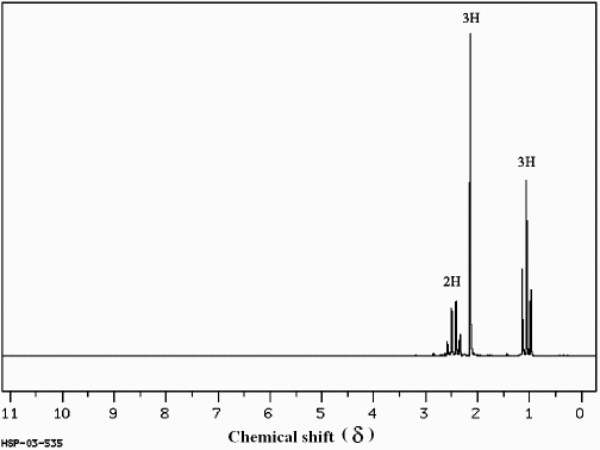 (Spectrum obtained from:SDBSWeb:http://www.aist.go.jp/RIODB/SDBS/)
-Refer to instructions.Propose a structure for this compound.
(Spectrum obtained from:SDBSWeb:http://www.aist.go.jp/RIODB/SDBS/)
-Refer to instructions.Propose a structure for this compound. (Essay)
4.8/5 (80)
(80) 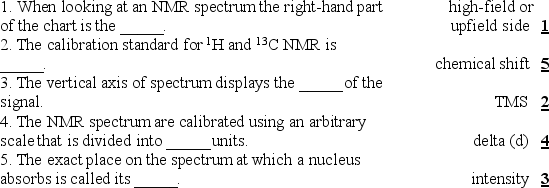
Which feature in the 1H NMR spectrum provides information about the number of neighboring protons of each proton in the compound?
(Multiple Choice)
4.9/5 (90)
(90) Arrange the following compounds in order of increasing number of signals in a 13C NMR spectrum.
(Essay)
4.7/5 (93)
(93) How many signals appear in the broadband-decoupled 13C NMR spectrum of 1,2-dibromobenzene?
(Multiple Choice)
4.9/5 (79)
(79) How many positive and negative peaks appear in the DEPT-135 spectrum of 2,4-dimethylpentane?
(Multiple Choice)
4.8/5 (75)
(75) Instructions: For each of the compounds below tell how many signals you would expect the molecule to have in its normal,broadband decoupled 13C NMR spectra.
-Number of signals: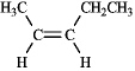
(Essay)
4.8/5 (65)
(65) Which feature in the 1H NMR spectrum provides information about the electronic environment of the protons in a compound?
(Multiple Choice)
4.9/5 (77)
(77) 
Filters
- Essay(0)
- Multiple Choice(0)
- Short Answer(0)
- True False(0)
- Matching(0)