



 Chat with AI
Exam 12: Organohalides: Nucleophilic Substitutions and Eliminations

Exam 1: Structure and Bonding30 Questions
Exam 2: Polar Covalent Bonds: Acids and Bases35 Questions
Exam 3: Organic Compounds: Alkanes and Their Stereochemistry32 Questions
Exam 4: Organic Compounds: Cycloalkanes and Their Stereochemistry18 Questions
Exam 5: Stereochemistry at Tetrahedral Centers33 Questions
Exam 6: An Overview of Organic Reactions32 Questions
Exam 7: Alkenes and Alkynes34 Questions
Exam 8: Reactions of Alkenes and Alkynes37 Questions
Exam 9: Aromatic Compounds36 Questions
Exam 10: Structure Determination: Mass Spectrometry,infrared Spectroscopy,and Ultraviolet Spectroscopy41 Questions
Exam 11: Structure Determination: Nuclear Magnetic Resonance Spectroscopy37 Questions
Exam 12: Organohalides: Nucleophilic Substitutions and Eliminations37 Questions
Exam 13: Alcohols,phenols,and Thiols: Ethers and Sulfides19 Questions
Exam 14: Aldehydes and Ketones: Nucleophilic Addition Reactions30 Questions
Exam 15: Carboxylic Acids and Nitriles23 Questions
Exam 16: Carboxylic Acid Derivatives: Nucleophilic Acyl Substitution Reactions42 Questions
Exam 17: Carbonyl Alpha-Substitution and Condensation Reactions84 Questions
Exam 18: Amines and Heterocycles28 Questions
Exam 19: Biomolecules: Amino Acids,peptides,and Proteins36 Questions
Exam 20: Amino Acid Metabolism34 Questions
Exam 21: Biomolecules: Carbohydrates42 Questions
Exam 22: Carbohydrate Metabolism41 Questions
Exam 23: Biomolecules: Lipids and Their Metabolism31 Questions
Exam 24: Biomolecules: Nucleic Acids and Their Metabolism23 Questions
Select questions type


Instructions: Consider the reaction below to answer the following question(s). 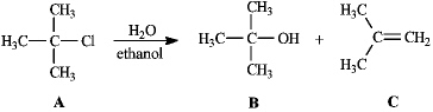 -Refer to instructions.Compound B is the:
 (Multiple Choice)
4.9/5  (86)
(86) 
Instructions: Circle the correct response in each set below.
Refer to instructions.The least reactive compound in an SN1 reaction.
(Essay)
5.0/5 (66)
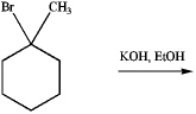
(66) Complete the following reaction sequence by drawing the structure of the products in the boxes provided.
(Essay)
5.0/5 (84)
(84) Instructions: Circle the correct response in each set below.
Refer to instructions.The least reactive compound in an SN2 reaction.Explain your choice.
(Essay)
4.8/5 (72)
(72) Instructions: Consider the pair of reactions below to answer the following question(s). 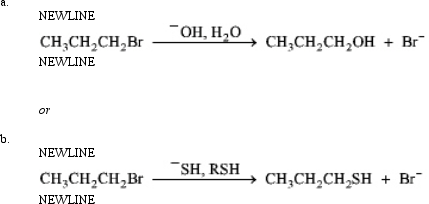 -Refer to instructions.Which of the following statements is false?
 (Multiple Choice)
4.9/5 (85)
(85) Instructions: Circle the correct response in each set below.
Refer to instructions.The best leaving group in an elimination reaction.
(Essay)
4.8/5 (82)
(82) Consider the following reaction: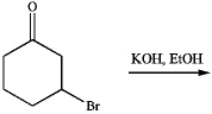 a)Draw the product of the reaction. How would you categorize this process mechanistically?
b)Which of the following spectral methods could be used to follow the progress of the reaction?
a. NMR spectroscopy
b. Mass spectrometry
c. Infrared spectroscopy
d. UV spectroscopy
e. all of these
f. a, b, and c only
a)Draw the product of the reaction. How would you categorize this process mechanistically?
b)Which of the following spectral methods could be used to follow the progress of the reaction?
a. NMR spectroscopy
b. Mass spectrometry
c. Infrared spectroscopy
d. UV spectroscopy
e. all of these
f. a, b, and c only
(Essay)
4.9/5 (75)
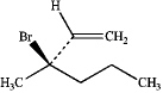
(75) 
Instructions: Consider the pair of reactions below to answer the following question(s). 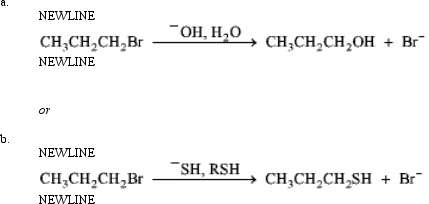 Refer to instructions.If the alkyl halide in each of these reactions was an alkyl chloride instead of the bromide,
 (Multiple Choice)
5.0/5 (71)
(71) Which of the following statements about an SN2 reaction is true?
(Multiple Choice)
4.9/5 (96)
(96) Which of the following would produce a mixture of products when treated under appropriate conditions with N-bromosuccinimide?
(Multiple Choice)
4.8/5 (71)
(71) Instructions: Consider the reaction below to answer the following question.  -Refer to instructions.The mechanism for this reaction is:
 (Multiple Choice)
4.9/5 (69)
(69) Instructions: Consider the pair of reactions below to answer the following question(s). 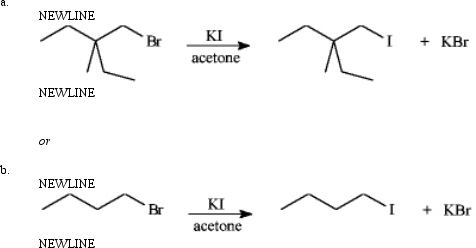 -Refer to instructions.The alkyl bromide starting materials in these reactions are classified as:
 (Multiple Choice)
4.9/5 (90)
(90) What is the preferred stereochemistry of the E2 elimination?
(Multiple Choice)
4.9/5 (74)
(74) Which of the following statements about an SN1 reaction is true?
(Multiple Choice)
4.7/5 (77)
(77) Upon treatment with base,the following isotopically labeled compound gives rise to a major and a minor elimination product.Draw their structures and label each as major or minor.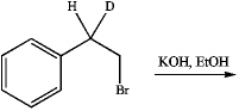
(Essay)
4.7/5 (66)
(66) 
Filters
- Essay(0)
- Multiple Choice(0)
- Short Answer(0)
- True False(0)
- Matching(0)