



 Chat with AI
Exam 19: Biomolecules: Amino Acids,peptides,and Proteins

Exam 1: Structure and Bonding30 Questions
Exam 2: Polar Covalent Bonds: Acids and Bases35 Questions
Exam 3: Organic Compounds: Alkanes and Their Stereochemistry32 Questions
Exam 4: Organic Compounds: Cycloalkanes and Their Stereochemistry18 Questions
Exam 5: Stereochemistry at Tetrahedral Centers33 Questions
Exam 6: An Overview of Organic Reactions32 Questions
Exam 7: Alkenes and Alkynes34 Questions
Exam 8: Reactions of Alkenes and Alkynes37 Questions
Exam 9: Aromatic Compounds36 Questions
Exam 10: Structure Determination: Mass Spectrometry,infrared Spectroscopy,and Ultraviolet Spectroscopy41 Questions
Exam 11: Structure Determination: Nuclear Magnetic Resonance Spectroscopy37 Questions
Exam 12: Organohalides: Nucleophilic Substitutions and Eliminations37 Questions
Exam 13: Alcohols,phenols,and Thiols: Ethers and Sulfides19 Questions
Exam 14: Aldehydes and Ketones: Nucleophilic Addition Reactions30 Questions
Exam 15: Carboxylic Acids and Nitriles23 Questions
Exam 16: Carboxylic Acid Derivatives: Nucleophilic Acyl Substitution Reactions42 Questions
Exam 17: Carbonyl Alpha-Substitution and Condensation Reactions84 Questions
Exam 18: Amines and Heterocycles28 Questions
Exam 19: Biomolecules: Amino Acids,peptides,and Proteins36 Questions
Exam 20: Amino Acid Metabolism34 Questions
Exam 21: Biomolecules: Carbohydrates42 Questions
Exam 22: Carbohydrate Metabolism41 Questions
Exam 23: Biomolecules: Lipids and Their Metabolism31 Questions
Exam 24: Biomolecules: Nucleic Acids and Their Metabolism23 Questions
Select questions type


Consider the following structure.Based on this structure answer the following question(s).
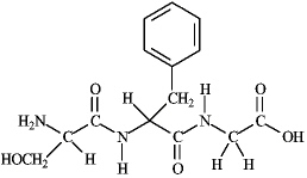 -Refer to instructions.Identify the C-terminal amino acid and the N-terminal amino acid.
 (Essay)
4.9/5  (84)
(84) Write the equation for the reaction,using methanol (CH3OH),that would render the carboxyl group of alanine unreactive.
(Essay)
4.9/5 (91)
(91) Which of the following amino acids has an aromatic side chain?
(Multiple Choice)
4.7/5 (70)
(70) Which of the following tripeptides is not hydrolysed by chymotrypsin?
(Multiple Choice)
4.9/5 (66)
(66) Which of the following reagents can be used to cleave a tert-butoxycarbonyl (Boc)protecting group from a peptide?
(Multiple Choice)
4.9/5 (84)
(84) Draw the structure of the product of the following reaction and describe the usefulness of this type of reaction.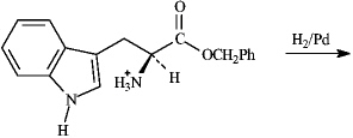
(Essay)
4.9/5 (83)
(83) To what structural feature does the term "secondary structure" refer?
(Multiple Choice)
4.9/5 (83)
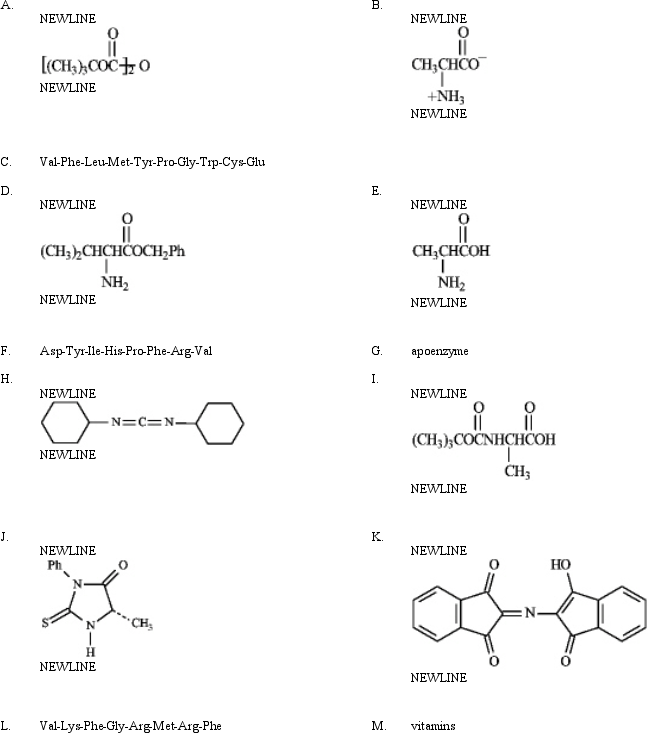
(83) Match a structure from the list below to each of the following terms.
-
(Essay)
4.9/5 (94)
(94) Refer to the data below to answer the following question.
 -Refer to instructions.At what pH would you carry out an electrophoresis experiment if you wanted to separate a mixture of lysine,aspartic acid and phenylalanine? Explain.
 (Essay)
4.9/5 (94)
(94) Which of the following tripeptides is not hydrolysed by trypsin?
(Multiple Choice)
4.8/5 (74)
(74) Refer to the data below to answer the following question(s).
Porcine dynorphin is a neuropeptide having 17 amino acid residues.Its structure is shown below.
Tyr-Gly-Gly-Phe-Leu-Arg-Arg-Ile-Arg-Pro-Lys-Leu-Lys-Trp-Asp-Asn-Gln
-Refer to instructions.Show the steps involved in a synthesis of F-G-I using the Merrifield procedure.
(Essay)
4.8/5 (86)
(86) To what structural feature does the term "primary structure" refer?
(Multiple Choice)
4.9/5 (81)
(81) Instructions: Match a term from the list below to each definition.
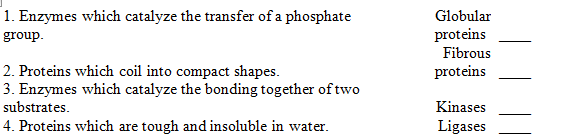
(Short Answer)
4.7/5 (82)
(82) How does phenyl isothiocyanate,Ph-N=C=S,react with a peptide in the Edman degradation?
(Multiple Choice)
4.7/5 (75)
(75) Which of the following amino acids migrates to the positive electrode on paper electrophoresis at a pH of 7.0?
(Multiple Choice)
4.8/5 (85)
(85) 
Filters
- Essay(0)
- Multiple Choice(0)
- Short Answer(0)
- True False(0)
- Matching(0)