



 Chat with AI
Exam 22: Carbohydrate Metabolism

Exam 1: Structure and Bonding30 Questions
Exam 2: Polar Covalent Bonds: Acids and Bases35 Questions
Exam 3: Organic Compounds: Alkanes and Their Stereochemistry32 Questions
Exam 4: Organic Compounds: Cycloalkanes and Their Stereochemistry18 Questions
Exam 5: Stereochemistry at Tetrahedral Centers33 Questions
Exam 6: An Overview of Organic Reactions32 Questions
Exam 7: Alkenes and Alkynes34 Questions
Exam 8: Reactions of Alkenes and Alkynes37 Questions
Exam 9: Aromatic Compounds36 Questions
Exam 10: Structure Determination: Mass Spectrometry,infrared Spectroscopy,and Ultraviolet Spectroscopy41 Questions
Exam 11: Structure Determination: Nuclear Magnetic Resonance Spectroscopy37 Questions
Exam 12: Organohalides: Nucleophilic Substitutions and Eliminations37 Questions
Exam 13: Alcohols,phenols,and Thiols: Ethers and Sulfides19 Questions
Exam 14: Aldehydes and Ketones: Nucleophilic Addition Reactions30 Questions
Exam 15: Carboxylic Acids and Nitriles23 Questions
Exam 16: Carboxylic Acid Derivatives: Nucleophilic Acyl Substitution Reactions42 Questions
Exam 17: Carbonyl Alpha-Substitution and Condensation Reactions84 Questions
Exam 18: Amines and Heterocycles28 Questions
Exam 19: Biomolecules: Amino Acids,peptides,and Proteins36 Questions
Exam 20: Amino Acid Metabolism34 Questions
Exam 21: Biomolecules: Carbohydrates42 Questions
Exam 22: Carbohydrate Metabolism41 Questions
Exam 23: Biomolecules: Lipids and Their Metabolism31 Questions
Exam 24: Biomolecules: Nucleic Acids and Their Metabolism23 Questions
Select questions type


Instructions: Consider the reaction below to answer the following question(s).
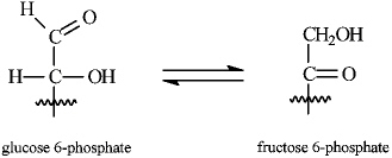 -Refer to instructions.This reaction proceeds through a common enol structure.Draw the structure of the glucose/fructose enol.
 (Essay)
4.9/5  (75)
(75) If gluconeogenesis were the exact reverse of glycolysis,which of the following would not be possible?
(Multiple Choice)
4.9/5 (74)
(74) Circle the carbon atoms in the molecule of glucose shown that enter the citric acid cycle as -CH3 groups.
(Essay)
4.9/5 (72)
(72) The first reaction of gluconeogenesis is  This reaction is classified as:
 (Multiple Choice)
4.7/5 (79)
(79) 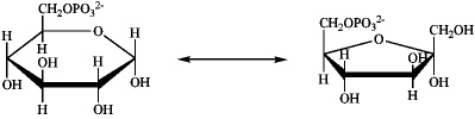
The following reactions all occur during oxidative decarboxylation of pyruvate,except:
(Multiple Choice)
4.8/5 (79)
(79) Which group of small molecules best fit the boxes associated with the reaction shown? 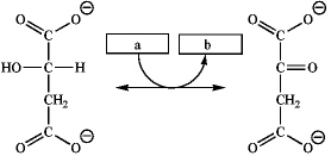 A b
A b (Multiple Choice)
4.8/5 (93)
(93) Which enzymes in the citric acid cycle catalyze oxidative decarboxylation reactions?
(Multiple Choice)
4.8/5 (77)
(77) The citric acid cycle is considered to be the central metabolic pathway for all the following reasons,except:
(Multiple Choice)
4.8/5 (81)
(81) Consider the structure of amylopectin below to answer the following questions.
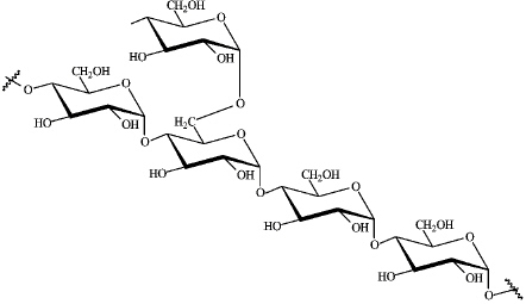 a) Circle the glycosidic links that are hydrolyzed in the small intestine.
b) What is the final product of complete hydrolysis of amylpectin?
a) Circle the glycosidic links that are hydrolyzed in the small intestine.
b) What is the final product of complete hydrolysis of amylpectin?
(Essay)
5.0/5 (85)
(85) The citric acid cycle is linked to the electron transport chain via:
(Multiple Choice)
4.9/5 (70)
(70) Which of the following types of reactions are involved in glycolysis? Select all that apply.
(Multiple Choice)
4.9/5 (74)
(74) During the complete catabolism of a molecule of glucose,the ultimate fate of the carbon atoms are
(Multiple Choice)
4.9/5 (82)
(82) Which group of small molecules best fit the boxes associated with the reaction shown? 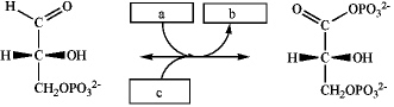 A b c
A b c (Multiple Choice)
4.8/5 (90)
(90) Which group of small molecules best fit the boxes associated with the reaction shown? 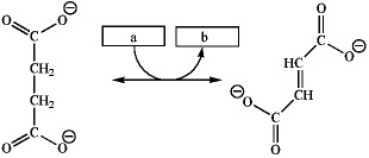 A b
A b (Multiple Choice)
4.9/5 (89)
(89) At the beginning of polysaccharide catabolism,a-amylase catalyzes:
(Multiple Choice)
4.9/5 (85)
(85) Biotin is important in gluconeogenesis for all of these reasons,except:
(Multiple Choice)
4.8/5 (99)
(99) In the reaction catalyzed by aldolase,the substrate is bound to the enzyme
(Multiple Choice)
4.8/5 (86)
(86) 
Filters
- Essay(0)
- Multiple Choice(0)
- Short Answer(0)
- True False(0)
- Matching(0)