



 Chat with AI
Exam 8: Reactions of Alkenes and Alkynes

Exam 1: Structure and Bonding30 Questions
Exam 2: Polar Covalent Bonds: Acids and Bases35 Questions
Exam 3: Organic Compounds: Alkanes and Their Stereochemistry32 Questions
Exam 4: Organic Compounds: Cycloalkanes and Their Stereochemistry18 Questions
Exam 5: Stereochemistry at Tetrahedral Centers33 Questions
Exam 6: An Overview of Organic Reactions32 Questions
Exam 7: Alkenes and Alkynes34 Questions
Exam 8: Reactions of Alkenes and Alkynes37 Questions
Exam 9: Aromatic Compounds36 Questions
Exam 10: Structure Determination: Mass Spectrometry,infrared Spectroscopy,and Ultraviolet Spectroscopy41 Questions
Exam 11: Structure Determination: Nuclear Magnetic Resonance Spectroscopy37 Questions
Exam 12: Organohalides: Nucleophilic Substitutions and Eliminations37 Questions
Exam 13: Alcohols,phenols,and Thiols: Ethers and Sulfides19 Questions
Exam 14: Aldehydes and Ketones: Nucleophilic Addition Reactions30 Questions
Exam 15: Carboxylic Acids and Nitriles23 Questions
Exam 16: Carboxylic Acid Derivatives: Nucleophilic Acyl Substitution Reactions42 Questions
Exam 17: Carbonyl Alpha-Substitution and Condensation Reactions84 Questions
Exam 18: Amines and Heterocycles28 Questions
Exam 19: Biomolecules: Amino Acids,peptides,and Proteins36 Questions
Exam 20: Amino Acid Metabolism34 Questions
Exam 21: Biomolecules: Carbohydrates42 Questions
Exam 22: Carbohydrate Metabolism41 Questions
Exam 23: Biomolecules: Lipids and Their Metabolism31 Questions
Exam 24: Biomolecules: Nucleic Acids and Their Metabolism23 Questions
Select questions type


Instructions: Consider the reaction sequence below to answer the following question.
 -Refer to instructions.Write the complete reaction mechanism for the first step of this reaction sequence.Show all electron flow with arrows and show all intermediate structures.
 (Essay)
4.8/5  (68)
(68) What type of reactive intermediate is formed in the reaction of an alkene with HBr to give a bromoalkane?
(Multiple Choice)
4.9/5 (81)
(81) Instructions: Consider the reaction below to answer the following question(s).
Alkenes may be hydrated by the hydroboration/oxidation procedure shown. 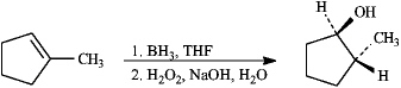 Refer to instructions.The regiochemistry of hydroboration/oxidation of alkenes is:
 (Multiple Choice)
4.8/5 (80)
(80) What type of reaction mechanism accounts for the reaction of an alkyne with HBr to give an alkyl bromide?
(Multiple Choice)
4.9/5 (86)
(86) What is the major organic product obtained from the following reaction?
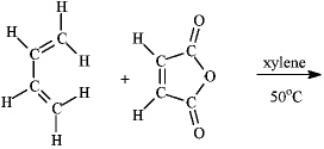
(Essay)
4.7/5 (86)
(86) Draw the structure of the polymer formed from the monomer given below,showing four repeating units.
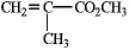
(Essay)
4.7/5 (82)
(82) Instructions: The reaction of 2-methylpropene with HBr in ether gives one of the two products below.Answer the following question(s)about this reaction.
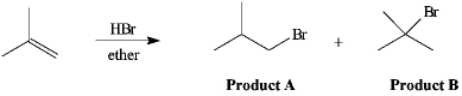 -Refer to instructions.Which product would have a lower energy transition state for the formation of the intermediate leading to it?
 (Essay)
4.8/5 (85)
(85) Instructions: Consider the reaction below to answer the following question(s).
Alkenes may be hydrated by the hydroboration/oxidation procedure shown. 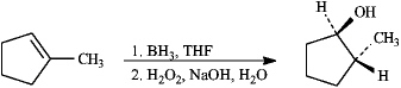 Refer to instructions.The intermediate formed in the first step of this reaction is:
 (Multiple Choice)
4.9/5 (86)
(86) What type of reactive intermediate is involved in both of the following general reaction types? 
(Multiple Choice)
4.9/5 (86)
(86) The product(s)of the reaction when carried out in an organic solvent 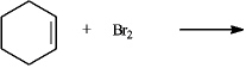 Would be:
 (Multiple Choice)
5.0/5 (69)
(69) Instructions: For each reaction below,suggest structures for alkenes that give the indicated reaction products.There may be more than one answer.
-Suggest structure(s):
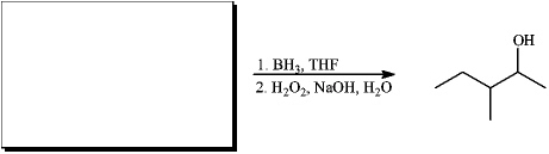
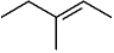
(Essay)
5.0/5 (85)
(85) What is the major organic product obtained from the following reaction?
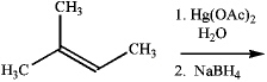
(Essay)
4.7/5 (78)
(78) Which set of reagents is used for the Markovnikov addition of water to an alkene without rearrangement?
(Multiple Choice)
5.0/5 (90)
(90) What type of reactive intermediate is formed in the reaction of an alkene with aqueous acid to give an alcohol?
(Multiple Choice)
4.9/5 (79)
(79) How many isomeric products would be formed when the following compound undergoes dehydration? 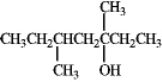
(Multiple Choice)
4.9/5 (80)
(80) Predict the product of the reaction below.Indicate regiochemistry and stereochemistry if relevant.(D2 = deuterium)

(Essay)
4.9/5 (80)
(80) Instructions: To answer the question(s)below,consider the following reaction:
When cyclohexene reacts with chlorine in tetrachloromethane,the trans-dihalide is formed.
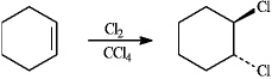 -Refer to instructions.Write the complete,stepwise mechanism for this reaction.Show all intermediate structures and all electron flow using arrows.
 (Essay)
4.9/5 (64)
(64) 
Filters
- Essay(0)
- Multiple Choice(0)
- Short Answer(0)
- True False(0)
- Matching(0)