



 Chat with AI
Exam 25: Related Party Disclosures

Exam 1: An Overview of the Australian External Reporting Environment70 Questions
Exam 2: The Conceptual Framework of Accounting and Its Relevance to Financial Reporting72 Questions
Exam 3: Theories of Accounting76 Questions
Exam 4: An Overview of Accounting for Assets77 Questions
Exam 5: Depreciation of Property, plant and Equipment77 Questions
Exam 6: Revaluations and Impairment Testing of Non-Current Assets76 Questions
Exam 7: Inventory75 Questions
Exam 8: Accounting for Intangibles77 Questions
Exam 9: Accounting for Heritage Assets and Biological Assets76 Questions
Exam 10: An Overview of Accounting for Liabilities78 Questions
Exam 11: Accounting for Leases81 Questions
Exam 12: Accounting for Employee Benefits84 Questions
Exam 13: Share Capital and Reserves85 Questions
Exam 14: Accounting for Financial Instruments90 Questions
Exam 15: Revenue Recognition Issues79 Questions
Exam 16: The Statement of Comprehensive Income and Statement of Changes in Equity77 Questions
Exam 17: Accounting for Share-Based Payments77 Questions
Exam 18: Accounting for Income Taxes80 Questions
Exam 19: The Statement of Cash Flows77 Questions
Exam 20: Accounting for the Extractive Industries75 Questions
Exam 21: Accounting for General Insurance Contracts73 Questions
Exam 22: Accounting for Superannuation Plans77 Questions
Exam 23: Events Occurring After the End of the Reporting Period77 Questions
Exam 24: Segment Reporting77 Questions
Exam 25: Related Party Disclosures77 Questions
Exam 26: Earnings Per Share76 Questions
Exam 27: Accounting for Group Structures87 Questions
Exam 28: Further Consolidation Issues I: Accounting for Intragroup Transactions60 Questions
Exam 29: Further Consolidation Issues II: Accounting for Non-Controlling Interests44 Questions
Exam 30: Further Consolidation Issues IV: Accounting for Changes in the Degree of Ownership of a Subsidiary49 Questions
Exam 31: Accounting for Equity Investments,including Investments in Associates and Joint Arrangements70 Questions
Exam 32: Accounting for Foreign Currency Transactions78 Questions
Exam 33: Translating the Financial Statements of Foreign Operations52 Questions
Exam 34: Accounting for Corporate Social Responsibility73 Questions
Select questions type


The following diagram shows three companies and their associated equity ownership percentages.Which of the companies shown would most likely be considered related entities?
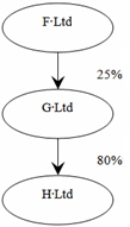
(Multiple Choice)
4.9/5  (82)
(82) Tests to indicate whether significant influence exits include:
(Multiple Choice)
4.8/5 (70)
(70) Discuss the performance conditions utilised in the compensation plans for key management personnel.
(Essay)
4.7/5 (94)
(94) Transactions between the reporting entity and its directors are considered:
(Multiple Choice)
4.8/5 (87)
(87) Other related entities for disclosure purposes in AASB 124 include:
(Multiple Choice)
4.9/5 (83)
(83) Which of the following parties is/are covered by the definition of a related party in AASB 124?
(Multiple Choice)
4.7/5 (93)
(93) AASB 124 reflects the view that transactions carried out by related parties cannot be presumed to be at arm's length.
(True/False)
4.8/5 (80)
(80) A related party relationship can affect the profit and loss of an entity.
(True/False)
4.8/5 (84)
(84) The definition of related parties relies on three key terms.These are:
(Multiple Choice)
4.7/5 (86)
(86) A frequently applied practice in relation to the disclosure of related-party transactions of directors is to:
(Multiple Choice)
4.9/5 (77)
(77) In order for two parties to be related they must be under the common control or influence of a third party.
(True/False)
4.9/5 (85)
(85) Reasons for the requirement to disclose related-party transactions include:
(Multiple Choice)
4.9/5 (89)
(89) Entities being under common control as defined by AASB 124 include:
(Multiple Choice)
5.0/5 (96)
(96) Disclosing entities are within the scope of AASB 124 Related Party Disclosures.
(True/False)
4.8/5 (83)
(83) 
Filters
- Essay(0)
- Multiple Choice(0)
- Short Answer(0)
- True False(0)
- Matching(0)