



 Chat with AI
Exam 7: Thermochemistry

Exam 1: Matter: Its Properties and Measurement136 Questions
Exam 2: Atoms and the Atomic Theory119 Questions
Exam 3: Chemical Compounds152 Questions
Exam 4: Chemical Reactions170 Questions
Exam 5: Introduction to Reactions in Aqueous Solutions124 Questions
Exam 6: Gases113 Questions
Exam 7: Thermochemistry125 Questions
Exam 8: Electrons in Atoms123 Questions
Exam 9: The Periodic Table and Some Atomic Properties93 Questions
Exam 10: Chemical Bonding I: Basic Concepts107 Questions
Exam 11: Chemical Bonding Ii: Valence Bond and Molecular Orbital Theories104 Questions
Exam 12: Intermolecular Forces: Liquids and Solids121 Questions
Exam 13: Spontaneous Change: Entropy and Gibbs Energy123 Questions
Exam 14: Solutions and Their Physical Properties132 Questions
Exam 15: Principles of Chemical Equilibrium118 Questions
Exam 16: Acids and Bases137 Questions
Exam 17: Additional Aspects of Acidbase Equilibria130 Questions
Exam 18: Solubility and Complex-Ion Equilibria104 Questions
Exam 19: Electrochemistry127 Questions
Exam 20: Chemical Kinetics124 Questions
Exam 21: Chemistry of the Main-Group Elements I: Groups 1,2,13,and 14116 Questions
Exam 22: Chemistry of the Main-Group Elements Ii: Groups 18,17,16,15,and Hydrogen100 Questions
Exam 23: The Transition Elements108 Questions
Exam 24: Complex Ions and Coordination Compounds104 Questions
Exam 25: Nuclear Chemistry116 Questions
Exam 26: Structures of Organic Compounds99 Questions
Exam 27: Reactions of Organic Compounds94 Questions
Exam 28: Chemistry of the Living State104 Questions
Select questions type


Hydrogen peroxide decomposes to water and oxygen at constant pressure by the following reaction:

 (l)→
 O(l)+
 (g)
 H = -196 kJ
Calculate the value of q (kJ)in this exothermic reaction when 4.00 g of hydrogen peroxide decomposes at constant pressure?
(l)→ O(l)+ (g)
H = -196 kJ
Calculate the value of q (kJ)in this exothermic reaction when 4.00 g of hydrogen peroxide decomposes at constant pressure? (Multiple Choice)
4.8/5  (65)
(65) The enthalpy of a system is the internal energy minus the pressure-volume product.
(True/False)
4.9/5 (67)
(67) H2S(g)+ 3/2 O2(g)→ H2O (l)+ SO2(g)ΔrH° = -562.3 kJ/mol
1/8 S8(s)+ O2(g)→ SO2(g)ΔrH° = -297.0 kJ/mol
H2(g)+ 1/2O2 → H2O (l)ΔrH° = -266.9 kJ/mol
Compute ΔrH° for H2(g)+ 1/8 S8 (s)→ H2S(g)in kJ/mol.
(Multiple Choice)
4.9/5 (73)
(73) The heat of combustion of several fuels are listed in the table below.On a per gram basis,which fuel releases the most energy?
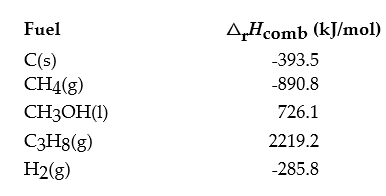
(Multiple Choice)
4.9/5 (90)
(90) What is the enthalpy of reaction for the neutralization reaction occurring between dilute Ba(OH)2(aq)and dilute HNO3(aq)? Values of ΔfH° from data tables are given below.
Hint: Balance the equation so the coefficients are the lowest possible set of whole numbers.
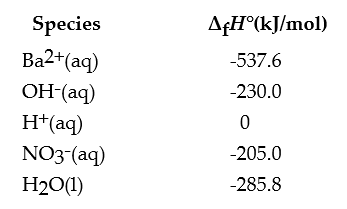
(Multiple Choice)
4.8/5 (64)
(64) The heat of combustion,ΔrHcomb,of 1-butene(l),C4H8(l),is -2696.9 kJ/mol.From the following values of ΔfH° CO2(g)= -393.5 kJ/mol and ΔfH° H2O(l)= -285.8 kJ/mol,calculate the standard enthalpy of formation of butene(l).
(Multiple Choice)
4.8/5 (81)
(81) 14.0 g of metal at 24.0 °C has 250 joules of heat added to it.The metal's specific heat is 0.105 J/g °C.What is its final temperature?
(Multiple Choice)
4.8/5 (86)
(86) Calculate the kinetic energy of a 150 g baseball moving at a speed of 39.m  (87 mph).
 (Multiple Choice)
4.9/5 (84)
(84) A sample gives off 2505 cal when burned in a bomb calorimeter.The temperature of the calorimeter assembly increases by 2.24 °C.What is the heat capacity of the calorimeter?
(Multiple Choice)
4.7/5 (85)
(85) When 50.0 mL of 0.400 mol L-1 Ca(NO3)2 is added to 50.0 mL of 0.800 mol L-1 NaF,CaF2 precipitates,as shown in the net ionic equation below.The initial temperature of both solutions is 23.0 °C.Assuming that the reaction goes to completion,and that the resulting solution has a mass of 100.00 g and a specific heat of 4.18 J g-1°C-1 ,calculate the final temperature of the solution.
Ca2+(aq)+ 2 F-(aq)→ CaF2(s)
 H = -11.5 kJ
 (Multiple Choice)
4.8/5 (82)
(82) How much heat is required to raise the temperature of 175 g of aluminum from 21.0 °C to 145 °C? The specific heat of aluminum is 0.903 J g-1 °C-1.
(Multiple Choice)
4.9/5 (86)
(86) Calculate the work needed to make room for products in the combustion of sulfur,S8(s),to SO2(g)at STP.
(Multiple Choice)
4.9/5 (71)
(71) The specific heat of copper is 0.385 J g-1k-1.If 34.2 g of copper,initially at 21.0 °C,absorbs 4.689 kJ,what will be the final temperature of the copper?
(Multiple Choice)
4.7/5 (66)
(66) The standard enthalpy of formation for CuSO4 ∙ 5 H2O(s)is -2278.0 kJ/mol at 25 °C.The chemical equation to which this value applies is:
(Multiple Choice)
4.8/5 (77)
(77) A mixture of 125 g of iron and 250 g of water is heated from 25.0 °C to 70.0 °C.How much heat is absorbed by the mixture? (Specific heat of water = 4.18 J/g °C;iron = 0.473 J/g °C)
(Multiple Choice)
4.9/5 (88)
(88) Using the heat of combustion of methanol as -726.6 kJ/mol and the following data:
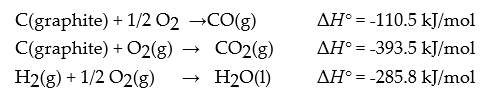 Determine ΔrH° for the following reaction:
CO(g)+ 2 H2(g)→ CH3OH(l)
Determine ΔrH° for the following reaction:
CO(g)+ 2 H2(g)→ CH3OH(l) (Multiple Choice)
4.9/5 (88)
(88) 250.0 g of hot coffee at 95.0 °C are placed in a 0.2000 kg mug at 20.0 °C.The specific heat of the coffee is 4.00 J/g °C,while that of the mug is 0.80 J/g °C.Assuming no heat is lost to the surroundings,what is the final temperature of the system: mug + coffee?
(Multiple Choice)
4.8/5 (86)
(86)  Compute ΔrH° for this reaction.

Filters
- Essay(0)
- Multiple Choice(0)
- Short Answer(0)
- True False(0)
- Matching(0)