



 Chat with AI
Exam 7: Thermochemistry

Exam 1: Matter: Its Properties and Measurement136 Questions
Exam 2: Atoms and the Atomic Theory119 Questions
Exam 3: Chemical Compounds152 Questions
Exam 4: Chemical Reactions170 Questions
Exam 5: Introduction to Reactions in Aqueous Solutions124 Questions
Exam 6: Gases113 Questions
Exam 7: Thermochemistry125 Questions
Exam 8: Electrons in Atoms123 Questions
Exam 9: The Periodic Table and Some Atomic Properties93 Questions
Exam 10: Chemical Bonding I: Basic Concepts107 Questions
Exam 11: Chemical Bonding Ii: Valence Bond and Molecular Orbital Theories104 Questions
Exam 12: Intermolecular Forces: Liquids and Solids121 Questions
Exam 13: Spontaneous Change: Entropy and Gibbs Energy123 Questions
Exam 14: Solutions and Their Physical Properties132 Questions
Exam 15: Principles of Chemical Equilibrium118 Questions
Exam 16: Acids and Bases137 Questions
Exam 17: Additional Aspects of Acidbase Equilibria130 Questions
Exam 18: Solubility and Complex-Ion Equilibria104 Questions
Exam 19: Electrochemistry127 Questions
Exam 20: Chemical Kinetics124 Questions
Exam 21: Chemistry of the Main-Group Elements I: Groups 1,2,13,and 14116 Questions
Exam 22: Chemistry of the Main-Group Elements Ii: Groups 18,17,16,15,and Hydrogen100 Questions
Exam 23: The Transition Elements108 Questions
Exam 24: Complex Ions and Coordination Compounds104 Questions
Exam 25: Nuclear Chemistry116 Questions
Exam 26: Structures of Organic Compounds99 Questions
Exam 27: Reactions of Organic Compounds94 Questions
Exam 28: Chemistry of the Living State104 Questions
Select questions type


Calculate the work,w,gained or lost by the system when a gas expands from 15 L to 40 L against a constant external pressure of 1.5199 bar.
(Multiple Choice)
4.7/5  (78)
(78) Oxygen gas at 34.5 °C expands from 34.5 L to 45.7 L against a constant pressure of 750 mmHg.What is the work done in joules by the system?
(Multiple Choice)
4.8/5 (85)
(85) Coal contains an impurity that reacts with oxygen during the combustion process,producing oxides that are major environmental pollutants.This impurity is:
(Multiple Choice)
4.9/5 (67)
(67) Compute ΔrH° for the following reaction.The value of ΔfH° in kJ/mol is given below each species:
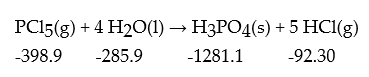
(Multiple Choice)
4.9/5 (89)
(89) For the reaction H2(g)+ 1/2 O2(g)→ H2O(g)ΔrH° = -241.8 kJ/mol,
What mass of H2(g)is required to liberate 1.00 × 10³ kJ of heat?
(Multiple Choice)
5.0/5 (68)
(68) The specific heat capacity of liquid mercury is 0.14 J g-1k-1.How many joules of heat are needed to raise the temperature of 5.00 g of mercury from 15.0 °C to 36.5 °C?
(Multiple Choice)
4.7/5 (69)
(69) The complete combustion of propane,C3H8(g),is represented by the equation:
C3H8(g)+ 5 O2(g)→ 3 CO2(g)+ 4 H2O(l)ΔrH° = -2220 kJ /mol
How much heat is evolved in the complete combustion of 12.5 L C3H8(g)at 25 °C and 790 mmHg?
(Multiple Choice)
4.8/5 (90)
(90) The standard enthalpy of formation of NH4Cl(s)is -315.4 kJ/mol.The equation that describes this △fH° is:
(Multiple Choice)
4.7/5 (72)
(72) Given the heat of formation of the following compounds:
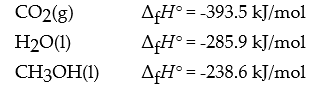 What is the value of ΔrH° for the reaction:
CH3OH(l)+ 3/2 O2(g)→ CO2(g)+ 2 H2O(l)
What is the value of ΔrH° for the reaction:
CH3OH(l)+ 3/2 O2(g)→ CO2(g)+ 2 H2O(l) (Multiple Choice)
4.7/5 (87)
(87) To have a standard enthalpy of formation referenced to 0 J/mol,the substance must:
I.be a simple substance (chemical element)
II.be in its most stable form
III.be under 1 bar of pressure
IV.have a concentration of 1.0000 M
(Multiple Choice)
4.9/5 (78)
(78) Calculate ΔU for a system that loses 475 kJ of heat and does 155 kJ of expansion work on the surroundings.
(Multiple Choice)
4.9/5 (87)
(87) Determine the enthalpy change in the following equation:
Cl2(g)+ H2O(l)→ 2 HCl(g)+ 1/2 O2(g)
ΔfH° H2O(l)= -285.8 kJ/mol
ΔfH° HCl(g)= -92.31 kJ/mol
(Multiple Choice)
4.8/5 (77)
(77)  Compute ΔrH° for this reaction.
Calculate ΔfH° of octane,C8H18(l),given the enthalpy of combustion of octane to CO2(g)and H2O(l),-5471 kJ/mol,and the standard enthalpies of formation of CO2(g)and H2O(l),-393.5 kJ/mol and -285.8 kJ/mol,respectively.
(Multiple Choice)
4.8/5 (82)
(82) From the following thermochemical equations,calculate ΔrH° for the reaction:
SO2(g)+ NO2(g)→ SO3(g)+ NO(g)
2 SO2(g)+ O2(g)→ 2 SO3(g)ΔrH° = -197.8 kJ/mol
2 NO(g)+ O2(g)→ 2 NO2(g)ΔrH° = -114.14 kJ/mol
(Multiple Choice)
4.8/5 (78)
(78) The standard enthalpy for diamond and graphite are the same value.
(True/False)
4.8/5 (83)
(83) A 5.00 g sample of copper metal at 25.0 °C is heated by the addition of 96.0 J of energy.The final temperature of the copper is ________ °C.The specific heat capacity of copper is 
(Multiple Choice)
4.9/5 (86)
(86) A closed system can exchange matter but not energy with the surroundings.
(True/False)
4.9/5 (70)
(70) 
Filters
- Essay(0)
- Multiple Choice(0)
- Short Answer(0)
- True False(0)
- Matching(0)