



 Chat with AI
Exam 20: Chemical Kinetics

Exam 1: Matter: Its Properties and Measurement136 Questions
Exam 2: Atoms and the Atomic Theory119 Questions
Exam 3: Chemical Compounds152 Questions
Exam 4: Chemical Reactions170 Questions
Exam 5: Introduction to Reactions in Aqueous Solutions124 Questions
Exam 6: Gases113 Questions
Exam 7: Thermochemistry125 Questions
Exam 8: Electrons in Atoms123 Questions
Exam 9: The Periodic Table and Some Atomic Properties93 Questions
Exam 10: Chemical Bonding I: Basic Concepts107 Questions
Exam 11: Chemical Bonding Ii: Valence Bond and Molecular Orbital Theories104 Questions
Exam 12: Intermolecular Forces: Liquids and Solids121 Questions
Exam 13: Spontaneous Change: Entropy and Gibbs Energy123 Questions
Exam 14: Solutions and Their Physical Properties132 Questions
Exam 15: Principles of Chemical Equilibrium118 Questions
Exam 16: Acids and Bases137 Questions
Exam 17: Additional Aspects of Acidbase Equilibria130 Questions
Exam 18: Solubility and Complex-Ion Equilibria104 Questions
Exam 19: Electrochemistry127 Questions
Exam 20: Chemical Kinetics124 Questions
Exam 21: Chemistry of the Main-Group Elements I: Groups 1,2,13,and 14116 Questions
Exam 22: Chemistry of the Main-Group Elements Ii: Groups 18,17,16,15,and Hydrogen100 Questions
Exam 23: The Transition Elements108 Questions
Exam 24: Complex Ions and Coordination Compounds104 Questions
Exam 25: Nuclear Chemistry116 Questions
Exam 26: Structures of Organic Compounds99 Questions
Exam 27: Reactions of Organic Compounds94 Questions
Exam 28: Chemistry of the Living State104 Questions
Select questions type


What is the order of reaction for the following reaction: Rate = k[A]-1/2 [B]1/2?

Free
(Multiple Choice)
4.9/5  (92)
(92) Correct Answer: Verified
B
Energy of activation has no effect on reaction rate.
Free
(True/False)
4.8/5 (88)
(88) Correct Answer:Verified
VerifiedFalse
The decomposition of dinitrogen pentoxide is described by the chemical equation
2 N2O5(g)→ 4 NO2(g)+ O2(g).
If the rate of disappearance of N2O5 is equal to 1.60 mol min-1 at a particular moment,what is the rate of appearance of NO2 at that moment?
Free
(Multiple Choice)
4.9/5 (77)
(77) Correct Answer:Verified
VerifiedC
Data for the reaction A + B → C are given below.Find the rate constant for this system. 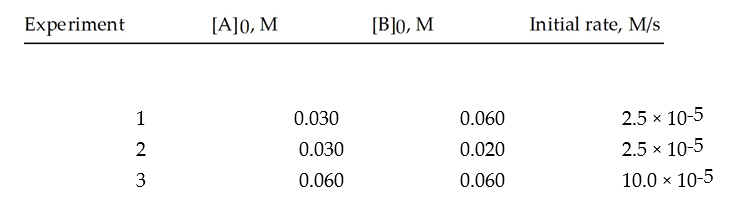
(Multiple Choice)
4.8/5 (77)
(77) A reaction is first order.If its initial rate is 0.0200 M/s and 25.0 days later its rate is 6.25 × 10⁻⁴ M/s,then its half-life is ________.
(Multiple Choice)
4.9/5 (91)
(91) Activation energy is:
I.the minimum kinetic energy required for each molecule in a collision to produce a reaction.
II.the minimum total kinetic energy required for the molecules in a collision to produce a reaction.
III.a factor in determining the rate of a reaction.
IV.high for fast reactions.
(Multiple Choice)
4.9/5 (67)
(67) According to the collision theory in gaseous molecules,collision frequency is ________ and the rate of reaction is ________ because ________.
(Multiple Choice)
4.8/5 (83)
(83) The rate of disappearance of HBr in the gas phase reaction
2 HBr(g)→  (g)+
 (g) Is 0.130 mol L-1
 At 150 °C.The rate of reaction is ________ mol L-1
 .
(g)+ (g) Is 0.130 mol L-1
At 150 °C.The rate of reaction is ________ mol L-1
. (Multiple Choice)
4.9/5 (73)
(73) What is the overall reaction order for the reaction that has the rate law Rate = k[Cl ][N]2?
(Multiple Choice)
4.8/5 (70)
(70) For a reaction Rate = k[A][B]2,what factor will keep k unchanged?
(Multiple Choice)
4.8/5 (74)
(74) For the second order reaction A → products,the following data are obtained:
[A] = 3.024 M,t = 0 min
[A] = 2.935 M,t = 1.0 min
[A] = 2.852 M,t = 2.0 min
What is the rate constant,k?
(Multiple Choice)
4.7/5 (73)
(73) In a second order reaction:
I.the sum of the exponents in the rate law is equal to two.
II.at least one of the exponents in the rate law is a two.
III.the half-life is dependent on the initial concentration of the reactant species.
IV.the half-life is independent of the initial concentration of the reactant species.
V.k can be expressed as M-2s-1 or M-2min-1.
(Multiple Choice)
4.8/5 (82)
(82) For the second order reaction A → products,the following data are obtained:
[A] = 1.512 M,t = 0 min
[A] = 1.490 M,t = 1.0 min
[A] = 1.469 M,t = 2.0 min
What is the rate constant,k,for the reaction?
(Multiple Choice)
4.8/5 (91)
(91) What is the rate law for the following reaction and its mechanism?
2 O3 → 3 O2 (overall reaction)
O3 → O2 + O∙ (slow)
O∙ + O3 → 2 O2 (fast)
(Multiple Choice)
4.8/5 (64)
(64) In the Arrhenius equation,ln k = -Ea/RT + ln A,the symbol A denotes:
(Multiple Choice)
4.8/5 (78)
(78) The isomerization of methylisonitrile to acetonitrile
 NC(g)→
 CN(g)
Is first order in
 NC.The half-life of the reaction is 5.20 × 101 s at 545 K.The rate constant when the initial [
 NC] is 0.030 mol L-1 is ________
 .
NC(g)→ CN(g)
Is first order in NC.The half-life of the reaction is 5.20 × 101 s at 545 K.The rate constant when the initial [ NC] is 0.030 mol L-1 is ________
. (Multiple Choice)
4.7/5 (87)
(87) The rate constant at 160 °C for the first order decomposition of ore is 0.032/min.The half-life of the reaction is ________.
(Multiple Choice)
4.7/5 (83)
(83) For the second-order reaction A → products,the following data are obtained:
[A] = 3.024 M,t = 0 min
[A] = 2.935 M,t = 1.0 min
[A] = 2.852 M,t = 2.0 min
What is the concentration of [A] after 4 min?
(Multiple Choice)
4.9/5 (83)
(83) Given the following initial rate data,write the rate law expression. 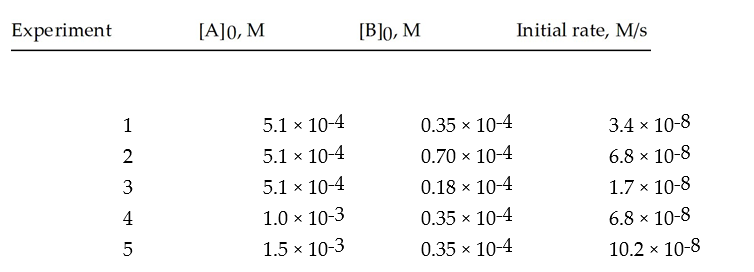
(Multiple Choice)
4.8/5 (93)
(93) 
Filters
- Essay(0)
- Multiple Choice(0)
- Short Answer(0)
- True False(0)
- Matching(0)