



 Chat with AI
Exam 7: Thermochemistry

Exam 1: Matter: Its Properties and Measurement136 Questions
Exam 2: Atoms and the Atomic Theory119 Questions
Exam 3: Chemical Compounds152 Questions
Exam 4: Chemical Reactions170 Questions
Exam 5: Introduction to Reactions in Aqueous Solutions124 Questions
Exam 6: Gases113 Questions
Exam 7: Thermochemistry125 Questions
Exam 8: Electrons in Atoms123 Questions
Exam 9: The Periodic Table and Some Atomic Properties93 Questions
Exam 10: Chemical Bonding I: Basic Concepts107 Questions
Exam 11: Chemical Bonding Ii: Valence Bond and Molecular Orbital Theories104 Questions
Exam 12: Intermolecular Forces: Liquids and Solids121 Questions
Exam 13: Spontaneous Change: Entropy and Gibbs Energy123 Questions
Exam 14: Solutions and Their Physical Properties132 Questions
Exam 15: Principles of Chemical Equilibrium118 Questions
Exam 16: Acids and Bases137 Questions
Exam 17: Additional Aspects of Acidbase Equilibria130 Questions
Exam 18: Solubility and Complex-Ion Equilibria104 Questions
Exam 19: Electrochemistry127 Questions
Exam 20: Chemical Kinetics124 Questions
Exam 21: Chemistry of the Main-Group Elements I: Groups 1,2,13,and 14116 Questions
Exam 22: Chemistry of the Main-Group Elements Ii: Groups 18,17,16,15,and Hydrogen100 Questions
Exam 23: The Transition Elements108 Questions
Exam 24: Complex Ions and Coordination Compounds104 Questions
Exam 25: Nuclear Chemistry116 Questions
Exam 26: Structures of Organic Compounds99 Questions
Exam 27: Reactions of Organic Compounds94 Questions
Exam 28: Chemistry of the Living State104 Questions
Select questions type


Which of the following are thermodynamic state functions?
I.heat
II.volume
III.temperature
IV.enthalpy
V.density
(Multiple Choice)
4.9/5  (87)
(87) Calculate the quantity of heat,in kJ,required to raise the temperature of a 2.15 kg iron bar 24.0 °C (specific heat of iron = 0.473 J/g °C).
(Multiple Choice)
4.7/5 (74)
(74) A system absorbs 623 J of heat while doing 457 J of work.What is the value of ΔU?
(Multiple Choice)
4.9/5 (74)
(74) At 1.0133 bar,the heat of sublimation of gallium is 277 kJ mol-1 And the heat of vaporization is 271 kJ mol-1 .To the correct number of significant figures,how much heat is required to melt 5.50 mol of gallium at 1.0133 bar?
(Multiple Choice)
4.7/5 (74)
(74) The complete combustion of propane,C3H8(g),is represented by the equation:
C3H8(g)+ 5 O2(g)→ 3 CO2(g)+ 4 H2O(l)ΔrH° = -2220 kJ /mol
How much heat is evolved in the complete combustion of 20.0 L C3H8(g)at STP?
(Multiple Choice)
4.8/5 (83)
(83) Many people believe that coffee  May be cooled by placing a silver spoon
 In the coffee.If 250 ml
 Of coffee at 200 °F had a spoon at 70 °F placed in it,what would be the final Celsius temperature of the spoon and coffee,assuming that no heat is lost to the surroundings? The mass of the spoon is 35 g.
May be cooled by placing a silver spoon
In the coffee.If 250 ml
Of coffee at 200 °F had a spoon at 70 °F placed in it,what would be the final Celsius temperature of the spoon and coffee,assuming that no heat is lost to the surroundings? The mass of the spoon is 35 g. (Multiple Choice)
4.8/5 (83)
(83) Given the following reactions:
2 NOCl(g)→ 2 NO(g)+ Cl2(g)ΔrH° = +75.56 kJ/mol
2 NO(g)+ O2(g)→ 2 NO2(g)ΔrH° = -113.05 kJ/mol
2 NO2(g)→ N2O4(g)ΔrH° = -58.03 kJ/mol
Compute ΔrH° of N2O4(g)+ Cl2(g)→ 2 NOCl(g)+ O2(g)in kJ/mol.
(Multiple Choice)
4.8/5 (70)
(70) 100.0 g of nickel at 150 °C was placed in 1.00 L of water at 25.0 °C.The final temperature of the nickel-water mixture was 26.3 °C.What is the specific heat of the nickel?
(Multiple Choice)
4.8/5 (66)
(66) 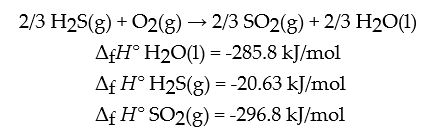
For the reaction H2(g)+ 1/2 O2(g)→ H2O(g)ΔrH° = -241.8 kJ/mol,
What quantity of heat,in kJ,evolved when a 72.0 g mixture containing equal parts of H2 and O2,by mass,is burned?
(Multiple Choice)
4.9/5 (73)
(73) 500 g of Al is heated to 100.0 °C and dropped into a l00.0 g glass beaker that contains 200.0 g of H2O.The temperature of the glass and water is 20.0 °C.What is the final temperature? (Specific heat of Al = 0.29 J/g °C,specific heat of glass = 0.84 J/g °C)
(Multiple Choice)
4.9/5 (64)
(64) 1674 J of heat are absorbed by 25.0 mL of NaOH (d = 1.10 g/mL,specific heat = 4.10 J/g °C).The temperature of the NaOH goes up by how many degrees?
(Multiple Choice)
4.7/5 (95)
(95) What is the reaction for the standard enthalpy of formation for Mn2O3(s)?
(Mn(s)is the stable form of manganese. )
(Multiple Choice)
4.8/5 (83)
(83) 1219 joules of heat raise the temperature of 250 g of metal by 64 °C.What is the specific heat of the metal in J/(g °C?)
(Multiple Choice)
4.8/5 (73)
(73) Complete combustion of 75.0 g acetylene,C2H2,liberated 3750 kJ of heat.What is the heat of combustion,ΔrHcomb,of acetylene?
(Multiple Choice)
4.8/5 (82)
(82) 2 LiOH(s)→ Li2O(s)+ H2O(l)ΔrH° = 379.1 kJ/mol
LiH(s)+ H2O(l)→ LiOH(s)+ H2(g)ΔrH° = -111.0 kJ/mol
2 H2(g)+ O2(g)→ 2 H2O(l)ΔrH° = -285.9 kJmol
Compute ΔrH° in kJ/mol for 2 LiH(s)+ O2(g)→ Li2O(s)+ H2O(l)
(Multiple Choice)
5.0/5 (81)
(81) Determine the enthalpy change in the following equation:
2 NH3(g)→ N2(g)+ 3 H2(g)
ΔfH° NH3(g)= -46.11 kJ/mol
(Multiple Choice)
4.8/5 (69)
(69) Which of the following has a standard enthalpy of formation of zero?
(Multiple Choice)
4.8/5 (86)
(86) Given the following thermochemical equations:
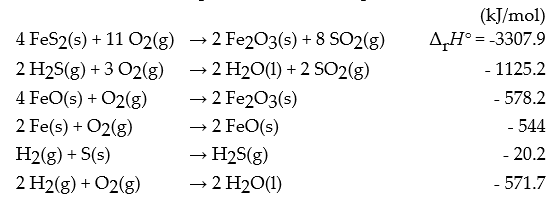 Compute the ΔfH° for FeS2(s)in kJ/mol.
 (Multiple Choice)
4.9/5 (76)
(76) The heat of combustion of methane is -50.38 kJ/mol.How many moles of methane must be burned to produce 137 kJ of heat?
(Multiple Choice)
4.9/5 (74)
(74) 
Filters
- Essay(0)
- Multiple Choice(0)
- Short Answer(0)
- True False(0)
- Matching(0)