



 Chat with AI
Exam 14: Imperfectly Competitive Markets for Factors of Production

Exam 1: Economics: The Study of Choice145 Questions
Exam 2: Confronting Scarcity: Choices in Production198 Questions
Exam 3: Demand and Supply251 Questions
Exam 4: Applications of Supply and Demand113 Questions
Exam 5: Elasticity: a Measure of Response255 Questions
Exam 6: Markets, Maximizers, and Efficiency239 Questions
Exam 7: The Analysis of Consumer Choice244 Questions
Exam 8: Production and Cost227 Questions
Exam 9: Competitive Markets for Goods and Services265 Questions
Exam 10: Monopoly234 Questions
Exam 11: The World of Imperfect Competition237 Questions
Exam 12: Wages and Employment in Perfect Competition189 Questions
Exam 13: Interest Rates and the Markets for Capital and Natural Resources170 Questions
Exam 14: Imperfectly Competitive Markets for Factors of Production183 Questions
Exam 15: Public Finance and Public Choice188 Questions
Exam 16: Antitrust Policy and Business Regulation137 Questions
Exam 17: International Trade186 Questions
Exam 18: The Economics of the Environment148 Questions
Exam 19: Inequality, Poverty, and Discrimination140 Questions
Select questions type


Use the following to answer question(s): Wage-Employment Model in Perfectly Competitive and Monopsony Factor Markets
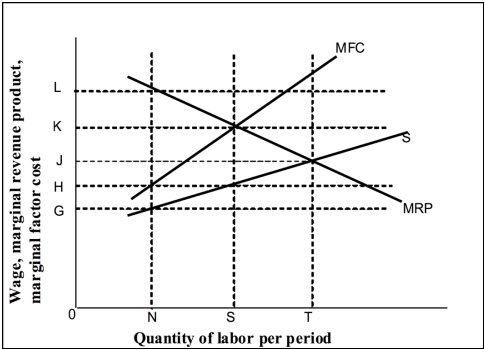 -(Exhibit: Wage-Employment Model in Perfectly Competitive and Monopsony Factor Markets) If this diagram portrayed a monopsony market, the equilibrium wage rate would be:
 (Multiple Choice)
4.7/5  (69)
(69) Restricting entry into a particular craft is likely to cause the wage in that craft to ________ and the quantity of labor employed in that craft to _______ .
(Multiple Choice)
4.7/5 (87)
(87) When a firm is allowed to hire nonunion workers who are required to join the union within a specified time period, this is called a(n):
(Multiple Choice)
4.9/5 (73)
(73) Suppose that a firm hiring labor in a perfectly competitive factor market increases the quantity of labor from 20 workers to 21 workers.If the marginal factor cost for the twenty-first worker is $10, the market wage is:
(Multiple Choice)
4.9/5 (91)
(91) A craft union is best defined as a union composed of workers in:
(Multiple Choice)
4.9/5 (69)
(69) According to the Case in Point on Boeing, the issue in the Boeing case was whether Boeing made its decision to locate in South Carolina in order to:
(Multiple Choice)
4.9/5 (89)
(89) Use the following to answer question(s): Minimum Wage and Monopsony
 -(Exhibit: Minimum Wage and Monopsony) If a $30 minimum wage is imposed, the monopsony firm in the exhibit would maximize profits by hiring _______ units of labor per period at the wage _______ .
 (Multiple Choice)
4.9/5 (89)
(89) Use the following to answer question(s): Supply and Marginal Factor Cost
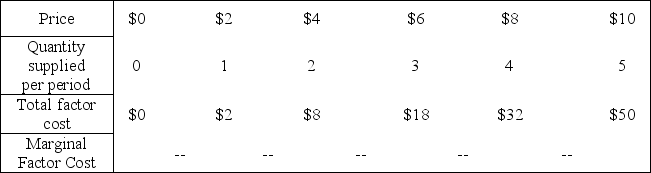 -(Exhibit: Supply and Marginal Factor Cost) The MFC of the fourth unit of the factor is:
 (Multiple Choice)
5.0/5 (85)
(85) Use the following to answer question(s): Labor Market
 -(Exhibit: Labor Market) Given competitive market demand curve D and union members supply curve S, a successful education and training campaign sponsored by the union is likely to generate a wage of _______ and a labor quantity of _______ .
 (Multiple Choice)
4.9/5 (82)
(82) Collective bargaining is the basic process by which unions and management negotiate the conditions of employment.
(True/False)
4.8/5 (79)
(79) Use the following to answer question 63-70.
Exhibit: Monopoly and Monopsony
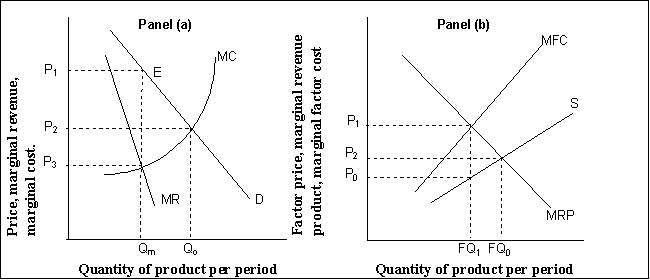 -(Exhibit: Monopoly and Monopsony) In monopoly, _______ is determined by the point on the ________ curve that corresponds to the profit-maximizing quantity of output.
 (Multiple Choice)
4.9/5 (92)
(92) All other things unchanged, a monopsonistic firm, as compared with the situation where the monopsony firm was broken up into a large number of firms buying inputs in a perfectly competitive factor market, pays a:
(Multiple Choice)
4.8/5 (66)
(66) Suppose that a firm hiring labor in a perfectly competitive factor market increases the quantity of labor from 10 workers to 11 workers.If the market wage is $10 per worker, the marginal factor cost for the tenth worker is:
(Multiple Choice)
4.9/5 (79)
(79) In a perfectly competitive labor market, the equilibrium wage level is determined by:
(Multiple Choice)
4.9/5 (73)
(73) Use the following to answer question(s): Monopsony
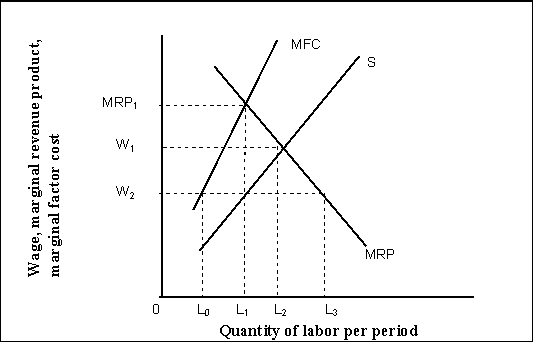 -(Exhibit: Monopsony) Given perfect competition in the factor market, how much labor will be hired?
 (Multiple Choice)
4.9/5 (79)
(79) A firm that is a single seller of an input can be expected to behave like a:
(Multiple Choice)
4.8/5 (88)
(88) The representation of workers by a union during contract negotiations is:
(Multiple Choice)
5.0/5 (77)
(77) A buyer that faces an upward-sloping supply curve for a good, service, or factor of production is said to have:
(Multiple Choice)
4.7/5 (84)
(84) Use the following to answer question(s): Minimum Wage and Monopsony
-(Exhibit: Minimum Wage and Monopsony) If a $30 minimum wage is imposed, the monopsony firm in the exhibit would maximize profits by hiring _______ units of labor per period.
-(Exhibit: Minimum Wage and Monopsony) If a $30 minimum wage is imposed, the monopsony firm in the exhibit would maximize profits by hiring _______ units of labor per period. (Multiple Choice)
4.7/5 (65)
(65) The price of a commodity determined in bilateral monopoly is usually:
(Multiple Choice)
4.8/5 (71)
(71) 
Filters
- Essay(0)
- Multiple Choice(0)
- Short Answer(0)
- True False(0)
- Matching(0)