



 Chat with AI
Exam 14: Imperfectly Competitive Markets for Factors of Production

Exam 1: Economics: The Study of Choice145 Questions
Exam 2: Confronting Scarcity: Choices in Production198 Questions
Exam 3: Demand and Supply251 Questions
Exam 4: Applications of Supply and Demand113 Questions
Exam 5: Elasticity: a Measure of Response255 Questions
Exam 6: Markets, Maximizers, and Efficiency239 Questions
Exam 7: The Analysis of Consumer Choice244 Questions
Exam 8: Production and Cost227 Questions
Exam 9: Competitive Markets for Goods and Services265 Questions
Exam 10: Monopoly234 Questions
Exam 11: The World of Imperfect Competition237 Questions
Exam 12: Wages and Employment in Perfect Competition189 Questions
Exam 13: Interest Rates and the Markets for Capital and Natural Resources170 Questions
Exam 14: Imperfectly Competitive Markets for Factors of Production183 Questions
Exam 15: Public Finance and Public Choice188 Questions
Exam 16: Antitrust Policy and Business Regulation137 Questions
Exam 17: International Trade186 Questions
Exam 18: The Economics of the Environment148 Questions
Exam 19: Inequality, Poverty, and Discrimination140 Questions
Select questions type


The monopoly sets its product _______ based on the _______ curve it faces, and monopsony sets its factor _______ based on the _______ curve it faces.
(Multiple Choice)
4.9/5  (84)
(84) If the American Bar Association sought to increase the incomes of its members, it could do so by:
(Multiple Choice)
4.7/5 (86)
(86) The price of a factor in a monopolistic factor market, as compared to a situation where the monopoly supplier is broken up into a large number of firms selling the factor in a perfectly competitive factor market:
(Multiple Choice)
4.9/5 (87)
(87) The situation in which a large university in a small community is the only employer for hundreds of secretarial workers who form a union is called a:
(Multiple Choice)
4.9/5 (68)
(68) Where unions operate in otherwise competitive markets, they _______ economic efficiency.
(Multiple Choice)
4.9/5 (76)
(76) Use the following to answer question(s): Monopsony
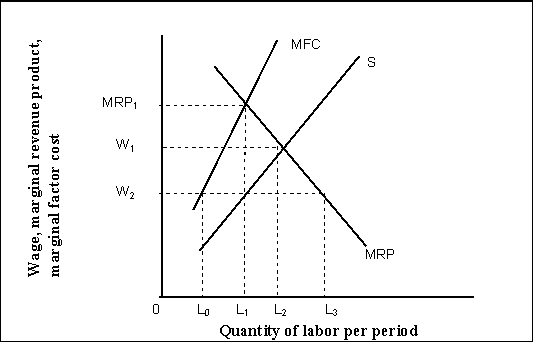 -(Exhibit: Monopsony) Given monopsony in the factor market, the equilibrium wage and quantity of labor would be:
 (Multiple Choice)
4.8/5 (74)
(74) If the American Medical Association wants to increase the income of American physicians, it could do so by advocating:
(Multiple Choice)
4.9/5 (80)
(80) A work rule that requires nonunion workers in a particular firm to join a union after they are hired is called a(n):
(Multiple Choice)
4.7/5 (80)
(80) Suppose that wages paid to both factory workers and construction workers in a perfectly competitive factor market is $15 per hour.If the market for factory workers becomes unionized, you would expect:
(Multiple Choice)
4.9/5 (79)
(79) If the bargaining power in a bilateral monopoly for labor is relatively greater for the seller than the buyer, the wage is likely to be:
(Multiple Choice)
4.8/5 (80)
(80) Studies indicate that, before the late 1970s, baseball players were paid:
(Multiple Choice)
4.8/5 (87)
(87) According to the Case in Point on The Monopsony-Minimum Wage Controversy, the fact that some studies have found that increases in the minimum wage have led to either increased employment or no significant reductions in employment:
(Multiple Choice)
4.8/5 (82)
(82) Define and explain the difference between monopoly power and monopsony power.
(Essay)
4.8/5 (81)
(81) Union efforts to restrict entry into a particular craft are likely to shift:
(Multiple Choice)
4.9/5 (81)
(81) A market in which there is a single buyer of a good, service, or factor of production is called a:
(Multiple Choice)
4.8/5 (90)
(90) Firms buying factors of production in perfectly competitive factor markets:
(Multiple Choice)
4.9/5 (92)
(92) A firm that can hire union as well as nonunion workers, but that requires nonunion workers to join the union within a specified period of time is a(n):
(Multiple Choice)
4.8/5 (87)
(87) 
Filters
- Essay(0)
- Multiple Choice(0)
- Short Answer(0)
- True False(0)
- Matching(0)