



 Chat with AI
Exam 14: Imperfectly Competitive Markets for Factors of Production

Exam 1: Economics: The Study of Choice145 Questions
Exam 2: Confronting Scarcity: Choices in Production198 Questions
Exam 3: Demand and Supply251 Questions
Exam 4: Applications of Supply and Demand113 Questions
Exam 5: Elasticity: a Measure of Response255 Questions
Exam 6: Markets, Maximizers, and Efficiency239 Questions
Exam 7: The Analysis of Consumer Choice244 Questions
Exam 8: Production and Cost227 Questions
Exam 9: Competitive Markets for Goods and Services265 Questions
Exam 10: Monopoly234 Questions
Exam 11: The World of Imperfect Competition237 Questions
Exam 12: Wages and Employment in Perfect Competition189 Questions
Exam 13: Interest Rates and the Markets for Capital and Natural Resources170 Questions
Exam 14: Imperfectly Competitive Markets for Factors of Production183 Questions
Exam 15: Public Finance and Public Choice188 Questions
Exam 16: Antitrust Policy and Business Regulation137 Questions
Exam 17: International Trade186 Questions
Exam 18: The Economics of the Environment148 Questions
Exam 19: Inequality, Poverty, and Discrimination140 Questions
Select questions type


Use the following to answer question(s): Minimum Wage and Monopsony
 -(Exhibit: Minimum Wage and Monopsony) If a $25 minimum wage is imposed, the monopsony firm in the exhibit would maximize profits by hiring _______ units of labor per period than it would in the situation with a $30 minimum wage.
 (Multiple Choice)
4.9/5  (83)
(83) A firm buying factors of production in a perfectly competitive factor market faces a market-determined price for each factor that it hires.
(True/False)
4.8/5 (83)
(83) A situation in which a monopoly seller faces a monopsony buyer is called bilateral monopoly.
(True/False)
4.9/5 (64)
(64) Use the following to answer question(s): Supply and Marginal Factor Cost
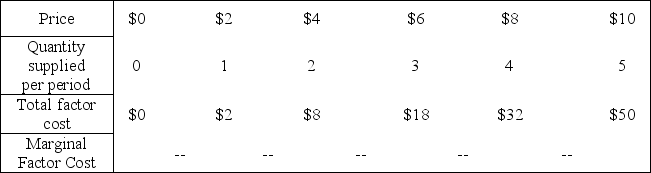 -(Exhibit: Supply and Marginal Factor Cost) Given _______ in the _______ market, the ________ curve lies _______ the supply curve.
 (Multiple Choice)
4.9/5 (74)
(74) In a monopsony labor market, the supply curve of labor lies above the MFC curve.
(True/False)
4.8/5 (81)
(81) Use the following to answer question 63-70.
Exhibit: Monopoly and Monopsony
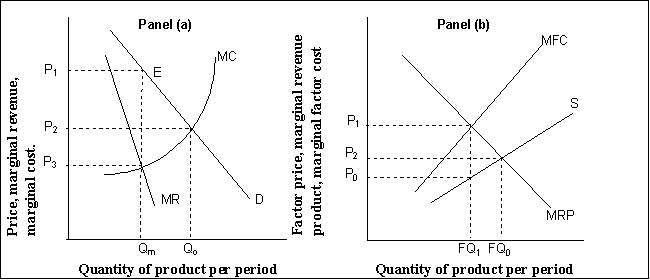 -(Exhibit: Monopoly and Monopsony) In monopoly, _______ ; in monopsony, ________.
 (Multiple Choice)
4.7/5 (84)
(84) Assuming identical marginal revenue product curves and all other things unchanged, the price of a factor in a monopolistic factor market is:
(Multiple Choice)
4.8/5 (81)
(81) An industrial union represents _______ workers in a particular industry _______ .
(Multiple Choice)
4.7/5 (94)
(94) To maximize profits, a perfectly competitive firm sells the quantity of output where MRP = price of output.
(True/False)
5.0/5 (63)
(63) A firm in which workers must belong to a union before they can gain employment is a(n):
(Multiple Choice)
4.9/5 (77)
(77) Labor unions generally seek to raise wages and improve working conditions.
(True/False)
4.8/5 (79)
(79) In a monopsony model of a labor market, as more labor is hired, the marginal factor cost of labor:
(Multiple Choice)
4.7/5 (85)
(85) A firm buying factors of production in a perfectly competitive factor market faces a perfectly elastic supply curve of labor.
(True/False)
4.8/5 (81)
(81) Monopsonistic factor markets and monopolistic output markets are similar in that both generate:
(Multiple Choice)
4.9/5 (74)
(74) Use the following to answer question 63-70.
Exhibit: Monopoly and Monopsony
-(Exhibit: Monopoly and Monopsony) In monopsony, _______ is determined by the point on the ________ curve that corresponds to the profit-maximizing quantity of the factor.
-(Exhibit: Monopoly and Monopsony) In monopsony, _______ is determined by the point on the ________ curve that corresponds to the profit-maximizing quantity of the factor. (Multiple Choice)
4.8/5 (81)
(81) Use the following to answer question(s): Labor Market
 -(Exhibit: Labor Market) Given competitive market demand curve D and initial union members supply curve S, the effect of the union successfully restricting entry into the factor market is illustrated by a:
 (Multiple Choice)
4.8/5 (80)
(80) All other things being equal, a monopsonistic firm pays a higher wage and hires fewer workers than do firms in the situation where the monopsony firm was broken up into a large number of firms buying inputs in a perfectly competitive factor market.
(True/False)
4.9/5 (74)
(74) Use the following to answer question(s): Supply and Marginal Factor Cost
-(Exhibit: Supply and Marginal Factor Cost) How many units of the factor will be supplied at a factor price of $6?
-(Exhibit: Supply and Marginal Factor Cost) How many units of the factor will be supplied at a factor price of $6? (Multiple Choice)
4.9/5 (96)
(96) 
Filters
- Essay(0)
- Multiple Choice(0)
- Short Answer(0)
- True False(0)
- Matching(0)