



 Chat with AI
Exam 3: Demand, Supply, and Market Equilibrium

Exam 1: Limits, Alternatives, and Choices398 Questions
Exam 2: The Market System and the Circular Flow252 Questions
Exam 3: Demand, Supply, and Market Equilibrium339 Questions
Exam 4: Market Failures: Public Goods and Externalities235 Questions
Exam 5: Governments Role and Government Failure275 Questions
Exam 6: Elasticity255 Questions
Exam 7: Utility Maximization256 Questions
Exam 8: Behavioral Economics274 Questions
Exam 9: Businesses and the Costs of Production307 Questions
Exam 10: Pure Competition in the Short Run167 Questions
Exam 11: Pure Competition in the Long Run182 Questions
Exam 12: Pure Monopoly224 Questions
Exam 13: Monopolistic Competition194 Questions
Exam 14: Oligopoly and Strategic Behavior265 Questions
Exam 15: Technology, Rd, and Efficiency231 Questions
Exam 16: The Demand for Resources244 Questions
Exam 17: Wage Determination308 Questions
Exam 18: Rent, Interest, and Profit210 Questions
Exam 19: Natural Resource and Energy Economics290 Questions
Exam 20: Public Finance: Expenditures and Taxes232 Questions
Exam 21: Antitrust Policy and Regulation237 Questions
Exam 22: Agriculture: Economics and Policy217 Questions
Exam 23: Income Inequality, Poverty, and Discrimination272 Questions
Exam 24: Health Care240 Questions
Exam 25: Immigration197 Questions
Exam 26: International Trade241 Questions
Exam 27: The Balance of Payments, Exchange Rates, and Trade Deficits252 Questions
Exam 28: The Economics of Developing Countries249 Questions
Select questions type


Assume a drought in the Great Plains reduces the supply of wheat. Noting that wheat is a basic ingredient in the production of bread, and potatoes are a consumer substitute for bread, we would expect the price of wheat to
(Multiple Choice)
4.8/5  (83)
(83) A market that is achieving allocative efficiency must also be achieving productive efficiency.
(True/False)
4.9/5 (80)
(80) When economists say that the demand for a product has decreased, they mean that
(Multiple Choice)
4.9/5 (75)
(75) The figure below shows three demand curves for coffee. 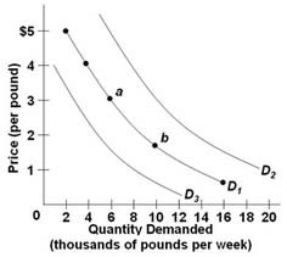 An increase in the price of coffee, other factors constant, would cause a
 (Multiple Choice)
4.7/5 (82)
(82) For most products, purchases tend to fall with decreases in buyers' incomes. Such products are known as
(Multiple Choice)
4.8/5 (87)
(87) The table below shows the weekly demand for hamburger in a market where there are just three buyers. 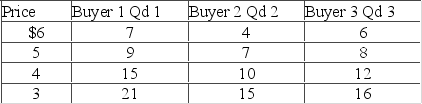 At a price of $6, the weekly market quantity demanded for hamburger is
 (Multiple Choice)
4.8/5 (81)
(81) An increase in quantity supplied might be caused by an increase in production costs.
(True/False)
4.9/5 (85)
(85) (Advanced analysis) The demand for commodity X is represented by the equation P = 100 - 2Q and supply by the equation P = 10 + 4Q. If demand changed from P = 100 - 2Q to P = 130 - Q, the new equilibrium price is
(Multiple Choice)
4.9/5 (77)
(77) In the following question you are asked to determine, other things equal, the effects of a given change in a determinant of demand or supply for product X upon (1) the demand (D) for, or supply (S) of, X; (2) the equilibrium price (P) of X; and (3) the equilibrium quantity (Q) of X. An improvement in the technology used to produce X will
(Multiple Choice)
4.7/5 (80)
(80) Which would be a likely cause of an increase in the demand for pizza?
(Multiple Choice)
4.8/5 (73)
(73) If products A and B are complements and the price of B decreases, the
(Multiple Choice)
4.7/5 (75)
(75) In the market for sushi, an increase in supply and a greater decrease in demand will cause both the equilibrium price and quantity to decrease.
(True/False)
4.9/5 (88)
(88) Last year the price of corn was $3 a bushel and the quantity of corn demanded was 10 million bushels. This year the price of corn was $4.00 a bushel and the quantity demanded was 9 million bushels. Is this evidence that the law of demand does not apply to corn?
(Multiple Choice)
4.8/5 (88)
(88) An increase in demand coupled with a simultaneous and bigger decrease in supply will cause equilibrium
(Multiple Choice)
4.9/5 (84)
(84) The relationship between quantity supplied and price is , and the relationship between quantity demanded and price is .
(Multiple Choice)
4.7/5 (84)
(84) Markets, viewed from the perspective of the supply and demand model,
(Multiple Choice)
4.9/5 (67)
(67) 
Filters
- Essay(0)
- Multiple Choice(0)
- Short Answer(0)
- True False(0)
- Matching(0)