



 Chat with AI
Exam 3: Demand, Supply, and Market Equilibrium

Exam 1: Limits, Alternatives, and Choices398 Questions
Exam 2: The Market System and the Circular Flow252 Questions
Exam 3: Demand, Supply, and Market Equilibrium339 Questions
Exam 4: Market Failures: Public Goods and Externalities235 Questions
Exam 5: Governments Role and Government Failure275 Questions
Exam 6: Elasticity255 Questions
Exam 7: Utility Maximization256 Questions
Exam 8: Behavioral Economics274 Questions
Exam 9: Businesses and the Costs of Production307 Questions
Exam 10: Pure Competition in the Short Run167 Questions
Exam 11: Pure Competition in the Long Run182 Questions
Exam 12: Pure Monopoly224 Questions
Exam 13: Monopolistic Competition194 Questions
Exam 14: Oligopoly and Strategic Behavior265 Questions
Exam 15: Technology, Rd, and Efficiency231 Questions
Exam 16: The Demand for Resources244 Questions
Exam 17: Wage Determination308 Questions
Exam 18: Rent, Interest, and Profit210 Questions
Exam 19: Natural Resource and Energy Economics290 Questions
Exam 20: Public Finance: Expenditures and Taxes232 Questions
Exam 21: Antitrust Policy and Regulation237 Questions
Exam 22: Agriculture: Economics and Policy217 Questions
Exam 23: Income Inequality, Poverty, and Discrimination272 Questions
Exam 24: Health Care240 Questions
Exam 25: Immigration197 Questions
Exam 26: International Trade241 Questions
Exam 27: The Balance of Payments, Exchange Rates, and Trade Deficits252 Questions
Exam 28: The Economics of Developing Countries249 Questions
Select questions type


A decrease in the price of multi-touch screens for electronic tablets will increase the supply of electronic tablets.
(True/False)
4.9/5  (86)
(86) An increase in demand for oil along with a simultaneous increase in supply of oil will
(Multiple Choice)
4.8/5 (89)
(89) In moving along a supply curve, which of the following is not held constant?
(Multiple Choice)
5.0/5 (87)
(87) If the demand for electronic readers and tablets increases, then their supply will increase as price rises.
(True/False)
4.7/5 (64)
(64) A fall in the price of milk, used in the production of ice cream, will
(Multiple Choice)
4.9/5 (68)
(68) An effective price ceiling will lower the equilibrium price and cause a surplus.
(True/False)
4.8/5 (76)
(76) At the current price, there is a shortage of a product. We would expect price to
(Multiple Choice)
4.8/5 (77)
(77) The presence of ticket scalpers in popular events like concerts will hurt consumers who buy from the scalpers.
(True/False)
4.9/5 (88)
(88) In a competitive market, every consumer willing to pay the market price can buy a product and every producer willing to sell the product at that price can sell it.
(True/False)
4.8/5 (90)
(90) Camille's Creations and Julia's Jewels both sell beads in a competitive market. If at the market price of $5 both are running out of beads to sell (they can't keep up with the quantity demanded at that price), then we would expect both Camille's and Julia's to
(Multiple Choice)
4.8/5 (78)
(78) Assume that the graphs show a competitive market for the product stated in the question. 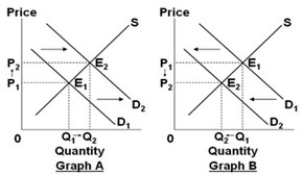
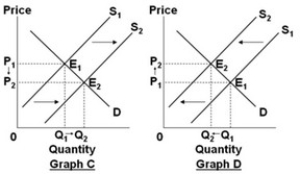 Select the graph above that best shows the change in the market specified in the following situation: the market for leather coats, when leather coats become more fashionable among young consumers.
 (Multiple Choice)
4.8/5 (83)
(83) In 2007, the price of oil increased, which in turn caused the price of natural gas to rise. This can best be explained by saying that oil and natural gas are
(Multiple Choice)
4.9/5 (85)
(85) If the price of Pepsi decreases, other factors constant, then we'd expect to see a consequent shift of the demand curve for
(Multiple Choice)
4.8/5 (78)
(78) A surplus indicates that the quantity demanded is greater than the quantity supplied at that price.
(True/False)
4.8/5 (72)
(72) (Advanced analysis) The demand for commodity X is represented by the equation P = 10 - 0.2Q and supply by the equation P = 2 + 0.2Q. The equilibrium quantity is
(Multiple Choice)
4.8/5 (80)
(80) 
Filters
- Essay(0)
- Multiple Choice(0)
- Short Answer(0)
- True False(0)
- Matching(0)