



 Chat with AI
Exam 3: Demand, Supply, and Market Equilibrium

Exam 1: Limits, Alternatives, and Choices398 Questions
Exam 2: The Market System and the Circular Flow252 Questions
Exam 3: Demand, Supply, and Market Equilibrium339 Questions
Exam 4: Market Failures: Public Goods and Externalities235 Questions
Exam 5: Governments Role and Government Failure275 Questions
Exam 6: Elasticity255 Questions
Exam 7: Utility Maximization256 Questions
Exam 8: Behavioral Economics274 Questions
Exam 9: Businesses and the Costs of Production307 Questions
Exam 10: Pure Competition in the Short Run167 Questions
Exam 11: Pure Competition in the Long Run182 Questions
Exam 12: Pure Monopoly224 Questions
Exam 13: Monopolistic Competition194 Questions
Exam 14: Oligopoly and Strategic Behavior265 Questions
Exam 15: Technology, Rd, and Efficiency231 Questions
Exam 16: The Demand for Resources244 Questions
Exam 17: Wage Determination308 Questions
Exam 18: Rent, Interest, and Profit210 Questions
Exam 19: Natural Resource and Energy Economics290 Questions
Exam 20: Public Finance: Expenditures and Taxes232 Questions
Exam 21: Antitrust Policy and Regulation237 Questions
Exam 22: Agriculture: Economics and Policy217 Questions
Exam 23: Income Inequality, Poverty, and Discrimination272 Questions
Exam 24: Health Care240 Questions
Exam 25: Immigration197 Questions
Exam 26: International Trade241 Questions
Exam 27: The Balance of Payments, Exchange Rates, and Trade Deficits252 Questions
Exam 28: The Economics of Developing Countries249 Questions
Select questions type


In the following question you are asked to determine, other things equal, the effects of a given change in a determinant of demand or supply for product X upon (1) the demand (D) for, or supply (S) of, X; (2) the equilibrium price (P) of X; and (3) the equilibrium quantity (Q) of X. An increase in the prices of resources used to produce X will
(Multiple Choice)
4.8/5  (82)
(82) If farmers withhold some of their current corn harvest from the market because they anticipate a higher price of corn in the near future, then this would cause a(n)
(Multiple Choice)
4.9/5 (72)
(72) Assume in a competitive market that price is initially above the equilibrium level. We can predict that price will
(Multiple Choice)
4.9/5 (81)
(81) If two goods are substitutes, a decline in the price of one will cause a decrease in the demand for the other.
(True/False)
4.7/5 (84)
(84) A television station reports that the price of orange juice has declined but the quantity traded has increased. This situation could be caused by a(n)
(Multiple Choice)
4.9/5 (77)
(77) Because of unseasonably cold weather, the supply of oranges has substantially decreased. This statement indicates the
(Multiple Choice)
4.9/5 (83)
(83) The rationing function of prices refers to the fact that government must distribute any surplus goods that may be left in a competitive market.
(True/False)
4.9/5 (67)
(67) Answer the question on the basis of the given supply and demand data for wheat. 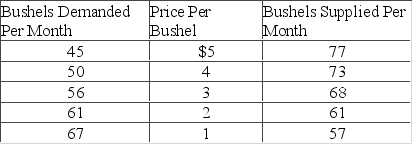 If price was initially $4 and free to fluctuate, we would expect the
 (Multiple Choice)
4.8/5 (78)
(78) Assume that the graphs show a competitive market for the product stated in the question. 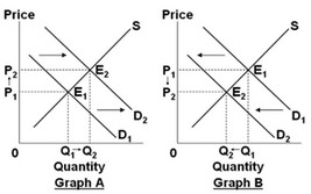
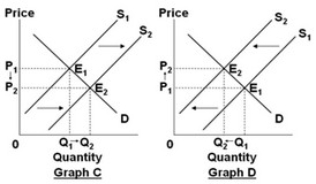 Select the graph above that best shows the change in the market specified in the following situation: the market for chicken, when the price of a substitute, such as beef, decreases.
 (Multiple Choice)
5.0/5 (80)
(80) An increase in demand accompanied by an increase in supply will increase the equilibrium quantity, but the effect on equilibrium price will be indeterminate.
(True/False)
4.9/5 (65)
(65) The equilibrium price and quantity in a market usually produce allocative efficiency because
(Multiple Choice)
4.8/5 (84)
(84) In the market for crude oil, if the change in demand due to the falling price of natural gas (a substitute for oil) is greater than the change in supply due to disruptions in oil-well operations in the Middle East, then the equilibrium price of oil will decrease.
(True/False)
4.7/5 (76)
(76) (Consider This) A primary advantage of Uber to government-regulated taxis is that
(Multiple Choice)
4.8/5 (77)
(77) When an economist says that the demand for a product has increased, this means that
(Multiple Choice)
4.7/5 (69)
(69) If there's a huge increase in the number of Americans traveling to Europe (say, for the Olympics), then the effect on the foreign exchange market is that the
(Multiple Choice)
4.9/5 (80)
(80) The following data show the supply and demand schedules for a product. 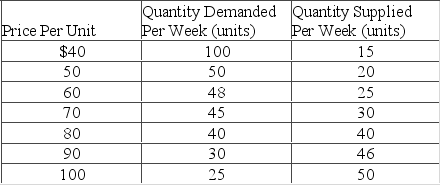 The government now introduces a subsidy payment to producers of $30 per unit. Assuming a purely competitive market for the product, the new equilibrium price will be between
 (Multiple Choice)
4.9/5 (86)
(86) When high-school and college graduates apply for jobs in the labor markets,
(Multiple Choice)
4.9/5 (81)
(81) 
Filters
- Essay(0)
- Multiple Choice(0)
- Short Answer(0)
- True False(0)
- Matching(0)