



 Chat with AI
Exam 8: Interest Rate Risk I

Exam 1: Why Are Financial Institutions Special100 Questions
Exam 2: Financial Services: Depository Institutions226 Questions
Exam 3: Financial Services: Finance Companies82 Questions
Exam 4: Financial Services: Securities Firms and Investment Banks119 Questions
Exam 5: Financial Services: Mutual Fund and Hedge Fund Companies129 Questions
Exam 6: Financial Services: Insurance Companies124 Questions
Exam 7: Risks of Financial Institutions128 Questions
Exam 8: Interest Rate Risk I124 Questions
Exam 9: Interest Rate Risk II124 Questions
Exam 10: Credit Risk: Individual Loan Risk119 Questions
Exam 11: Credit Risk: Loan Portfolio and Concentration Risk65 Questions
Exam 12: Liquidity Risk108 Questions
Exam 13: Foreign Exchange Risk109 Questions
Exam 14: Sovereign Risk94 Questions
Exam 15: Market Risk104 Questions
Exam 16: Off-Balance-Sheet Risk109 Questions
Exam 17: Technology and Other Operational Risks113 Questions
Exam 18: Liability and Liquidity Management131 Questions
Exam 19: Deposit Insurance and Other Liability Guarantees108 Questions
Exam 20: Capital Adequacy139 Questions
Exam 21: Product and Geographic Expansion156 Questions
Exam 22: Futures and Forwards130 Questions
Exam 23: Options, Caps, Floors, and Collars120 Questions
Exam 24: Swaps104 Questions
Exam 25: Loan Sales96 Questions
Exam 26: Securitization120 Questions
Select questions type


If the interest rate spread between rate sensitive-assets and rate sensitive liabilities increases for a bank,future increases in interest rates will lead to an increase in net interest income.
(True/False)
5.0/5  (83)
(83) Because of its simplicity,smaller depository institutions still use this model as their primary measure of interest rate risk.
(Multiple Choice)
4.8/5 (85)
(85) Hadbucks National Bank current balance sheet appears below. All assets and liabilities are currently priced at par and pay interest annually.
 -What is the impact on the FI's equity of a 2 percent overall increase in market interest rates on all fixed-rate instruments?
 (Multiple Choice)
4.8/5 (79)
(79) The following is the balance sheet of Boston Bank. The average maturity of demand deposits is estimated at 2 years.  -What is the repricing gap if a 3-year maturity gap is used? Ignore runoffs.
 (Multiple Choice)
4.9/5 (95)
(95) A positive repricing gap implies that a decrease in interest rates will cause interest expense to decrease more than the decrease in interest income.
(True/False)
4.9/5 (86)
(86) The market segmentation theory of the term structure of interest rates
(Multiple Choice)
4.9/5 (74)
(74) The balance sheet of XYZ Bank appears below. All figures in millions of U.S. dollars.
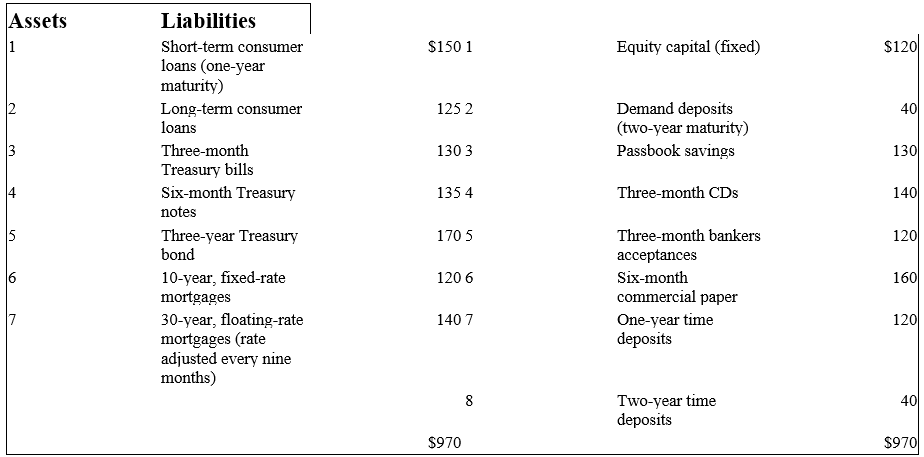 -Total one-year rate-sensitive assets is
 (Multiple Choice)
4.7/5 (85)
(85) Large banks have adopted interest rate risk measurement models based on market value accounting and duration.
(True/False)
4.7/5 (66)
(66) The balance sheet of XYZ Bank appears below. All figures in millions of U.S. dollars.
-Suppose that interest rates rise by 2 percent on both RSAs and RSLs.The expected annual change in net interest income of the bank is
-Suppose that interest rates rise by 2 percent on both RSAs and RSLs.The expected annual change in net interest income of the bank is (Multiple Choice)
4.9/5 (51)
(51) The repricing model is based on an accounting world that reports asset and liability values at
(Multiple Choice)
4.8/5 (73)
(73) Hadbucks National Bank current balance sheet appears below. All assets and liabilities are currently priced at par and pay interest annually.
-What is the weighted average maturity of assets?
-What is the weighted average maturity of assets? (Multiple Choice)
4.9/5 (82)
(82) The economic insolvency of many thrift institutions during the 1980s was due,at least in part,to unexpected increases in interest rates.
(True/False)
4.9/5 (84)
(84) Because the repricing model ignores the market value effect of changing interest rates,the repricing gap is an incomplete measure of the true interest rate risk exposure of an FI.
(True/False)
4.9/5 (63)
(63) Which theory of term structure argues that individual investors have specific maturity preferences?
(Multiple Choice)
4.8/5 (77)
(77) When interest rates increase,banks are more likely to be forced to increase rate-sensitive liabilities to replace decreased balances in demand deposits and savings accounts.
(True/False)
4.8/5 (86)
(86) Because the increased level of financial market integration has increased the speed with which interest rate changes are transmitted among countries,control of U.S.interest rates by the Federal Reserve is more difficult and less certain.
(True/False)
4.7/5 (69)
(69) The spread effect demonstrates that,regardless of the direction of a change in market interest rates,a positive relation exists between the changes in spread and changes in net interest income.
(True/False)
4.8/5 (85)
(85) Which theory of term structure posits that long-term rates are a geometric average of current and expected short-term interest rates?
(Multiple Choice)
4.9/5 (89)
(89) 
Filters
- Essay(0)
- Multiple Choice(0)
- Short Answer(0)
- True False(0)
- Matching(0)