



 Chat with AI
Exam 8: Interest Rate Risk I

Exam 1: Why Are Financial Institutions Special100 Questions
Exam 2: Financial Services: Depository Institutions226 Questions
Exam 3: Financial Services: Finance Companies82 Questions
Exam 4: Financial Services: Securities Firms and Investment Banks119 Questions
Exam 5: Financial Services: Mutual Fund and Hedge Fund Companies129 Questions
Exam 6: Financial Services: Insurance Companies124 Questions
Exam 7: Risks of Financial Institutions128 Questions
Exam 8: Interest Rate Risk I124 Questions
Exam 9: Interest Rate Risk II124 Questions
Exam 10: Credit Risk: Individual Loan Risk119 Questions
Exam 11: Credit Risk: Loan Portfolio and Concentration Risk65 Questions
Exam 12: Liquidity Risk108 Questions
Exam 13: Foreign Exchange Risk109 Questions
Exam 14: Sovereign Risk94 Questions
Exam 15: Market Risk104 Questions
Exam 16: Off-Balance-Sheet Risk109 Questions
Exam 17: Technology and Other Operational Risks113 Questions
Exam 18: Liability and Liquidity Management131 Questions
Exam 19: Deposit Insurance and Other Liability Guarantees108 Questions
Exam 20: Capital Adequacy139 Questions
Exam 21: Product and Geographic Expansion156 Questions
Exam 22: Futures and Forwards130 Questions
Exam 23: Options, Caps, Floors, and Collars120 Questions
Exam 24: Swaps104 Questions
Exam 25: Loan Sales96 Questions
Exam 26: Securitization120 Questions
Select questions type


The market value of a fixed-rate liability will increase as interest rates rise,although the market value of a fixed-rate asset will decrease as interest rates rise.

Free
(True/False)
4.9/5  (91)
(91) Correct Answer: Verified
False
Defining buckets of time over a range of maturities assures the capture of all relevant information necessary to accurately assess the interest rate risk exposure of an FI.
Free
(True/False)
4.7/5 (84)
(84) Correct Answer:Verified
VerifiedFalse
The following information details the current rate sensitivity report for Gotbucks Bank, Inc. ($ million).
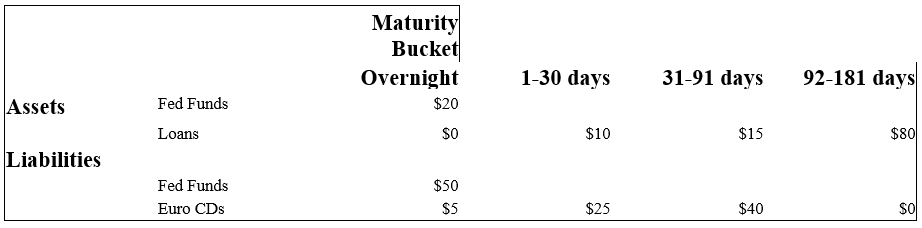 -Calculate the funding gap for Gotbucks Bank using (a)a 30 day maturity period and (b)a 91 day maturity period.
Free
(Multiple Choice)
4.8/5 (67)
(67) Correct Answer:Verified
VerifiedB
One reason to exclude NOW accounts when estimating a bank's repricing gap is because the interest rates paid on these accounts typically do not change with the level of market rates.
(True/False)
4.9/5 (83)
(83) Runoff in demand deposits in a repricing model is typically lower during periods of falling interest rates.
(True/False)
4.7/5 (91)
(91) The Bank for International Settlements (BISs)requires depository institutions to have interest rate risk management systems.
(True/False)
4.9/5 (75)
(75) The liquidity premium theory of the term structure of interest rates
(Multiple Choice)
4.9/5 (81)
(81) The repricing model measures the impact of unanticipated changes in interest rates on
(Multiple Choice)
4.8/5 (90)
(90) To be more precise in measuring interest rate risk,the runoff component of long-term mortgages should be considered in the time buckets in which the maturities actually occur.
(True/False)
4.9/5 (73)
(73) Which theory of term structure states that long-term rates are equal to the geometric average of current and expected short-term rates plus a risk premium that increases with the maturity of the security?
(Multiple Choice)
4.9/5 (81)
(81) Which of the following indicates a positive gap according to the repricing model?
(Multiple Choice)
4.9/5 (89)
(89) Changes in short term interest rates rarely affect the entire term structure of interest rates.
(True/False)
4.9/5 (90)
(90) Retail passbook savings accounts are included as part of rate-sensitive liabilities because the rates on these accounts rarely change.
(True/False)
4.9/5 (79)
(79) Because of its complexity,small depository institutions rarely use the repricing,or funding gap,model.
(True/False)
4.9/5 (79)
(79) The following are the assets and liabilities of a government security dealer.
 -Use the repricing model to determine the funding gap for a maturity bucket of 30 days.
 (Multiple Choice)
4.8/5 (68)
(68) The following is the balance sheet of Boston Bank. The average maturity of demand deposits is estimated at 2 years.  -What is the repricing gap if a 1-year maturity gap is used if runoffs are also considered?
 (Multiple Choice)
4.8/5 (78)
(78) If the average maturity of assets is 4 years and the average maturity of liabilities is 4 years,then the FI has no interest rate risk exposure.
(True/False)
4.9/5 (83)
(83) The following information is from First Yaupon Savings Association.  -If all interest rates decrease by 15 basis points,what is the expected impact on the FI's net interest income? (Hint: Use the repricing model to answer this question. )
 (Multiple Choice)
4.9/5 (80)
(80) 
Filters
- Essay(0)
- Multiple Choice(0)
- Short Answer(0)
- True False(0)
- Matching(0)