



 Chat with AI
Exam 1: Globalization and the Multinational Firm

Exam 1: Globalization and the Multinational Firm100 Questions
Exam 2: International Monetary System100 Questions
Exam 3: Balance of Payments100 Questions
Exam 4: Corporate Governance Around the World100 Questions
Exam 5: The Market for Foreign Exchange98 Questions
Exam 6: International Parity Relationships and Forecasting Foreign Exchange Rates100 Questions
Exam 7: Futures and Options on Foreign Exchange100 Questions
Exam 8: Management of Transaction Exposure98 Questions
Exam 9: Management of Economic Exposure100 Questions
Exam 10: Management of Translation Exposure81 Questions
Exam 11: International Banking and Money Market103 Questions
Exam 12: International Bond Market100 Questions
Exam 13: International Equity Markets100 Questions
Exam 14: Interest Rate and Currency Swaps100 Questions
Exam 15: International Portfolio Investment101 Questions
Exam 16: Foreign Direct Investment and Cross-Border Acquisitions100 Questions
Exam 17: International Capital Structure and the Cost of Capital100 Questions
Exam 18: International Capital Budgeting102 Questions
Exam 19: Multinational Cash Management100 Questions
Exam 20: International Trade Finance100 Questions
Exam 21: International Tax Environment and Transfer Pricing99 Questions
Select questions type


Which state has a comparative advantage in wheat production in Case I?
(Multiple Choice)
4.7/5  (79)
(79) Under the theory of comparative advantage, liberalization of international trade will
(Multiple Choice)
5.0/5 (74)
(74) What is the increased amount of goods available in Northern Ireland after trade?
(Multiple Choice)
4.8/5 (83)
(83) For case II, in what range must the "international" price of wheat fall? i.e. if North and South Dakota trade only with each other, what is the range of prices possible?
(Multiple Choice)
4.9/5 (83)
(83) While the corporate governance problem is not confined to the United States,
(Multiple Choice)
4.9/5 (63)
(63) Japan has experienced large trade surpluses. Japanese investors have responded to this by
(Multiple Choice)
4.7/5 (86)
(86) Suppose Mexico is a major export market for your U.S.-based company and the Mexican peso appreciates drastically against the U.S. dollar. This means
(Multiple Choice)
4.9/5 (83)
(83) The ultimate guardians of shareholder interest in a corporation, are the
(Multiple Choice)
4.9/5 (92)
(92) Counties A and B currently consume 400 units of food and 400 units of textiles each and currently do not trade with one another. The citizens of country A have to give up one unit of food to gain two units of textiles, while the citizens of country B have to give up one unit of textiles to gain two units of food. Their production possibilities curves are shown. 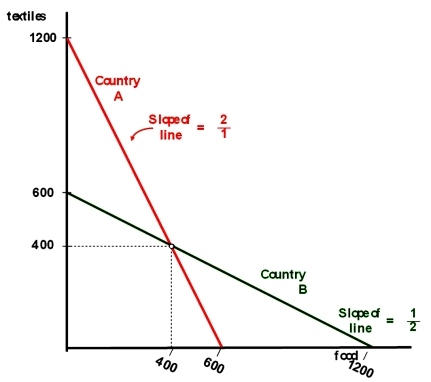 Under the theory of comparative advantage, if free trade is allowed, the market clearing price (or exchange rate if you will) between food and textiles will be
 (Multiple Choice)
4.8/5 (85)
(85) Undoubtedly, we are now living in a world where all the major economic functions-consumption, production, and investment
(Multiple Choice)
4.8/5 (74)
(74) The Nestlé Corporation, a well-known Swiss MNC, used to issue two different classes of common stock, bearer shares and registered shares, and foreigners were allowed to hold only
(Multiple Choice)
4.9/5 (81)
(81) Which state has an absolute advantage in producing wheat in Case I?
(Multiple Choice)
4.9/5 (84)
(84) The ascendance of the dollar the dominant global currency reflects several key factors such as
(Multiple Choice)
4.8/5 (77)
(77) Since the end of World War I, the U.S. dollar has played the role of the dominant global currency, displacing the
(Multiple Choice)
4.9/5 (96)
(96) Now suppose that Southern workers receive a raise to €2 per day. Will trade be possible at the exchange rate you found in the last question?
(Multiple Choice)
4.9/5 (76)
(76) 
Filters
- Essay(0)
- Multiple Choice(0)
- Short Answer(0)
- True False(0)
- Matching(0)