



 Chat with AI
Exam 11: International Banking and Money Market

Exam 1: Globalization and the Multinational Firm100 Questions
Exam 2: International Monetary System100 Questions
Exam 3: Balance of Payments100 Questions
Exam 4: Corporate Governance Around the World100 Questions
Exam 5: The Market for Foreign Exchange98 Questions
Exam 6: International Parity Relationships and Forecasting Foreign Exchange Rates100 Questions
Exam 7: Futures and Options on Foreign Exchange100 Questions
Exam 8: Management of Transaction Exposure98 Questions
Exam 9: Management of Economic Exposure100 Questions
Exam 10: Management of Translation Exposure81 Questions
Exam 11: International Banking and Money Market103 Questions
Exam 12: International Bond Market100 Questions
Exam 13: International Equity Markets100 Questions
Exam 14: Interest Rate and Currency Swaps100 Questions
Exam 15: International Portfolio Investment101 Questions
Exam 16: Foreign Direct Investment and Cross-Border Acquisitions100 Questions
Exam 17: International Capital Structure and the Cost of Capital100 Questions
Exam 18: International Capital Budgeting102 Questions
Exam 19: Multinational Cash Management100 Questions
Exam 20: International Trade Finance100 Questions
Exam 21: International Tax Environment and Transfer Pricing99 Questions
Select questions type


Consider the position of a treasurer of a MNC, who has $20,000,000 that his firm will not need for the next 90 days.

Free
(Multiple Choice)
4.9/5  (86)
(86) Correct Answer: Verified
B
Consider the balance sheets of Bank A and Bank B. Bank A is in Milan, Bank B is in New York. The current exchange rate is €1.00 = $1.25. Show the correct balances in each account if a currency trader employed at Bank A buys €100,000 from a currency trader at bank B for $125,000 using its correspondent relationship with Bank B. 
Free
(Essay)
4.7/5 (63)
(63) Correct Answer:Verified
VerifiedInstructors note: numerical correspondent banking problems assume a background in accounting. This material is also covered in chapter 5. 
International banks are different from domestic banks in what way(s)?
(Multiple Choice)
4.7/5 (67)
(67) Multinational banks are often not subject to the same regulations as domestic banks.
(Multiple Choice)
4.8/5 (70)
(70) You are a bank and your customer asks you to quote an agreed-upon rate for a 3 × 6 FRA. You observe the following rates: 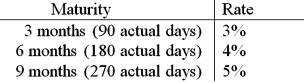 What rate should you quote?
 (Multiple Choice)
4.7/5 (70)
(70) Edge Act banks are not prohibited from owning equity in business corporations, unlike domestic commercial banks.
(True/False)
4.8/5 (91)
(91) A bank may establish a multinational operation for the reason of home country information services. The underlying rationale being that
(Multiple Choice)
4.9/5 (93)
(93) A foreign branch bank operates like a local bank, but legally
(Multiple Choice)
4.9/5 (75)
(75) Approximately ___ of wholesale Eurobank external liabilities come from fixed time deposits, the remainder from Negotiable Certificates of Deposit.
(Multiple Choice)
5.0/5 (75)
(75) A forward rate agreement (FRA) is a contract between two banks
(Multiple Choice)
4.9/5 (70)
(70) Forward rate agreements can be used for speculative purposes. If one believes rates will be less than the agreement rate,
(Multiple Choice)
5.0/5 (98)
(98) A bank may establish a multinational operation for the reason of regulatory advantage. The underlying rationale being that
(Multiple Choice)
4.9/5 (71)
(71) Which of the following are principles of sound banking behavior?
(Multiple Choice)
4.8/5 (82)
(82) Banks that both perform traditional commercial banking functions and engage in investment banking activities are often called
(Multiple Choice)
4.9/5 (87)
(87) You are a bank and your customer asks you to quote an agreed-upon rate for a 3 × 9 FRA. You observe the following rates. 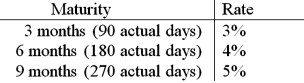 What rate should you quote?
 (Multiple Choice)
4.8/5 (77)
(77) A bank bought a "three against six" FRA. Payment is made when?
(Multiple Choice)
4.9/5 (99)
(99) 
Filters
- Essay(0)
- Multiple Choice(0)
- Short Answer(0)
- True False(0)
- Matching(0)