



 Chat with AI
Exam 2: International Monetary System

Exam 1: Globalization and the Multinational Firm100 Questions
Exam 2: International Monetary System100 Questions
Exam 3: Balance of Payments100 Questions
Exam 4: Corporate Governance Around the World100 Questions
Exam 5: The Market for Foreign Exchange98 Questions
Exam 6: International Parity Relationships and Forecasting Foreign Exchange Rates100 Questions
Exam 7: Futures and Options on Foreign Exchange100 Questions
Exam 8: Management of Transaction Exposure98 Questions
Exam 9: Management of Economic Exposure100 Questions
Exam 10: Management of Translation Exposure81 Questions
Exam 11: International Banking and Money Market103 Questions
Exam 12: International Bond Market100 Questions
Exam 13: International Equity Markets100 Questions
Exam 14: Interest Rate and Currency Swaps100 Questions
Exam 15: International Portfolio Investment101 Questions
Exam 16: Foreign Direct Investment and Cross-Border Acquisitions100 Questions
Exam 17: International Capital Structure and the Cost of Capital100 Questions
Exam 18: International Capital Budgeting102 Questions
Exam 19: Multinational Cash Management100 Questions
Exam 20: International Trade Finance100 Questions
Exam 21: International Tax Environment and Transfer Pricing99 Questions
Select questions type


Willem Duisenberg, the first president of the European Central Bank, defined "price stability" as an annual inflation rate of

Free
(Multiple Choice)
4.8/5  (72)
(72) Correct Answer: Verified
B
The monetary system of bimetallism is unstable. Due to the fluctuation of the commercial value of the metals,
Free
(Multiple Choice)
4.9/5 (98)
(98) Correct Answer:Verified
VerifiedC
Since the end of the fixed exchange rate system of the Smithsonian agreement
Free
(Multiple Choice)
4.8/5 (69)
(69) Correct Answer:Verified
VerifiedB
The price-specie-flow mechanism will work only if governments are willing to play by the rules of the game by letting the money stock rise and fall as gold flows in and out. Once the government demonetizes (neutralizes) gold, the mechanism will break down. In addition, the effectiveness of the mechanism depends on
(Multiple Choice)
4.9/5 (69)
(69) In the years leading to the collapse of the Bretton Woods system
(Multiple Choice)
4.8/5 (86)
(86) In 1963, President John Kennedy imposed the Interest Equalization Tax (IET) on U.S. purchases of foreign securities. The IET was designed to
(Multiple Choice)
4.9/5 (80)
(80) The growth of the Eurodollar market, which is a transnational, unregulated fund market
(Multiple Choice)
4.8/5 (86)
(86) Ecuador does not have its own national currency, circulating the U.S. dollar instead. About how many countries do not have their own national currency?
(Multiple Choice)
4.7/5 (90)
(90) Suppose that country A and country B are both on a bimetallic standard. In country A the ratio is 15 to one (i.e. an ounce of gold is worth 15 times as much as an ounce of silver in that currency), while in country B the ratio is ten to one. If the free flow of capital is allowed between countries A and B is this a sustainable framework?
(Multiple Choice)
4.8/5 (78)
(78) Following the introduction of the euro, the national central banks of the euro-12 nations
(Multiple Choice)
4.9/5 (85)
(85) Consider the supply-demand framework for the British pound relative to the U.S. dollar shown in the nearby chart. The exchange rate is currently $1.80 = £1.00. Which of the following is correct? 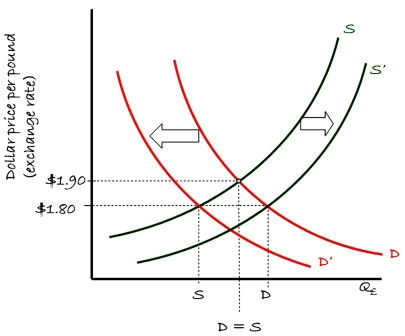
(Multiple Choice)
4.8/5 (73)
(73) With regard to the current exchange rate arrangement between Italy and Germany, it is best characterized as
(Multiple Choice)
4.9/5 (79)
(79) A booming economy with a fixed or stable nominal exchange rate
(Multiple Choice)
4.8/5 (87)
(87) The euro zone remarkably comparable to the United States in terms of
(Multiple Choice)
4.7/5 (79)
(79) 
Filters
- Essay(0)
- Multiple Choice(0)
- Short Answer(0)
- True False(0)
- Matching(0)