



 Chat with AI
Exam 17: International Capital Structure and the Cost of Capital

Exam 1: Globalization and the Multinational Firm100 Questions
Exam 2: International Monetary System100 Questions
Exam 3: Balance of Payments100 Questions
Exam 4: Corporate Governance Around the World100 Questions
Exam 5: The Market for Foreign Exchange98 Questions
Exam 6: International Parity Relationships and Forecasting Foreign Exchange Rates100 Questions
Exam 7: Futures and Options on Foreign Exchange100 Questions
Exam 8: Management of Transaction Exposure98 Questions
Exam 9: Management of Economic Exposure100 Questions
Exam 10: Management of Translation Exposure81 Questions
Exam 11: International Banking and Money Market103 Questions
Exam 12: International Bond Market100 Questions
Exam 13: International Equity Markets100 Questions
Exam 14: Interest Rate and Currency Swaps100 Questions
Exam 15: International Portfolio Investment101 Questions
Exam 16: Foreign Direct Investment and Cross-Border Acquisitions100 Questions
Exam 17: International Capital Structure and the Cost of Capital100 Questions
Exam 18: International Capital Budgeting102 Questions
Exam 19: Multinational Cash Management100 Questions
Exam 20: International Trade Finance100 Questions
Exam 21: International Tax Environment and Transfer Pricing99 Questions
Select questions type


Solve for the weighted average cost of capital: 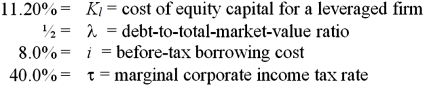

Free
(Multiple Choice)
4.7/5  (77)
(77) Correct Answer: Verified
B
Compute the domestic country beta of Stansfield Bicycles as well as its world beta. 
Free
(Multiple Choice)
4.9/5 (85)
(85) Correct Answer:Verified
VerifiedA

Compute the debt-to-equity ratio for a firm that has a debt-to-value ratio of 60%.
(Multiple Choice)
5.0/5 (78)
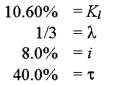
(78) The required return on equity for a levered firm is 10.60%. The debt to equity ratio is ½ the tax rate is 40%, the pre-tax cost of debt is 8%. Find the cost of capital if this firm were financed entirely with equity.
(Multiple Choice)
4.9/5 (73)
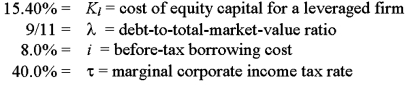
(73) 
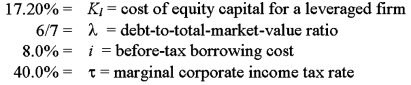
With regard to the financial structure of a foreign subsidiary
(Multiple Choice)
4.8/5 (83)
(83) Recent studies suggest that agency costs of managerial discretion are lower in Japan than in the United States. This suggests that
(Multiple Choice)
4.8/5 (71)
(71) One likely effect of a company or government instituting foreign equity ownership restrictions is
(Multiple Choice)
4.7/5 (78)
(78) Find the weighted average cost of capital for a firm that has a debt-to-equity ratio of 1½, a tax rate of 34%, a levered cost of equity of 12% and an after-tax cost of debt of 8%.
(Multiple Choice)
4.8/5 (75)
(75) 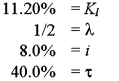
In the notation of the book, K = (1 - λ)Kl + λ(1 - τ)i Which of the following are correct?
(Multiple Choice)
4.9/5 (68)
(68) The following is an outline of certain potential benefits as well as costs associated with the cross-border listings of stocks: (i) - the company can expand its potential investor base
(ii) - issues involving the disclosure and listing requirements
(iii) - creates a secondary market for the company's shares
(iv) - volatility spillover from the overseas markets
(v) - liquidity
(vi) - control of the company by foreigners
(vii) - enhances the visibility of the company's name and its products in foreign marketplaces
Which of the following represent all the potential benefits of the cross-border listings of stocks?
(Multiple Choice)
4.8/5 (75)
(75) For a firm confronted with a fixed schedule of possible new investments, any policy that lowers the firm's cost of capital will increase the profitable capital expenditures the firm takes on and increase the wealth of the firm's shareholders. One such policy is
(Multiple Choice)
4.8/5 (90)
(90) 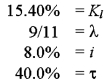
Find the debt-to-equity ratio for a firm with a debt-to-total-value ratio of ⅔.
(Multiple Choice)
4.7/5 (78)
(78) The firm's tax rate is 34%. The firm's pre-tax cost of debt is 8%; the firm's debt-to-equity ratio is 4; the risk-free rate is 3%; the beta of the firm's common stock is 1.5; the market risk premium is 9%. What is the firm's cost of equity capital?
(Multiple Choice)
4.8/5 (81)
(81) 
Filters
- Essay(0)
- Multiple Choice(0)
- Short Answer(0)
- True False(0)
- Matching(0)