



 Chat with AI
Exam 10: Management of Translation Exposure

Exam 1: Globalization and the Multinational Firm100 Questions
Exam 2: International Monetary System100 Questions
Exam 3: Balance of Payments100 Questions
Exam 4: Corporate Governance Around the World100 Questions
Exam 5: The Market for Foreign Exchange98 Questions
Exam 6: International Parity Relationships and Forecasting Foreign Exchange Rates100 Questions
Exam 7: Futures and Options on Foreign Exchange100 Questions
Exam 8: Management of Transaction Exposure98 Questions
Exam 9: Management of Economic Exposure100 Questions
Exam 10: Management of Translation Exposure81 Questions
Exam 11: International Banking and Money Market103 Questions
Exam 12: International Bond Market100 Questions
Exam 13: International Equity Markets100 Questions
Exam 14: Interest Rate and Currency Swaps100 Questions
Exam 15: International Portfolio Investment101 Questions
Exam 16: Foreign Direct Investment and Cross-Border Acquisitions100 Questions
Exam 17: International Capital Structure and the Cost of Capital100 Questions
Exam 18: International Capital Budgeting102 Questions
Exam 19: Multinational Cash Management100 Questions
Exam 20: International Trade Finance100 Questions
Exam 21: International Tax Environment and Transfer Pricing99 Questions
Select questions type


Find the foreign currency gain or loss for this U.S. MNC translating the balance sheet and income statement of a French subsidiary, which keeps its books in euro, but that is translated into U.S. dollars using the current/noncurrent method, the reporting currency of the U.S. MNC.
The subsidiary is at the end of its first year of operation.
The historical exchange rate is $1.60/€1.00 and the most recent exchange rate is $1.50/€ 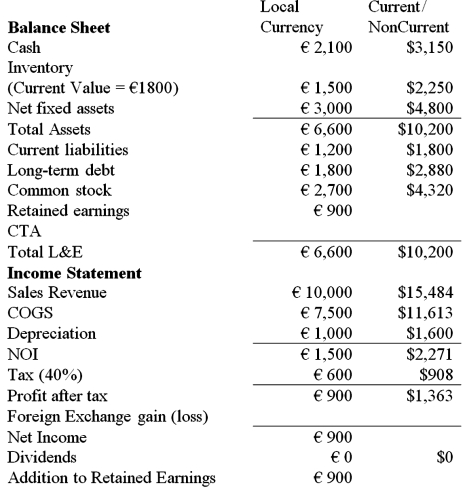
(Short Answer)
4.7/5  (67)
(67) When using the current/noncurrent method, current assets are defined as
(Multiple Choice)
4.7/5 (72)
(72) The current/noncurrent method of foreign currency translation was generally accepted in the United States from the 1930s until 1975, when
(Multiple Choice)
4.8/5 (78)
(78) Salient economic factors for determining the functional currency include
(Multiple Choice)
4.9/5 (73)
(73) The sensitivity of the firm's consolidated financial statements to unexpected changes in the exchange rate is
(Multiple Choice)
4.9/5 (71)
(71) Translation exposure, also frequently called accounting exposure, refers to the effect that an unanticipated change in exchange rates will have on the
(Multiple Choice)
4.8/5 (89)
(89) Under which method does the gain or loss due to translation adjustment not affect reported cash flows, as it does with the other three translation methods?
(Multiple Choice)
4.9/5 (90)
(90) The underlying principle of the current/noncurrent method is
(Multiple Choice)
4.8/5 (81)
(81) How many methods of foreign currency translation have been used in recent years? (U.S. GAAP.)
(Multiple Choice)
4.8/5 (91)
(91) The recognized methods for consolidating the financial reports of an MNC are
(Multiple Choice)
4.9/5 (72)
(72) The generally accepted method for consolidating the financial reports of an MNC from the 1930s to 1975 was
(Multiple Choice)
4.9/5 (98)
(98) Calculate the cumulative translation adjustment for this U.S. MNC translating the balance sheet and income statement of a French subsidiary, which keeps its books in euro, but that is translated into U.S. dollars using the current rate method, the reporting currency of the U.S. MNC.
The subsidiary is at the end of its first year of operation.
The historical exchange rate is $1.60/€1.00 and the most recent exchange rate is $1.50/€ 
(Essay)
4.8/5 (80)
(80) If a foreign entity is only a shell company for carrying accounts that could be carried on the parent's books,
(Multiple Choice)
4.9/5 (84)
(84) 
Filters
- Essay(0)
- Multiple Choice(0)
- Short Answer(0)
- True False(0)
- Matching(0)