



 Chat with AI
Exam 9: Bond Prices and Yields

Exam 1: Investments: Background and Issues55 Questions
Exam 2: Asset Classes and Financial Instruments59 Questions
Exam 3: Securities Markets60 Questions
Exam 4: Managed Funds and Other Investment Companies60 Questions
Exam 5: Risk and Return: Past and Prologue58 Questions
Exam 6: Efficient Diversification56 Questions
Exam 7: Capital Pricing and Arbitrage Pricing Theory59 Questions
Exam 8: The Efficient Market Hypothesis and Behavioral Finance60 Questions
Exam 9: Bond Prices and Yields58 Questions
Exam 10: Managing Bond Portfolios60 Questions
Exam 11: Equity Valuation60 Questions
Exam 12: Macroeconomic and Industry Analysis58 Questions
Exam 13: Financial Statement Analysis55 Questions
Exam 14: Options and Risk Management60 Questions
Exam 15: Futures and Risk Management60 Questions
Exam 16: Investors and the Investment Process60 Questions
Exam 17: Hedge Funds60 Questions
Exam 18: Portfolio Performance Evaluation54 Questions
Select questions type


A convertible bond has a par value of $1 000 but its current market price is $975. The current price of the issuing company's shares is $26 and the conversion ratio is 34 shares. The bond's market conversion value is ________.
(Multiple Choice)
4.9/5  (79)
(79) Inflation-indexed Treasury securities are commonly called ________.
(Multiple Choice)
4.8/5 (95)
(95) You buy a TIPS at issue at par for $1 000. The bond has a 3% coupon. Inflation turns out to be 2%, 3% and 4% over the next three years. The total annual coupon income you will receive in year three is ________.
(Multiple Choice)
4.9/5 (86)
(86) Everything else equal, the ________ the maturity of a bond and the ________ the coupon the greater the sensitivity of the bond's price to interest rate changes.
(Multiple Choice)
4.8/5 (83)
(83) Consider the expectations theory of the term structure of interest rates. If the yield curve is downward sloping, this indicates that investors expect short-term interest rates to ________ in the future.
(Multiple Choice)
4.7/5 (84)
(84) Floating rate bonds have a ________ that is adjusted with current market interest rates.
(Multiple Choice)
4.8/5 (76)
(76) Consider the following $1 000 par value zero-coupon bonds: 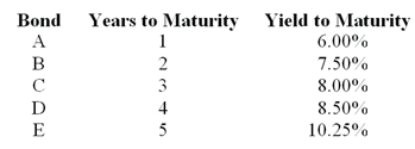 The expected one-year interest rate two years from now should be ________.
 (Multiple Choice)
4.8/5 (90)
(90) A corporate bond has a 10-year maturity and pays interest semiannually. The quoted coupon rate is 6% and the bond is priced at par. The bond is callable in 3 years at 110% of par. What is the bond's yield to call?
(Multiple Choice)
4.9/5 (82)
(82) Analysis of bond returns over a multiyear horizon based on forecasts of the bond's yield to maturity and reinvestment rate of coupons is called ________.
(Multiple Choice)
4.7/5 (70)
(70) Consider a 7-year bond with a 9% coupon and a yield to maturity of 12%. If interest rates remain constant, one year from now the price of this bond will be ________.
(Multiple Choice)
4.8/5 (77)
(77) The yield to maturity of a 10-year zero coupon bond, with a par value of $1 000 and a market price of $625, is ________.
(Multiple Choice)
4.9/5 (65)
(65) One-, two- and three-year maturity, default-free, zero-coupon bonds have yields-to-maturity of 7%, 8% and 9% respectively. What is the implied one-year forward rate, one year from today?
(Multiple Choice)
4.9/5 (73)
(73) If the price of a $10 000 par Treasury bond is $10 237.50 the quote would be listed in the newspaper as ________.
(Multiple Choice)
4.9/5 (76)
(76) A Treasury bond due in one year has a yield of 6.3% while a Treasury bond due in 5 years has a yield of 8.8%. A bond due in 5 years issued by High Country Marketing Corporation has a yield of 9.6% while a bond due in one year issued by High Country Marketing Corporation has a yield of 6.8%. The default risk premiums on the one-year and 5-year bonds issued by High Country Marketing Corp. are respectively ________ and ________.
(Multiple Choice)
4.9/5 (82)
(82) A 6% coupon US Treasury note pays interest on 31 May and 30 November and is traded for settlement on 10 August. The accrued interest on $100 000 face amount of this note is ________.
(Multiple Choice)
4.8/5 (80)
(80) Consider the liquidity preference theory of the term structure of interest rates. On average, one would expect investors to require ________.
(Multiple Choice)
4.8/5 (82)
(82) The yield to maturity on a bond is ________.
I. above the coupon rate when the bond sells at a discount, and below the coupon rate when the bond sells at a premium
II. the discount rate that will set the present value of the payments equal to the bond price
III. equal to the true compound return on investment only if all interest payments received are reinvested at the yield to maturity
(Multiple Choice)
4.8/5 (71)
(71) 
Filters
- Essay(0)
- Multiple Choice(0)
- Short Answer(0)
- True False(0)
- Matching(0)