



 Chat with AI
Exam 3: Securities Markets

Exam 1: Investments: Background and Issues55 Questions
Exam 2: Asset Classes and Financial Instruments59 Questions
Exam 3: Securities Markets60 Questions
Exam 4: Managed Funds and Other Investment Companies60 Questions
Exam 5: Risk and Return: Past and Prologue58 Questions
Exam 6: Efficient Diversification56 Questions
Exam 7: Capital Pricing and Arbitrage Pricing Theory59 Questions
Exam 8: The Efficient Market Hypothesis and Behavioral Finance60 Questions
Exam 9: Bond Prices and Yields58 Questions
Exam 10: Managing Bond Portfolios60 Questions
Exam 11: Equity Valuation60 Questions
Exam 12: Macroeconomic and Industry Analysis58 Questions
Exam 13: Financial Statement Analysis55 Questions
Exam 14: Options and Risk Management60 Questions
Exam 15: Futures and Risk Management60 Questions
Exam 16: Investors and the Investment Process60 Questions
Exam 17: Hedge Funds60 Questions
Exam 18: Portfolio Performance Evaluation54 Questions
Select questions type


You short-sell 200 shares of Tuckerton Trading Co., now selling for $50 per share. What is your maximum possible loss?

Free
(Multiple Choice)
4.8/5  (77)
(77) Correct Answer: Verified
D
________ often accompany short sales, and are used to limit potential losses from the short position.
Free
(Multiple Choice)
4.8/5 (83)
(83) Correct Answer:Verified
VerifiedD
You purchased XYZ share at $50 per share. The share is currently selling at $65. Your gains could be protected by placing a ________.
Free
(Multiple Choice)
4.7/5 (86)
(86) Correct Answer:Verified
VerifiedD
You purchased 250 shares on margin for $25 per share. The initial margin is 65% and the share pays no dividend. Your rate of return would be ________ if you sell the share at $32 per share. (Ignore interest on margin.)
(Multiple Choice)
4.9/5 (80)
(80) The cost of buying and selling a share include ________.
I. broker's commissions
II. dealer's bid-ask spread
III. price concessions investors may be forced to make
(Multiple Choice)
4.8/5 (69)
(69) ________ requires very heavy and frequent trading to cover the expense of maintaining the market.
(Multiple Choice)
4.7/5 (70)
(70) Private placements can be advantageous rather than public issue because ________.
I. private placements are cheaper to market than public issues
II. private placements may still be sold to the general public
III. privately placed securities trade on secondary markets
(Multiple Choice)
5.0/5 (84)
(84) The ________ price is the price at which a dealer is willing to purchase a security.
(Multiple Choice)
4.8/5 (78)
(78) An investor buys $16 000 worth of a share priced at $20 per share using 60% initial margin. The broker charges 8% on the margin loan and requires a 35% maintenance margin. The share pays a $0.50 per share dividend in one year and then the share is sold at $23 per share. What was the investor's rate of return?
(Multiple Choice)
4.9/5 (69)
(69) Consider the following limit order book of a specialist. The last trade in the share occurred at a price of $40. If a market buy order for 100 shares comes in, at what price will it be filled? 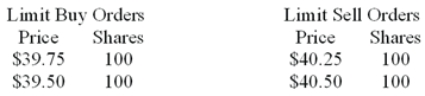
(Multiple Choice)
4.7/5 (88)
(88) As a type of secondary capital raising, ________ can be conducted very quickly and has very few regulatory requirements.
(Multiple Choice)
4.9/5 (78)
(78) You sell short 300 shares of Microsoft which are currently selling at $30 per share. You post the 50% margin required on the short sale. If you earn no interest on the funds in your margin account what will be your rate of return after one year if Microsoft is selling at $27?
(Ignore any dividends)
(Multiple Choice)
4.9/5 (79)
(79) A ________ is a long-term strategy for raising capital rather than a technique for raising capital quickly.
(Multiple Choice)
4.9/5 (74)
(74) The difference between the price at which a dealer is willing to buy, and the price at which a dealer is willing to sell, is called the ________.
(Multiple Choice)
4.9/5 (84)
(84) An investor puts up $5 000 but borrows an equal amount of money from their broker to double the amount invested to $10 000. The broker charges 7% on the loan. The shares were originally purchased at $25 per share and in one year the investor sells the shares for $28. The investor's rate of return was ________.
(Multiple Choice)
4.9/5 (69)
(69) 
Filters
- Essay(0)
- Multiple Choice(0)
- Short Answer(0)
- True False(0)
- Matching(0)