



 Chat with AI
Exam 9: Bond Prices and Yields

Exam 1: Investments: Background and Issues55 Questions
Exam 2: Asset Classes and Financial Instruments59 Questions
Exam 3: Securities Markets60 Questions
Exam 4: Managed Funds and Other Investment Companies60 Questions
Exam 5: Risk and Return: Past and Prologue58 Questions
Exam 6: Efficient Diversification56 Questions
Exam 7: Capital Pricing and Arbitrage Pricing Theory59 Questions
Exam 8: The Efficient Market Hypothesis and Behavioral Finance60 Questions
Exam 9: Bond Prices and Yields58 Questions
Exam 10: Managing Bond Portfolios60 Questions
Exam 11: Equity Valuation60 Questions
Exam 12: Macroeconomic and Industry Analysis58 Questions
Exam 13: Financial Statement Analysis55 Questions
Exam 14: Options and Risk Management60 Questions
Exam 15: Futures and Risk Management60 Questions
Exam 16: Investors and the Investment Process60 Questions
Exam 17: Hedge Funds60 Questions
Exam 18: Portfolio Performance Evaluation54 Questions
Select questions type


Consider two bonds, A and B. Both bonds presently are selling at their par value of $1 000. Each pay interest of $120 annually. Bond A will mature in 5 years while Bond B will mature in 6 years. If the yields to maturity on the two bonds change from 12% to 14%, ________.
(Multiple Choice)
4.9/5  (65)
(65) Consider a newly issued TIPS bond with a three year maturity, par value of $1000, and a coupon rate of 5%. Assume annual coupon payments. 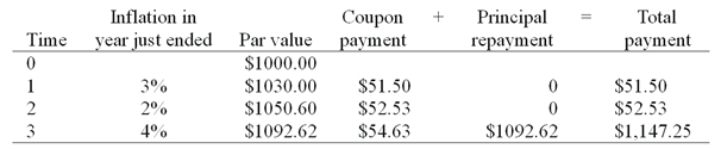 What is the nominal rate of return on the TIPS bond in the first year?
 (Multiple Choice)
4.9/5 (75)
(75) An investor pays $989.40 for a bond. The bond has an annual coupon rate of 4.8%. What is the current yield on this bond?
(Multiple Choice)
4.9/5 (89)
(89) A 1% decline in yield will have the least effect on the price of the bond with a ________.
(Multiple Choice)
4.8/5 (92)
(92) A bond has a 5% coupon rate. The coupon is paid semi-annually and the last coupon was paid 35 days ago. If the bond has a par value of $1 000, what is the accrued interest?
(Multiple Choice)
4.8/5 (77)
(77) A coupon bond which pays interest of 4% annually, has a par value of $1 000, matures in 5 years, and is selling today at $785. The actual yield to maturity on this bond is ________.
(Multiple Choice)
4.8/5 (72)
(72) The bonds of Elbow Grease Dishwashing Company have received a rating of 'C' by Moody's. The 'C' rating indicates the bonds are ________.
(Multiple Choice)
4.8/5 (73)
(73) Yields on tax-exempt bonds are typically ________ yields on corporate bonds of similar risk and time to maturity.
(Multiple Choice)
4.8/5 (80)
(80) Which of the following bonds would most likely sell at the lowest yield?
(Multiple Choice)
4.8/5 (64)
(64) You purchased a 5-year annual interest coupon bond one year ago. Its coupon interest rate was 6% and its par value was $1 000. At the time you purchased the bond, the yield to maturity was 4%. If you sold the bond after receiving the first interest payment and the bond's yield to maturity had changed to 3%, your annual total rate of return on holding the bond for that year would have been approximately ________.
(Multiple Choice)
4.7/5 (93)
(93) Everything else equal, ________ bonds will require a higher promised YTM than ________ bonds.
(Multiple Choice)
4.8/5 (78)
(78) A coupon bond which pays interest of $60 annually, has a par value of $1 000, matures in 5 years, and is selling today at a $75.25 discount from par value. The current yield on this bond is ________.
(Multiple Choice)
4.8/5 (85)
(85) Assuming semiannual compounding, a 20-year zero coupon bond with a par value of $1 000 and a required return of 12% would be priced at ________.
(Multiple Choice)
4.8/5 (93)
(93) A ________ bond is a bond where the issuer has an option to retire the bond before maturity at a specific price after a specific date.
(Multiple Choice)
4.8/5 (90)
(90) A zero-coupon bond has a yield to maturity of 5% and a par value of $1 000. If the bond matures in 16 years, it should sell for a price of ________ today.
(Multiple Choice)
4.8/5 (73)
(73) A ________ bond is a bond where the bondholder has the right to cash in the bond before maturity at a specific price after a specific date.
(Multiple Choice)
5.0/5 (83)
(83) Consider the following $1 000 par value zero-coupon bonds: 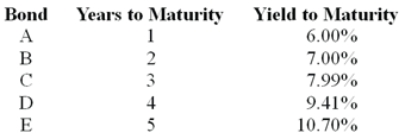 The expected one-year interest rate four years from now should be ________.
 (Multiple Choice)
4.9/5 (72)
(72) 
Filters
- Essay(0)
- Multiple Choice(0)
- Short Answer(0)
- True False(0)
- Matching(0)