



 Chat with AI
Exam 2: Project Selection and Prioritization

Exam 1: Introduction to Project Management49 Questions
Exam 2: Project Selection and Prioritization52 Questions
Exam 3: Organizational Capability: Structure,Culture and Roles50 Questions
Exam 4: Chartering Projects39 Questions
Exam 5: Stakeholder Analysis and Communication Planning46 Questions
Exam 6: Defining Scope and Constructing Work Breakdown Structures WBS44 Questions
Exam 7: Scheduling Activities56 Questions
Exam 8: Resourcing Projects45 Questions
Exam 9: Budgeting Projects46 Questions
Exam 10: Project Risk Planning45 Questions
Exam 11: Project Quality Planning and Project Kick-Off45 Questions
Exam 12: Project Supply Chain Management45 Questions
Exam 13: Leading and Managing Project Teams46 Questions
Exam 14: Determining Project Progress and Results44 Questions
Exam 15: Finishing the Project30 Questions
Select questions type


A project portfolio is a useful storage medium that enables the project manager to consolidate all project information in a single,convenient location.
(True/False)
4.7/5  (82)
(82) Which of the following is NOT a typical source selection criterion that an organization would use to evaluate potential contractors?
(Multiple Choice)
4.9/5 (81)
(81) Payback period models do not consider the amount of profit that may be realized after the costs are paid.
(True/False)
4.9/5 (78)
(78) Once selected projects have been prioritized,it is time to assign resources to projects based on their order of priority.Resources could include all of the following EXCEPT:
(Multiple Choice)
4.9/5 (72)
(72) Strategic analysis is an important first step in setting strategic direction.
(True/False)
4.9/5 (90)
(90) The vision should present a positive,inspiring and vivid description of the organization as it currently exists.
(True/False)
4.8/5 (67)
(67) In addition to considering financial factors,project selection should often consider how well each project fits with the organization's strategic planning.
(True/False)
4.8/5 (68)
(68) Strategic objectives describe both long and short term results that are desired,along with measures to determine their achievement.
(True/False)
4.8/5 (78)
(78) All of the following factors influence the opportunities and threats an organization must consider when performing a strategic analysis EXCEPT:
(Multiple Choice)
4.8/5 (94)
(94) If an organization does not have the right capabilities,a project may be too difficult to complete successfully.
(True/False)
4.8/5 (84)
(84) All of the following represent appropriate sources to identify new potential projects EXCEPT:
(Multiple Choice)
4.7/5 (77)
(77) The organization's leadership should establish the strategic objectives to set the stage for the strategic analysis.
(True/False)
4.7/5 (77)
(77) Strategic objectives should focus decisions regarding which projects to select and how to prioritize them.
(True/False)
4.9/5 (95)
(95) The prioritization of projects in a portfolio should consider whether the demands of performing each project are clearly understood.
(True/False)
5.0/5 (82)
(82) Describe the relationship between the strategic planning process and portfolio management in an organization.
(Essay)
4.8/5 (92)
(92) Portfolios deal with all of an organization's projects,while programs deal with:
(Multiple Choice)
4.9/5 (91)
(91) Figure 2-1 Project Selection and Prioritization Matrix
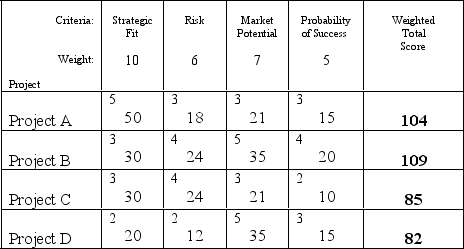 -Based on the information provided in Figure 2-1,which project is least attractive based on the strategic fit?
 (Multiple Choice)
4.9/5 (78)
(78) Projects tend to be the primary method for implementing many objectives.
(True/False)
4.8/5 (80)
(80) The internal part of strategic analysis considers opportunities and threats posed by competitors,suppliers and regulatory agencies among others.
(True/False)
4.8/5 (72)
(72) The document that describes why the project is needed,and may include estimated costs and benefits,is called a:
(Multiple Choice)
4.8/5 (85)
(85) 
Filters
- Essay(0)
- Multiple Choice(0)
- Short Answer(0)
- True False(0)
- Matching(0)