



 Chat with AI
Exam 21: The Theory of Consumer Choice

Exam 1: Ten Principles of Economics439 Questions
Exam 2: Thinking Like an Economist617 Questions
Exam 3: Interdependence and the Gains From Trade527 Questions
Exam 4: The Market Forces of Supply and Demand698 Questions
Exam 5: Elasticity and Its Application595 Questions
Exam 6: Supply, Demand, and Government Policies644 Questions
Exam 7: Consumers, Producers, and the Efficiency of Markets549 Questions
Exam 8: Application: The Costs of Taxation511 Questions
Exam 9: Application: International Trade493 Questions
Exam 10: Externalities524 Questions
Exam 11: Public Goods and Common Resources433 Questions
Exam 12: The Design of the Tax System551 Questions
Exam 13: The Costs of Production420 Questions
Exam 14: Firms in Competitive Markets543 Questions
Exam 15: Monopoly637 Questions
Exam 16: Monopolistic Competition587 Questions
Exam 17: Oligopoly496 Questions
Exam 18: The Markets for the Factors of Production564 Questions
Exam 19: Earnings and Discrimination490 Questions
Exam 20: Income Inequality and Poverty457 Questions
Exam 21: The Theory of Consumer Choice440 Questions
Exam 22: Frontiers of Microeconomics441 Questions
Select questions type


Just as the theory of the competitive firm provides a more complete understanding of supply, the theory of consumer choice provides a more complete understanding of
(Multiple Choice)
4.9/5  (67)
(67) Figure 21-18  -Refer to Figure 21-18. Bundle B represents a point where
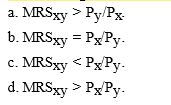
-Refer to Figure 21-18. Bundle B represents a point where
(Multiple Choice)
4.9/5 (83)
(83) Suppose a consumer spends her income on two goods: music CDs and DVDs. The consumer has $200 to allocate to these two goods, the price of a CD is $10, and the price of a DVD is $20. What is the maximum number of CDs the consumer can purchase?
(Multiple Choice)
4.8/5 (86)
(86) Which effect of a price change moves the consumer along the same indifference curve to a point with a new marginal rate of substitution?
(Multiple Choice)
4.9/5 (90)
(90) Assume that a college student purchases only Ramen noodles and textbooks. If Ramen noodles are an inferior good and textbooks are a normal good, then the substitution effect associated with a decrease in the price of a textbook, by itself, will result in
(Multiple Choice)
4.9/5 (85)
(85) The marginal rate of substitution is the slope of the budget constraint.
(True/False)
4.8/5 (83)
(83) Samantha is maximizing total utility while consuming food and clothing. Her marginal utility from food is 50, and her marginal utility from clothing is 25. If clothing is priced at $10 per unit, the price of food per unit must be
(Multiple Choice)
4.8/5 (74)
(74) The labor supply curve may have a backward-bending portion if, at higher wages, the income effect is
(Multiple Choice)
4.9/5 (94)
(94) When indifference curves are downward sloping, the marginal rate of substitution is usually constant.
(True/False)
4.9/5 (82)
(82) A decrease in the price of DVD players leads consumers to buy more DVD players. From this information we can conclude that DVD players
(Multiple Choice)
4.9/5 (82)
(82) Figure 21-7 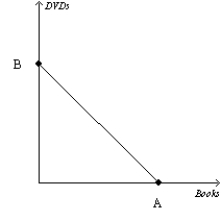 -Refer to Figure 21-7. Suppose a consumer has $200 in income, the price of a book is $5, and the price of a DVD is $10. What is the value of B?
 (Multiple Choice)
4.7/5 (96)
(96) The consumer's optimal choice is the one in which the marginal utility per dollar spent on good X is
(Multiple Choice)
4.9/5 (73)
(73) Graphically demonstrate the conditions associated with a consumer optimum. Carefully label all curves and axes.
(Essay)
4.8/5 (80)
(80) Consider the indifference curve map and budget constraint for two goods, X and Y. Suppose the good on the horizontal axis, X, is normal. When the price of X increases, the substitution effect
(Multiple Choice)
4.8/5 (82)
(82) Because people are more willing to trade away goods that they have in abundance and less willing to trade away goods of which they have little, indifference curves are ___________.
(Short Answer)
4.9/5 (84)
(84) If a consumer consumes two goods, X and Y, and has indifference curves that are bowed inward, the consumer's optional choice occurs when
(Multiple Choice)
4.9/5 (81)
(81) When a consumer experiences a price decrease for an inferior good, if the income effect is
(Multiple Choice)
4.8/5 (81)
(81) A budget constraint illustrates bundles that a consumer prefers equally, while an indifference curve illustrates bundles that are equally affordable to a consumer.
(True/False)
4.8/5 (75)
(75) 
Filters
- Essay(0)
- Multiple Choice(0)
- Short Answer(0)
- True False(0)
- Matching(0)