



 Chat with AI
Exam 21: The Theory of Consumer Choice

Exam 1: Ten Principles of Economics439 Questions
Exam 2: Thinking Like an Economist617 Questions
Exam 3: Interdependence and the Gains From Trade527 Questions
Exam 4: The Market Forces of Supply and Demand698 Questions
Exam 5: Elasticity and Its Application595 Questions
Exam 6: Supply, Demand, and Government Policies644 Questions
Exam 7: Consumers, Producers, and the Efficiency of Markets549 Questions
Exam 8: Application: The Costs of Taxation511 Questions
Exam 9: Application: International Trade493 Questions
Exam 10: Externalities524 Questions
Exam 11: Public Goods and Common Resources433 Questions
Exam 12: The Design of the Tax System551 Questions
Exam 13: The Costs of Production420 Questions
Exam 14: Firms in Competitive Markets543 Questions
Exam 15: Monopoly637 Questions
Exam 16: Monopolistic Competition587 Questions
Exam 17: Oligopoly496 Questions
Exam 18: The Markets for the Factors of Production564 Questions
Exam 19: Earnings and Discrimination490 Questions
Exam 20: Income Inequality and Poverty457 Questions
Exam 21: The Theory of Consumer Choice440 Questions
Exam 22: Frontiers of Microeconomics441 Questions
Select questions type


The substitution effect of a price change is depicted by a
(Multiple Choice)
4.9/5  (78)
(78) A consumer has preferences over consumption and leisure, both of which are normal goods. When the wage decreases, the consumer chooses to consume less leisure. For this consumer the labor supply curve will
(Multiple Choice)
4.8/5 (76)
(76) Figure 21-30
The graph shows two budget constraints for a consumer. 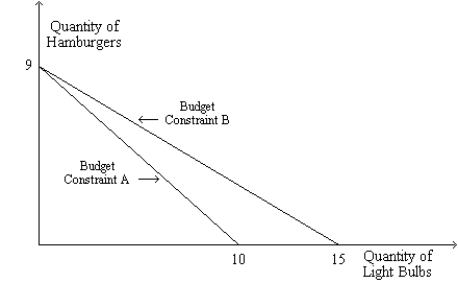 -Refer to Figure 21-30. Suppose the price of a hamburger is $10 and Budget Constraint A applies. What is the consumer's income? What is the price of a light bulb?
 (Essay)
4.9/5 (91)
(91) Figure 21-9 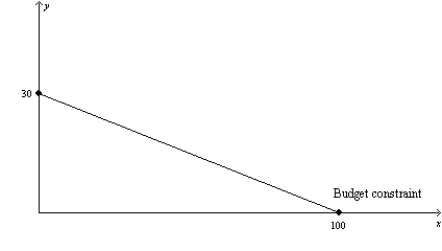 -Refer to Figure 21-9. If the price of good X is $15, what is the price of good Y?
 (Multiple Choice)
4.9/5 (75)
(75) An optimizing consumer will select the consumption bundle in which the marginal rate of substitution
(Multiple Choice)
4.8/5 (79)
(79) A typical consumer consumes both coffee and donuts. After the consumer's income decreases, the consumer consumes more coffee but fewer donuts than before. For this consumer, donuts are a normal good, but coffee is an inferior good.
(True/False)
4.9/5 (74)
(74) Figure 21-22 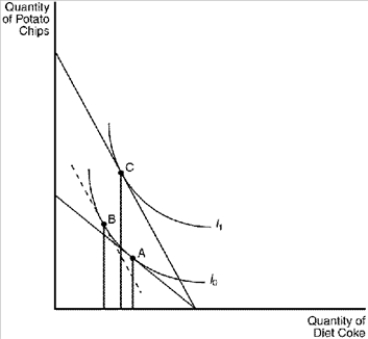 -Refer to Figure 21-22. The shift from point B to point C in the figure is due to the
 (Multiple Choice)
4.7/5 (87)
(87) Katie wins $3 million in her state's lottery. If Katie drastically reduces the number of hours she works after she wins the money, we can infer that the income effect is larger than the substitution effect for her.
(True/False)
4.8/5 (70)
(70) Figure 21-32
The figure shows three indifference curves and a budget constraint for a consumer named Hannah. When young, Hannah works and earns income. When old, she is retired and earns no income. 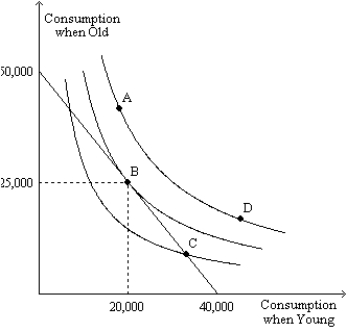 -Refer to Figure 21-32. From the figure we can determine how much income Hannah earns when young and we can determine the interest rate. Could the interest rate rise to a level at which Hannah could afford to be at point D?
 (Essay)
4.9/5 (83)
(83) The slope of the budget constraint reveals the relative price of good X compared to good Y.
(True/False)
4.9/5 (85)
(85) A family on a trip budgets $800 for meals and hotel accommodations. Suppose the price of a meal is $40. In addition, suppose the family could afford a total of 8 nights in a hotel if they don't buy any meals. How many meals could the family afford if they gave up two nights in the hotel?
(Multiple Choice)
4.9/5 (82)
(82) When economists describe preferences, they often use the concept of
(Multiple Choice)
4.9/5 (80)
(80) Evaluate the following statement, "Warren Buffet is the second richest person in the world. He doesn't face any constraint on his ability to purchase commodities he wants."
(Essay)
5.0/5 (75)
(75) Figure 21-24
The figure shows three indifference curves and a budget constraint for a certain consumer named Steve. 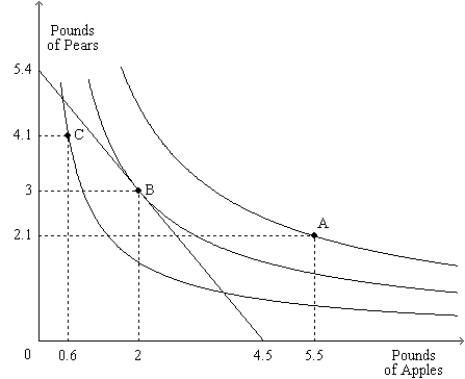 -Refer to Figure 21-24. At his optimum, Steve is willing to give up about
 (Multiple Choice)
4.9/5 (77)
(77) When considering household savings, the relative price between consuming when young and consuming when old is the
(Multiple Choice)
4.7/5 (81)
(81) Figure 21-4
In each case, the budget constraint moves from BC-1 to BC-2.
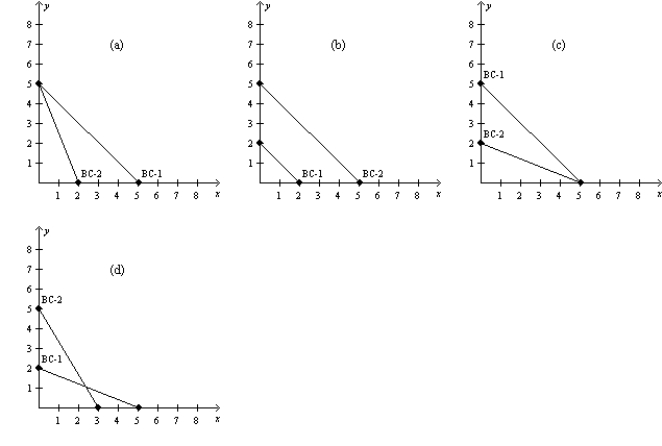 -Refer to Figure 21-4. Which of the graphs in the figure could reflect a decrease in income?
 (Multiple Choice)
4.9/5 (78)
(78) Figure 21-24
The figure shows three indifference curves and a budget constraint for a certain consumer named Steve.
-Refer to Figure 21-24. Suppose the price of pears, the price of apples, and Steve's income remain constant, and Steve moves from point B to point C. In doing so, Steve
-Refer to Figure 21-24. Suppose the price of pears, the price of apples, and Steve's income remain constant, and Steve moves from point B to point C. In doing so, Steve (Multiple Choice)
4.9/5 (81)
(81) 
Filters
- Essay(0)
- Multiple Choice(0)
- Short Answer(0)
- True False(0)
- Matching(0)