



 Chat with AI
Exam 13: Monopoly and Antitrust

Exam 1: The Role and Method of Economics198 Questions
Exam 2: Economics: Eight Powerful Ideas197 Questions
Exam 3: Scarcity, Trade-Offs, and Production Possibilities189 Questions
Exam 4: Demand, Supply, and Market Equilibrium240 Questions
Exam 5: Markets in Motion and Price Controls228 Questions
Exam 6: Elasticities206 Questions
Exam 7: Market Efficiency and Welfare136 Questions
Exam 8: Market Failure215 Questions
Exam 9: Public Finance and Public Choice64 Questions
Exam 10: Consumer Choice Theory149 Questions
Exam 11: The Firm: Production and Costs198 Questions
Exam 12: Firms in Perfectly Competitive Markets207 Questions
Exam 13: Monopoly and Antitrust189 Questions
Exam 14: Monopolistic Competition and Product Differentiation159 Questions
Exam 15: Oligopoly and Strategic Behavior146 Questions
Exam 16: The Markets for Labor, Capital, and Land177 Questions
Exam 17: Income, Poverty, and Health Care138 Questions
Exam 18: Introduction to Macroeconomics: Unemployment, Inflation, and Economic Fluctuations171 Questions
Exam 19: Measuring Economic Performance147 Questions
Exam 20: Economic Growth in the Global Economy127 Questions
Exam 21: Financial Markets, Saving, and Investment65 Questions
Exam 22: Aggregate Demand and Aggregate Supply163 Questions
Exam 23: The Aggregate Expenditure Model69 Questions
Exam 25: Monetary Institutions182 Questions
Exam 26: The Federal Reserve System and Monetary Policy147 Questions
Exam 27: Issues in Macroeconomic Theory and Policy130 Questions
Exam 28: International Trade182 Questions
Exam 29: International Finance138 Questions
Select questions type


Exhibit 13-2  Refer to Exhibit 13-2.The region bounded by P*ABC represents:
 (Multiple Choice)
4.8/5  (84)
(84) What is the maximum amount of profit that the firm below could generate? 
(Multiple Choice)
4.9/5 (76)
(76) If a firm seeks to maximize total revenue,it should produce the quantity where:
(Multiple Choice)
4.9/5 (84)
(84) A monopolist can sell 6 units per day at $8 per unit,or 7 units per day at $7 per unit.Its marginal revenue for the seventh unit of output is:
(Multiple Choice)
4.8/5 (77)
(77) Which of the following types of firms practices price discrimination?
(Multiple Choice)
5.0/5 (80)
(80) In perfect price discrimination,which of the following are reduced to zero?
(Multiple Choice)
4.8/5 (73)
(73) Exhibit 13-3 A monopoly producer of canned iced coffee produces with the following costs:
 Consumers demand iced coffee according to the following demand schedule:
 Refer to Exhibit 13-3.At the profit-maximizing level of output,the firm's profits equal:
Consumers demand iced coffee according to the following demand schedule:
Refer to Exhibit 13-3.At the profit-maximizing level of output,the firm's profits equal: (Multiple Choice)
4.9/5 (76)
(76) The U.S.Postal Service historically has had a monopoly over the market for the delivery of first-class letters in the United States.
(True/False)
4.9/5 (79)
(79) Exhibit 13-6 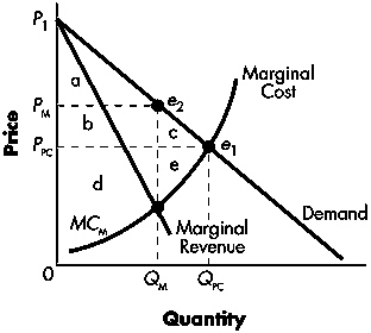 Refer to Exhibit 13-6.In single price monopoly,deadweight loss is area:
 (Multiple Choice)
4.9/5 (81)
(81) Average cost regulation of a natural monopoly does not involve:
(Multiple Choice)
4.9/5 (87)
(87) A market structure in which only one firm survives because of economies of scale:
(Multiple Choice)
4.9/5 (81)
(81) Exhibit 13-4 The following diagram contains information on cost and revenue curves facing a regulated monopoly. 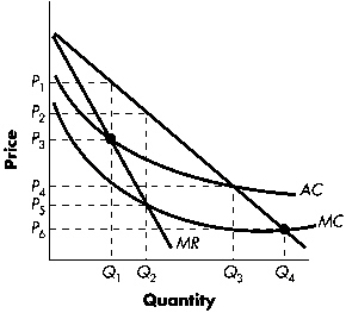 Refer to Exhibit 13-4.If the government is able to regulate the monopolist using marginal-cost pricing,what price and output combinations are expected to result?
 (Multiple Choice)
4.9/5 (83)
(83) Exhibit 13-6 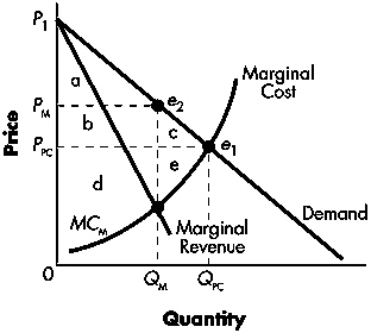 Refer to Exhibit 13-6.In perfect price discrimination,total welfare is area:
 (Multiple Choice)
4.9/5 (79)
(79) At a given output level,a monopolist earns a profit only if:
(Multiple Choice)
4.7/5 (79)
(79) Does the monopolist have an incentive to reduce cost under average cost pricing? How can this be overcome?
(Essay)
4.9/5 (85)
(85) The DeBeers Diamond Company,which owns most of the South African diamond production,has market power over the diamond trade.This market power was obtained through:
(Multiple Choice)
4.9/5 (86)
(86) Exhibit 13-6 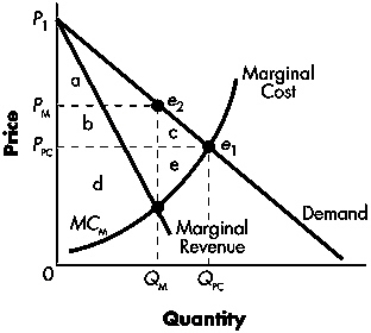 Refer to Exhibit 13-6.In perfect price discrimination,deadweight loss is area:
 (Multiple Choice)
4.8/5 (81)
(81) Ceteris paribus,in which of the following cases would we expect economic profits to be greatest?
(Multiple Choice)
4.8/5 (89)
(89) 
Filters
- Essay(0)
- Multiple Choice(0)
- Short Answer(0)
- True False(0)
- Matching(0)