



 Chat with AI
Exam 3: Scarcity, Trade-Offs, and Production Possibilities

Exam 1: The Role and Method of Economics198 Questions
Exam 2: Economics: Eight Powerful Ideas197 Questions
Exam 3: Scarcity, Trade-Offs, and Production Possibilities189 Questions
Exam 4: Demand, Supply, and Market Equilibrium240 Questions
Exam 5: Markets in Motion and Price Controls228 Questions
Exam 6: Elasticities206 Questions
Exam 7: Market Efficiency and Welfare136 Questions
Exam 8: Market Failure215 Questions
Exam 9: Public Finance and Public Choice64 Questions
Exam 10: Consumer Choice Theory149 Questions
Exam 11: The Firm: Production and Costs198 Questions
Exam 12: Firms in Perfectly Competitive Markets207 Questions
Exam 13: Monopoly and Antitrust189 Questions
Exam 14: Monopolistic Competition and Product Differentiation159 Questions
Exam 15: Oligopoly and Strategic Behavior146 Questions
Exam 16: The Markets for Labor, Capital, and Land177 Questions
Exam 17: Income, Poverty, and Health Care138 Questions
Exam 18: Introduction to Macroeconomics: Unemployment, Inflation, and Economic Fluctuations171 Questions
Exam 19: Measuring Economic Performance147 Questions
Exam 20: Economic Growth in the Global Economy127 Questions
Exam 21: Financial Markets, Saving, and Investment65 Questions
Exam 22: Aggregate Demand and Aggregate Supply163 Questions
Exam 23: The Aggregate Expenditure Model69 Questions
Exam 25: Monetary Institutions182 Questions
Exam 26: The Federal Reserve System and Monetary Policy147 Questions
Exam 27: Issues in Macroeconomic Theory and Policy130 Questions
Exam 28: International Trade182 Questions
Exam 29: International Finance138 Questions
Select questions type


Which of the following concepts are illustrated by the production possibilities curve?

Free
(Multiple Choice)
4.7/5  (95)
(95) Correct Answer: Verified
D
An economist defines efficiency as:
Free
(Multiple Choice)
4.8/5 (97)
(97) Correct Answer:Verified
VerifiedA
The economic system of which of the following countries can be treated as an example of a command economy?
Free
(Multiple Choice)
4.7/5 (79)
(79) Correct Answer:Verified
VerifiedD
Exhibit 3-7 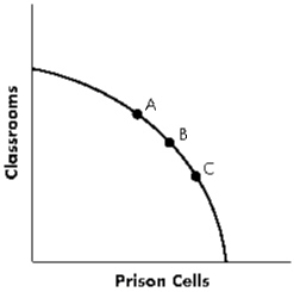 Refer to Exhibit 3-7.If the economy moves from Point C to Point A in the diagram:
 (Multiple Choice)
5.0/5 (70)
(70) Which of the following is not one of the fundamental economic questions all societies must face?
(Multiple Choice)
4.8/5 (89)
(89) Which of the following is considered to be the best method of production?
(Multiple Choice)
4.8/5 (73)
(73) How can we measure the opportunity cost of producing a good? Using a bowed outward production possibilities curve between ice cream and hammers,identify graphically the opportunity cost of obtaining an additional hammer.
(Essay)
4.9/5 (87)
(87) Exhibit 3-1  Refer to Exhibit 3-1.In the circular flow model:
 (Multiple Choice)
4.7/5 (79)
(79) Which of the following is likely to shift the production possibilities curve outward?
(Multiple Choice)
4.9/5 (70)
(70) Exhibit 3-3  Refer to Exhibit 3-3.A movement from Point C to Point B:
 (Multiple Choice)
4.8/5 (77)
(77) Exhibit 3-15 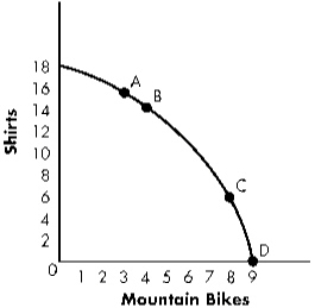 Refer to Exhibit 3-15.Moving from Point C to Point D,what is the opportunity cost of producing a mountain bike?
 (Short Answer)
4.9/5 (80)
(80) Exhibit 3-4  Refer to Exhibit 3-4.Currently,Point ____ is impossible to achieve.
 (Multiple Choice)
4.9/5 (85)
(85) Exhibit 3-6  Refer to Exhibit 3-6.In the diagram,Point D is:
 (Multiple Choice)
4.8/5 (71)
(71) Given its production possibilities curve,the optimal combination of outputs for a society:
(Multiple Choice)
4.9/5 (82)
(82) Exhibit 3-15 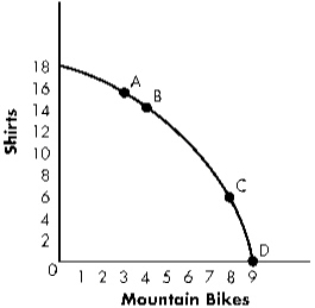 Refer to Exhibit 3-15.Why is the opportunity cost of producing a mountain bike different when moving from Point A to Point B than when moving from Point C to Point D along the production possibilities curve?
 (Essay)
4.9/5 (82)
(82) An economy may be operating at a point inside the production possibilities curve if:
(Multiple Choice)
5.0/5 (73)
(73) 
Filters
- Essay(0)
- Multiple Choice(0)
- Short Answer(0)
- True False(0)
- Matching(0)