



 Chat with AI
Exam 3: Scarcity, Trade-Offs, and Production Possibilities

Exam 1: The Role and Method of Economics198 Questions
Exam 2: Economics: Eight Powerful Ideas197 Questions
Exam 3: Scarcity, Trade-Offs, and Production Possibilities189 Questions
Exam 4: Demand, Supply, and Market Equilibrium240 Questions
Exam 5: Markets in Motion and Price Controls228 Questions
Exam 6: Elasticities206 Questions
Exam 7: Market Efficiency and Welfare136 Questions
Exam 8: Market Failure215 Questions
Exam 9: Public Finance and Public Choice64 Questions
Exam 10: Consumer Choice Theory149 Questions
Exam 11: The Firm: Production and Costs198 Questions
Exam 12: Firms in Perfectly Competitive Markets207 Questions
Exam 13: Monopoly and Antitrust189 Questions
Exam 14: Monopolistic Competition and Product Differentiation159 Questions
Exam 15: Oligopoly and Strategic Behavior146 Questions
Exam 16: The Markets for Labor, Capital, and Land177 Questions
Exam 17: Income, Poverty, and Health Care138 Questions
Exam 18: Introduction to Macroeconomics: Unemployment, Inflation, and Economic Fluctuations171 Questions
Exam 19: Measuring Economic Performance147 Questions
Exam 20: Economic Growth in the Global Economy127 Questions
Exam 21: Financial Markets, Saving, and Investment65 Questions
Exam 22: Aggregate Demand and Aggregate Supply163 Questions
Exam 23: The Aggregate Expenditure Model69 Questions
Exam 25: Monetary Institutions182 Questions
Exam 26: The Federal Reserve System and Monetary Policy147 Questions
Exam 27: Issues in Macroeconomic Theory and Policy130 Questions
Exam 28: International Trade182 Questions
Exam 29: International Finance138 Questions
Select questions type


Exhibit 3-2  Refer to Exhibit 3-2.In the circular flow diagram,payments for goods and services:
 (Multiple Choice)
5.0/5  (76)
(76) Exhibit 3-4  Refer to Exhibit 3-4.Based on the production possibilities curve above,which of the following points are inefficient?
 (Multiple Choice)
4.9/5 (79)
(79) The use of large amounts of labor relative to capital in an economy indicates:
(Multiple Choice)
4.9/5 (69)
(69) Suppose Freeland produces few consumption goods and many investment goods while Liberty Nation produces few investment goods and many consumption goods.Other things equal,you would expect
(Multiple Choice)
4.7/5 (96)
(96) Which concept explains how individual consumers in market economies determine what is to be produced?
(Multiple Choice)
4.7/5 (70)
(70) Other things being constant,an economy must give up some consumer goods and services today to produce more capital goods in order to grow.
(True/False)
4.9/5 (79)
(79) An increase in available resources will tend to cause a society's production possibilities curve to shift inward.
(True/False)
4.8/5 (82)
(82) Which of the following is not a resource exchanged in the factor markets?
(Multiple Choice)
4.9/5 (78)
(78) Exhibit 3-10 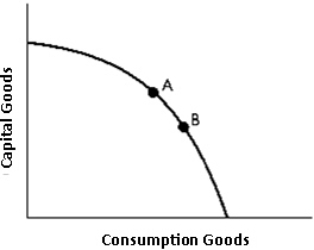 Refer to Exhibit 3-10.Societies choose between the level of consumption goods and capital goods.With reference to the diagram,if a society moves from Point B to Point A:
 (Multiple Choice)
4.9/5 (80)
(80) The opportunity cost of a particular good tends to increase with its rate of output because some resources cannot be easily adapted from the production of one good or service to another.
(True/False)
4.8/5 (89)
(89) In a market operating along the production possibilities curve,which of the following is inevitable if the production of one of the goods is increased?
(Multiple Choice)
4.9/5 (76)
(76) An economy is producing two goods,ice cream and cookies,and is currently operating efficiently.This economy can produce more cookies if:
(Multiple Choice)
4.8/5 (77)
(77) When collective decision making is utilized to resolve economic questions regarding the allocation of resources,then:
(Multiple Choice)
4.9/5 (96)
(96) Explain how each of the following could discourage economic growth:
a.The government closes all of the schools so that more people will be available for work.
b.The country fears military invasion and spends half of its income on military goods.
(Essay)
4.8/5 (81)
(81) An increase in the unemployment rate from 15 percent to 20 percent might be illustrated as:
(Multiple Choice)
4.9/5 (85)
(85) Workers in the 1800s building railroads by hand was an example of a(n)____ intensive form of production.
(Multiple Choice)
4.8/5 (81)
(81) Draw a picture of a production possibilities curve.Identify each axis as measuring either guns or butter.Select and label Point A,which is beyond the economy's ability to produce; Point B,which represents an inefficient level of production; Point C,an efficient combination of output in which more guns are produced than units of butter; and Point D,an efficient production point in which more units of butter are produced than guns.Be sure to label each clearly.
(Essay)
4.9/5 (77)
(77) Which of the following is most limited in scope under a pure market economy?
(Multiple Choice)
4.7/5 (93)
(93) A system of economic organization in which the ownership and control of productive capital assets rests with the state and resources are allocated through central planning and political decision making is called:
(Multiple Choice)
4.8/5 (80)
(80) 
Filters
- Essay(0)
- Multiple Choice(0)
- Short Answer(0)
- True False(0)
- Matching(0)