



 Chat with AI
Exam 3: Scarcity, Trade-Offs, and Production Possibilities

Exam 1: The Role and Method of Economics198 Questions
Exam 2: Economics: Eight Powerful Ideas197 Questions
Exam 3: Scarcity, Trade-Offs, and Production Possibilities189 Questions
Exam 4: Demand, Supply, and Market Equilibrium240 Questions
Exam 5: Markets in Motion and Price Controls228 Questions
Exam 6: Elasticities206 Questions
Exam 7: Market Efficiency and Welfare136 Questions
Exam 8: Market Failure215 Questions
Exam 9: Public Finance and Public Choice64 Questions
Exam 10: Consumer Choice Theory149 Questions
Exam 11: The Firm: Production and Costs198 Questions
Exam 12: Firms in Perfectly Competitive Markets207 Questions
Exam 13: Monopoly and Antitrust189 Questions
Exam 14: Monopolistic Competition and Product Differentiation159 Questions
Exam 15: Oligopoly and Strategic Behavior146 Questions
Exam 16: The Markets for Labor, Capital, and Land177 Questions
Exam 17: Income, Poverty, and Health Care138 Questions
Exam 18: Introduction to Macroeconomics: Unemployment, Inflation, and Economic Fluctuations171 Questions
Exam 19: Measuring Economic Performance147 Questions
Exam 20: Economic Growth in the Global Economy127 Questions
Exam 21: Financial Markets, Saving, and Investment65 Questions
Exam 22: Aggregate Demand and Aggregate Supply163 Questions
Exam 23: The Aggregate Expenditure Model69 Questions
Exam 25: Monetary Institutions182 Questions
Exam 26: The Federal Reserve System and Monetary Policy147 Questions
Exam 27: Issues in Macroeconomic Theory and Policy130 Questions
Exam 28: International Trade182 Questions
Exam 29: International Finance138 Questions
Select questions type


Exhibit 3-10 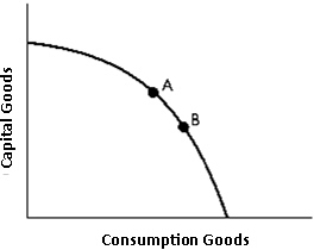 Refer to Exhibit 3-10.If Points A and B indicate consumption goods and capital goods for two different economies,other things held constant,which of the economies is likely to grow more rapidly?
 (Multiple Choice)
4.9/5  (71)
(71) A market economy answers the question "what" goods will be produced by focusing on
(Multiple Choice)
4.9/5 (87)
(87) Is increased capital spending the only way for an economy to expand its production possibilities curve?
(Multiple Choice)
4.9/5 (77)
(77) A production possibilities curve that is linear (a straight line):
(Multiple Choice)
4.8/5 (95)
(95) A production possibilities curve will be concave as opposed to straight line if
(Multiple Choice)
4.8/5 (86)
(86) The position of a country's production possibilities curve in the future will be affected by:
(Multiple Choice)
4.9/5 (62)
(62) Exhibit 3-4  Refer to Exhibit 3-4.Moving from Point ____ to Point ____ will result in an increase in the quantity of both capital and consumption goods produced this period.
 (Multiple Choice)
5.0/5 (77)
(77) A move from an abnormally high rate of unemployment toward a more typical level of unemployment would:
(Multiple Choice)
4.9/5 (78)
(78) Which of the following is the most accurate statement about a production possibilities curve?
(Multiple Choice)
4.9/5 (90)
(90) Along a production possibilities curve that is concave to the origin,the opportunity cost of production of the good on the horizontal axis ____ as we move down along the curve.
(Multiple Choice)
4.8/5 (81)
(81) Exhibit 3-4  Refer to Exhibit 3-4.Which point corresponds to an economy experiencing significant unemployment and/or producing inefficiently?
 (Multiple Choice)
4.9/5 (74)
(74) The production possibilities curve for an economy that experiences a constant opportunity cost of production is linear (a straight line).
(True/False)
4.8/5 (82)
(82) An increase in an economy's capital stock increases its future productive capacity.
(True/False)
4.9/5 (80)
(80) Excessive unemployment of resources is illustrated using a production possibilities curve by:
(Multiple Choice)
4.8/5 (92)
(92) Which of the following best distinguishes a "command economy" from a "market economy?"
(Multiple Choice)
4.7/5 (77)
(77) 
Filters
- Essay(0)
- Multiple Choice(0)
- Short Answer(0)
- True False(0)
- Matching(0)