



 Chat with AI
Exam 3: Scarcity, Trade-Offs, and Production Possibilities

Exam 1: The Role and Method of Economics198 Questions
Exam 2: Economics: Eight Powerful Ideas197 Questions
Exam 3: Scarcity, Trade-Offs, and Production Possibilities189 Questions
Exam 4: Demand, Supply, and Market Equilibrium240 Questions
Exam 5: Markets in Motion and Price Controls228 Questions
Exam 6: Elasticities206 Questions
Exam 7: Market Efficiency and Welfare136 Questions
Exam 8: Market Failure215 Questions
Exam 9: Public Finance and Public Choice64 Questions
Exam 10: Consumer Choice Theory149 Questions
Exam 11: The Firm: Production and Costs198 Questions
Exam 12: Firms in Perfectly Competitive Markets207 Questions
Exam 13: Monopoly and Antitrust189 Questions
Exam 14: Monopolistic Competition and Product Differentiation159 Questions
Exam 15: Oligopoly and Strategic Behavior146 Questions
Exam 16: The Markets for Labor, Capital, and Land177 Questions
Exam 17: Income, Poverty, and Health Care138 Questions
Exam 18: Introduction to Macroeconomics: Unemployment, Inflation, and Economic Fluctuations171 Questions
Exam 19: Measuring Economic Performance147 Questions
Exam 20: Economic Growth in the Global Economy127 Questions
Exam 21: Financial Markets, Saving, and Investment65 Questions
Exam 22: Aggregate Demand and Aggregate Supply163 Questions
Exam 23: The Aggregate Expenditure Model69 Questions
Exam 25: Monetary Institutions182 Questions
Exam 26: The Federal Reserve System and Monetary Policy147 Questions
Exam 27: Issues in Macroeconomic Theory and Policy130 Questions
Exam 28: International Trade182 Questions
Exam 29: International Finance138 Questions
Select questions type


Exhibit 3-7 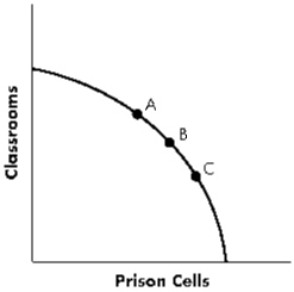 Refer to Exhibit 3-7.The diagram represents a tradeoff in an economy between prison cells and classrooms.Which position represents the choice to allocate the greatest amount of resources to producing classrooms?
 (Multiple Choice)
4.9/5  (84)
(84) It can be said that,ultimately,consumers are the driving force behind answers to the three basic economic questions faced by societies.Explain the consumer's role in providing these answers.
(Essay)
5.0/5 (66)
(66) A production possibilities curve that is "bowed out" or concave to the origin:
(Multiple Choice)
4.9/5 (75)
(75) An inefficient allocation of resources or unusually high unemployment:
(Multiple Choice)
4.7/5 (92)
(92) Capital accumulation causes the production possibilities curve to shift inward over time.
(True/False)
4.9/5 (75)
(75) Which of the following would not shift the production possibilities curve in an inward direction?
(Multiple Choice)
4.8/5 (87)
(87) Exhibit 3-7 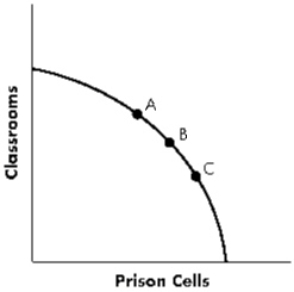 Refer to Exhibit 3-7.The diagram represents a tradeoff in an economy between prison cells and classrooms.Which position represents the choice to allocate the greatest amount of resources to producing prison cells?
 (Multiple Choice)
4.8/5 (90)
(90) A technological advance that increases the productivity of all inputs is best illustrated as:
(Multiple Choice)
5.0/5 (82)
(82) Which of the following would be likely to expand a production possibilities curve?
(Multiple Choice)
5.0/5 (80)
(80) Which of the following does not describe a pure market economy?
(Multiple Choice)
4.9/5 (79)
(79) Any output combination outside the production possibilities curve is attainable in the current period only if prices decrease.
(True/False)
4.9/5 (66)
(66) Exhibit 3-11 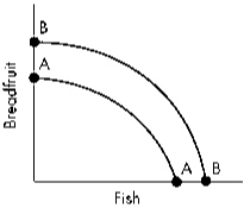 Refer to Exhibit 3-11.Which of the following best explains how the society producing breadfruit and fish depicted above could have moved from curve AA to curve BB?
 (Multiple Choice)
4.8/5 (88)
(88) Assume that,given factors of production and existing knowledge and technology,it is not possible to produce more of one good without foregoing the opportunity to produce some of another good.Economists would characterize this situation as:
(Multiple Choice)
4.8/5 (75)
(75) A devastating earthquake destroys ten percent of the population in California.As a result:
(Multiple Choice)
4.7/5 (74)
(74) Exhibit 3-3  Refer to Exhibit 3-3.Along the production possibilities curve,the most efficient point of production depicted is:
 (Multiple Choice)
4.9/5 (82)
(82) An increase in production of one good will have zero opportunity cost only if the economy initially existed at a point inside the production possibilities curve.
(True/False)
4.9/5 (83)
(83) Three economic questions must be determined in all societies.What are they?
(Multiple Choice)
4.9/5 (74)
(74) Exhibit 3-13 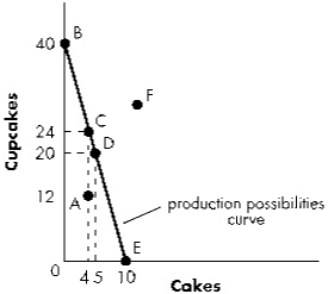 Refer to Exhibit 3-13.A movement from Point D to Point A:
 (Multiple Choice)
4.7/5 (86)
(86) A production possibilities curve is negatively sloped because:
(Multiple Choice)
4.7/5 (73)
(73) Which of the following is not a question that scarcity forces all societies to answer?
(Multiple Choice)
4.8/5 (90)
(90) 
Filters
- Essay(0)
- Multiple Choice(0)
- Short Answer(0)
- True False(0)
- Matching(0)