



 Chat with AI
Exam 13: Monopoly and Antitrust

Exam 1: The Role and Method of Economics198 Questions
Exam 2: Economics: Eight Powerful Ideas197 Questions
Exam 3: Scarcity, Trade-Offs, and Production Possibilities189 Questions
Exam 4: Demand, Supply, and Market Equilibrium240 Questions
Exam 5: Markets in Motion and Price Controls228 Questions
Exam 6: Elasticities206 Questions
Exam 7: Market Efficiency and Welfare136 Questions
Exam 8: Market Failure215 Questions
Exam 9: Public Finance and Public Choice64 Questions
Exam 10: Consumer Choice Theory149 Questions
Exam 11: The Firm: Production and Costs198 Questions
Exam 12: Firms in Perfectly Competitive Markets207 Questions
Exam 13: Monopoly and Antitrust189 Questions
Exam 14: Monopolistic Competition and Product Differentiation159 Questions
Exam 15: Oligopoly and Strategic Behavior146 Questions
Exam 16: The Markets for Labor, Capital, and Land177 Questions
Exam 17: Income, Poverty, and Health Care138 Questions
Exam 18: Introduction to Macroeconomics: Unemployment, Inflation, and Economic Fluctuations171 Questions
Exam 19: Measuring Economic Performance147 Questions
Exam 20: Economic Growth in the Global Economy127 Questions
Exam 21: Financial Markets, Saving, and Investment65 Questions
Exam 22: Aggregate Demand and Aggregate Supply163 Questions
Exam 23: The Aggregate Expenditure Model69 Questions
Exam 25: Monetary Institutions182 Questions
Exam 26: The Federal Reserve System and Monetary Policy147 Questions
Exam 27: Issues in Macroeconomic Theory and Policy130 Questions
Exam 28: International Trade182 Questions
Exam 29: International Finance138 Questions
Select questions type


A patent gives a firm a monopoly in the production of the patented good.While monopoly profits provide an incentive for firms to innovate,the monopoly power imposes a cost on consumers.Why do consumers bear a cost from that monopoly? Is the cost to consumers greater than the profits earned by the monopolist?
(Essay)
4.8/5  (65)
(65) Which of the following is not a necessary characteristic of a successful price discriminator?
(Multiple Choice)
4.9/5 (72)
(72) What was the first important law regulating monopoly that prohibited "restraint of trade"?
(Multiple Choice)
4.7/5 (71)
(71) Exhibit 13-7 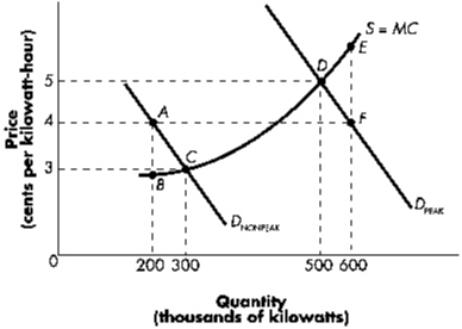 Refer to Exhibit 13-7.What price should be charged during peak periods to achieve efficiency?
 (Multiple Choice)
4.8/5 (92)
(92) Exhibit 13-1  Refer to Exhibit 13-1.The socially efficient level of output equals:
 (Multiple Choice)
4.9/5 (74)
(74) Control of a scarce resource or input can serve as an entry barrier.
(True/False)
4.9/5 (82)
(82) The monopolist,like the perfect competitor,maximizes profits at the output where marginal revenue equals marginal cost.
(True/False)
4.8/5 (73)
(73) When a single firm can produce output over the relevant range of demand more efficiently than two or more firms can,because of the existence of economies of scale,we have:
(Multiple Choice)
4.8/5 (72)
(72) If there are economies of scale throughout the relevant output range of production,which is false?
(Multiple Choice)
4.8/5 (78)
(78) A monopoly firm can sell as much output as it wants at whatever price it sets.
(True/False)
4.9/5 (83)
(83) Will all monopolistic firms always generate economic profits? Why or why not?
(Essay)
4.8/5 (90)
(90) Which of the following is the worst-case scenario for a consumer?
(Multiple Choice)
4.9/5 (77)
(77) In order to implement average cost pricing regulation,it is necessary to provide a natural monopolist with a subsidy equal to the economic loss.
(True/False)
5.0/5 (80)
(80) A natural gas monopoly currently sells 100 cubic feet of gas at $1.10 per cubic foot.To sell one more cubic foot,the natural gas company must lower the price of gas to $1.09.Which of the following best describes the marginal revenue of the 101st cubic foot of natural gas?
(Multiple Choice)
4.9/5 (80)
(80) If there is just one producer in an industry where the average total cost curve declines throughout the output range up to where it intersects the industry demand curve:
(Multiple Choice)
4.9/5 (85)
(85) 
Filters
- Essay(0)
- Multiple Choice(0)
- Short Answer(0)
- True False(0)
- Matching(0)