



 Chat with AI
Exam 13: Monopoly and Antitrust

Exam 1: The Role and Method of Economics198 Questions
Exam 2: Economics: Eight Powerful Ideas197 Questions
Exam 3: Scarcity, Trade-Offs, and Production Possibilities189 Questions
Exam 4: Demand, Supply, and Market Equilibrium240 Questions
Exam 5: Markets in Motion and Price Controls228 Questions
Exam 6: Elasticities206 Questions
Exam 7: Market Efficiency and Welfare136 Questions
Exam 8: Market Failure215 Questions
Exam 9: Public Finance and Public Choice64 Questions
Exam 10: Consumer Choice Theory149 Questions
Exam 11: The Firm: Production and Costs198 Questions
Exam 12: Firms in Perfectly Competitive Markets207 Questions
Exam 13: Monopoly and Antitrust189 Questions
Exam 14: Monopolistic Competition and Product Differentiation159 Questions
Exam 15: Oligopoly and Strategic Behavior146 Questions
Exam 16: The Markets for Labor, Capital, and Land177 Questions
Exam 17: Income, Poverty, and Health Care138 Questions
Exam 18: Introduction to Macroeconomics: Unemployment, Inflation, and Economic Fluctuations171 Questions
Exam 19: Measuring Economic Performance147 Questions
Exam 20: Economic Growth in the Global Economy127 Questions
Exam 21: Financial Markets, Saving, and Investment65 Questions
Exam 22: Aggregate Demand and Aggregate Supply163 Questions
Exam 23: The Aggregate Expenditure Model69 Questions
Exam 25: Monetary Institutions182 Questions
Exam 26: The Federal Reserve System and Monetary Policy147 Questions
Exam 27: Issues in Macroeconomic Theory and Policy130 Questions
Exam 28: International Trade182 Questions
Exam 29: International Finance138 Questions
Select questions type


Exhibit 13-1  Refer to Exhibit 13-1.Total cost when the monopolist is maximizing profits is indicated by area:
 (Multiple Choice)
4.8/5  (78)
(78) If a regulatory board wanted to make sure that a natural monopoly chose a price resulting in the efficient level of output,it should set a price equal to:
(Multiple Choice)
5.0/5 (85)
(85) Show Stoppers is a monopoly provider of ticket services for the concerts and sporting events and their current service charge is $10.00.In order to attract one more customer,they have to lower their service charge to $9.50.Show Stoppers' marginal revenue of this additional customer is:
(Multiple Choice)
4.9/5 (87)
(87) When a monopolist is able to sell its product at different prices to different customers,it is likely engaging in:
(Multiple Choice)
4.8/5 (79)
(79) Which of the following is true of successful price discriminators?
(Multiple Choice)
4.9/5 (81)
(81) Which of the following is not generally true about a profit-maximizing monopolist?
(Multiple Choice)
4.9/5 (71)
(71) If the demand curve facing a monopoly was 1 unit at $7,2 units at $6,3 units at $5,4 units at $4,and 5 units at $3,the marginal revenue from selling the third unit of output:
(Multiple Choice)
4.7/5 (76)
(76) Monopoly profits cannot persist in the long run,because there are barriers to entry.
(True/False)
4.9/5 (79)
(79) Exhibit 13-4 The following diagram contains information on cost and revenue curves facing a regulated monopoly. 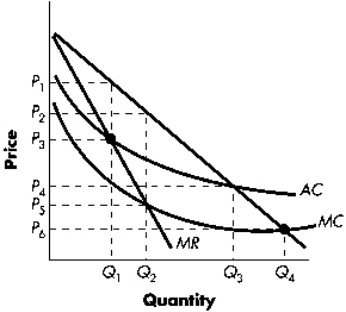 Refer to Exhibit 13-4.If regulators set a price according to marginal-cost pricing,the firm will:
 (Multiple Choice)
4.8/5 (80)
(80) A profit-maximizing monopolist will choose to operate along the inelastic portion of its demand curve.
(True/False)
4.9/5 (83)
(83) A monopolist can sell 20 units a week at a price of $10 per unit.To sell 21 units a week,it would have to lower its price to $9 per unit.The marginal revenue of the 21st unit would be:
(Multiple Choice)
4.9/5 (71)
(71) A monopoly firm is charging the price the market will bear at a level of output where MC equals $6 and is increasing,MR equals $9,and average variable cost equals $5.To maximize profits,the firm should:
(Multiple Choice)
4.9/5 (86)
(86) Exhibit 13-6 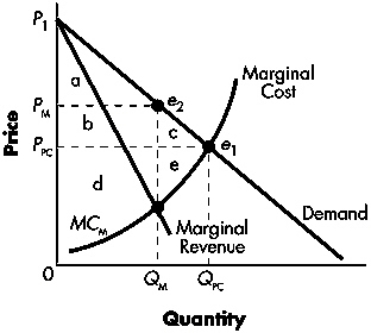 Refer to Exhibit 13-6.In perfect price discrimination,consumer surplus is:
 (Multiple Choice)
5.0/5 (98)
(98) Exhibit 13-7 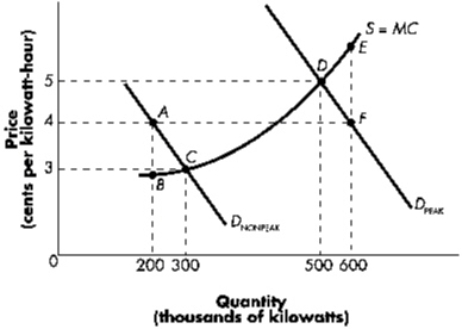 Refer to Exhibit 13-7.If customers are charged 4 cents during the non-peak period,it is:
 (Multiple Choice)
4.9/5 (70)
(70) "Monopolists do not worry about efficient production and cost saving since they can just pass along any increase in costs to their consumers." Is this statement true? Explain your answer.
(Essay)
4.8/5 (78)
(78) The practice of selling a product to different customers at different prices when marginal cost is the same is known as:
(Multiple Choice)
4.8/5 (79)
(79) Exhibit 13-6 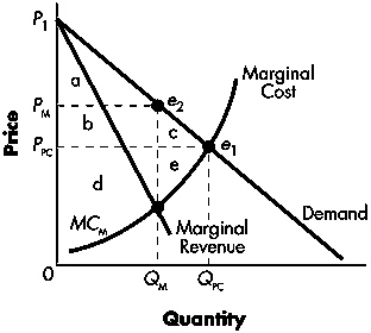 Refer to Exhibit 13-6.In perfect price discrimination,producer surplus is area:
 (Multiple Choice)
5.0/5 (77)
(77) 
Filters
- Essay(0)
- Multiple Choice(0)
- Short Answer(0)
- True False(0)
- Matching(0)