



 Chat with AI
Exam 13: Monopoly and Antitrust

Exam 1: The Role and Method of Economics198 Questions
Exam 2: Economics: Eight Powerful Ideas197 Questions
Exam 3: Scarcity, Trade-Offs, and Production Possibilities189 Questions
Exam 4: Demand, Supply, and Market Equilibrium240 Questions
Exam 5: Markets in Motion and Price Controls228 Questions
Exam 6: Elasticities206 Questions
Exam 7: Market Efficiency and Welfare136 Questions
Exam 8: Market Failure215 Questions
Exam 9: Public Finance and Public Choice64 Questions
Exam 10: Consumer Choice Theory149 Questions
Exam 11: The Firm: Production and Costs198 Questions
Exam 12: Firms in Perfectly Competitive Markets207 Questions
Exam 13: Monopoly and Antitrust189 Questions
Exam 14: Monopolistic Competition and Product Differentiation159 Questions
Exam 15: Oligopoly and Strategic Behavior146 Questions
Exam 16: The Markets for Labor, Capital, and Land177 Questions
Exam 17: Income, Poverty, and Health Care138 Questions
Exam 18: Introduction to Macroeconomics: Unemployment, Inflation, and Economic Fluctuations171 Questions
Exam 19: Measuring Economic Performance147 Questions
Exam 20: Economic Growth in the Global Economy127 Questions
Exam 21: Financial Markets, Saving, and Investment65 Questions
Exam 22: Aggregate Demand and Aggregate Supply163 Questions
Exam 23: The Aggregate Expenditure Model69 Questions
Exam 25: Monetary Institutions182 Questions
Exam 26: The Federal Reserve System and Monetary Policy147 Questions
Exam 27: Issues in Macroeconomic Theory and Policy130 Questions
Exam 28: International Trade182 Questions
Exam 29: International Finance138 Questions
Select questions type


A monopolist would charge ____ prices and produce ____ output than would exist under perfect competition.
(Multiple Choice)
4.9/5  (80)
(80) In perfect price discrimination,consumer surplus is zero because each consumer pays:
(Multiple Choice)
4.9/5 (82)
(82) Exhibit 13-6 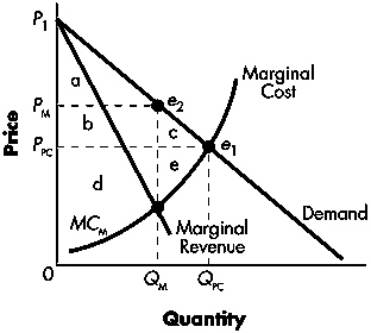 Refer to Exhibit 13-6.In single price monopoly,consumer surplus is area:
 (Multiple Choice)
4.8/5 (76)
(76) Which of the following is true for a monopolist but not for a perfectly competitive firm?
(Multiple Choice)
4.9/5 (81)
(81) If the demand curve facing a monopoly was 1 unit at $7,2 units at $6,3 units at $5,4 units at $4,and 5 units at $3,at the point along the curve where 3 units are being sold,the elasticity of demand:
(Multiple Choice)
4.7/5 (86)
(86) Exhibit 13-6 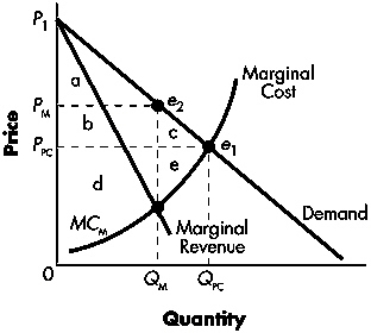 Refer to Exhibit 13-6.In perfect competition,producer surplus is area:
 (Multiple Choice)
4.8/5 (79)
(79) Exhibit 13-7 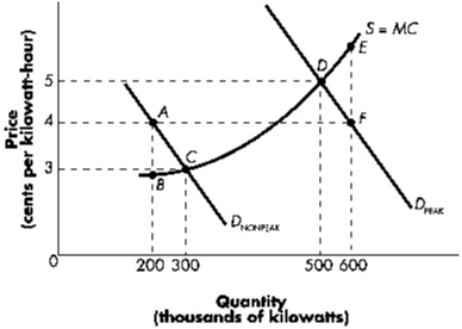 Refer to Exhibit 13-7.What price should be charged during the non-peak period to achieve efficiency?
 (Multiple Choice)
4.7/5 (95)
(95) Barriers that prevent the entry of new firms may arise because:
(Multiple Choice)
4.7/5 (78)
(78) Say that a monopolist is currently operating on the inelastic region of its demand curve.To maximize its profits,it should:
(Multiple Choice)
4.9/5 (75)
(75) A profit-maximizing monopolist,if producing at all,chooses a level of output where:
(Multiple Choice)
4.8/5 (75)
(75) A price-discriminating monopolist will tend to charge a higher price to senior citizens if it believes that senior citizens:
(Multiple Choice)
4.7/5 (69)
(69) For any monopolist with a positive marginal cost of production,its demand curve at its profit maximizing level:
(Multiple Choice)
4.8/5 (85)
(85) Exhibit 13-5 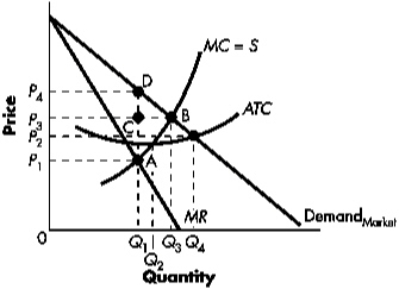 Refer to Exhibit 13-5.What quantity of output would a profit-maximizing monopolist produce?
 (Multiple Choice)
4.9/5 (69)
(69) Exhibit 13-4 The following diagram contains information on cost and revenue curves facing a regulated monopoly. 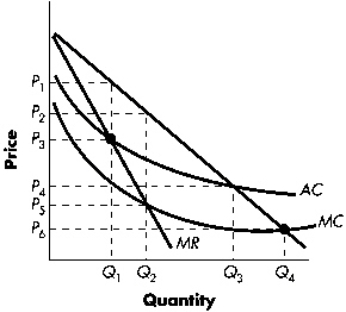 Refer to Exhibit 13-4.If the government is able to regulate the monopolist using average-cost pricing,what price and output combinations are expected to result?
 (Multiple Choice)
4.8/5 (70)
(70) The demand curve faced by a monopolist is the same as the marginal revenue curve.
(True/False)
4.7/5 (80)
(80) 
Filters
- Essay(0)
- Multiple Choice(0)
- Short Answer(0)
- True False(0)
- Matching(0)