



 Chat with AI
Exam 6: Consumer Choice and Behavioural Economics

Exam 1: Economics: Foundations and Models159 Questions
Exam 2: Choices and Trade-Offs in the Market192 Questions
Exam 3: Where Prices Come From: The Interaction of Demand and Supply202 Questions
Exam 4: Elasticity: The Responsiveness of Demand and Supply224 Questions
Exam 5: Economic Efficiency, Government Price Setting and Taxes187 Questions
Exam 6: Consumer Choice and Behavioural Economics254 Questions
Exam 7: Technology Production and Costs301 Questions
Exam 8: Firms in Perfectly Competitive Markets269 Questions
Exam 9: Monopoly Markets281 Questions
Exam 10: Monopolistic Competition: The Competitive Model in a More Realistic255 Questions
Exam 11: Oligopoly: Markets With Few Competitors186 Questions
Exam 12: The Markets for Labour and Other Factors of Production250 Questions
Exam 13: Comparative Advantage and the Gains From International Trade131 Questions
Exam 14: Government Intervention in the Market113 Questions
Exam 15: Externalities, Environmental Policy and Public Goods212 Questions
Exam 16: The Distribution of Income and Social Policy121 Questions
Select questions type


If you exhibit the endowment effect as a decision maker, then you are
(Multiple Choice)
4.9/5  (62)
(62) Figure 6.3 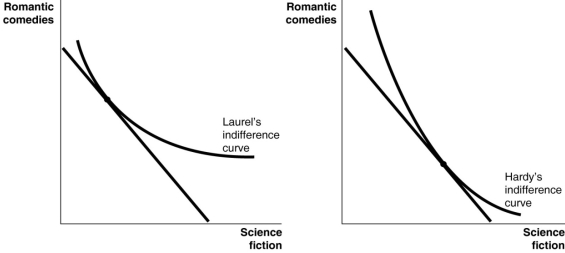 -Refer to Figure 6.3.The Bobsey twins, Laurel and Hardy, both enjoy watching romantic comedies and science fiction movies.Based on the diagrams above, what can you conclude about their movie preferences?
 (Multiple Choice)
4.9/5 (65)
(65) Psychologists Daniel Kahneman and Amos Tversky conducted the following experiments by asking a sample of people the following questions: Scenario A: 'Imagine that you have decided to see a play and paid the admission price of $10 per ticket.As you enter the theatre you discover that you have lost the ticket.The seat was not marked and the ticket cannot be recovered.Would you pay $10 for another ticket?'
Scenario B: 'Imagine that you have decided to see a play where admission is $10 per ticket.As you enter the theatre you discover that you have lost a $10 bill.Would you still pay $10 for a ticket for the play?'
As long as additional tickets are available, there is no meaningful difference between losing $10 in cash before buying a ticket, and losing the $10 ticket after buying it.In both cases, you are out $10.Yet, far more subjects (88 per cent)in Scenario B say they would pay $10 for another ticket and see the play while in Scenario A, only 46 per cent of the subjects say they would be willing to spend another $10 to see the play.
Which of the following is the best explanation for the results of the experiment?
(Multiple Choice)
4.9/5 (75)
(75) How is total utility maximised in the consumption of two goods?
(Multiple Choice)
4.9/5 (67)
(67) Figure 6.2 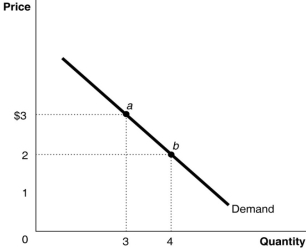 Figure 6.2 represents the demand for ice cream cones.
-Refer to Figure 6.2.Which of the following statements is true?
Figure 6.2 represents the demand for ice cream cones.
-Refer to Figure 6.2.Which of the following statements is true? (Multiple Choice)
4.9/5 (65)
(65) What is the additional utility that George receives from consuming one more slice of pizza?
(Multiple Choice)
4.9/5 (76)
(76) Figure 6.7  -Refer to Figure 6.7.If the consumer has $240 to spend on DVDs and CDs, what is the price of a CD if the budget constraint is BC2?
 (Multiple Choice)
4.8/5 (89)
(89) If Lisa spends her income on veggie burgers and pints of soy milk and the price of veggie burgers is three times the price of a pint of soy milk, then when Lisa maximises her utility she will buy
(Multiple Choice)
4.8/5 (84)
(84) During a study session for an economics exam with three other students, Peter Daltry commented on an example of a consumer who had to decide the on number of slices of pizza and cups of Coca-Cola he would consume.Peter explained that 'To maximise his utility, this consumer must equate the marginal utility per dollar for pizza and Coca-Cola.' Was Peter's analysis correct?
(Multiple Choice)
4.9/5 (83)
(83) Table 6.7  Table 6.7 shows Antonio's utility from beer and pizza.
-Refer to Table 6.7.Suppose Antonio has $10 to spend and the price of beer = $2 per glass and the price of pizza = $2 per slice.How many of each good will he consume when he maximises his utility?
Table 6.7 shows Antonio's utility from beer and pizza.
-Refer to Table 6.7.Suppose Antonio has $10 to spend and the price of beer = $2 per glass and the price of pizza = $2 per slice.How many of each good will he consume when he maximises his utility? (Multiple Choice)
4.8/5 (89)
(89) The income effect of a price increase causes a decrease in the quantity demanded of a normal good.
(True/False)
4.9/5 (66)
(66) If Dawson prefers pizza to hamburgers and hamburgers to hot dogs, and if preferences are transitive,
(Multiple Choice)
4.9/5 (90)
(90) The only Giffen goods that have been identified so far in the real world are luxury goods.
(True/False)
4.8/5 (81)
(81) What are costs that have already been incurred, and which cannot be recovered?
(Multiple Choice)
4.9/5 (82)
(82) Describe the demand curve for a Giffen good.
__________________________________________________________________________________________________________________________________________________________________________________________
(Essay)
4.8/5 (72)
(72) Many people leave their servers tips in restaurants, even when they are not likely to visit the restaurant again.This is evidence that
(Multiple Choice)
5.0/5 (82)
(82) Which of the following correctly describes the result of a price increase for an inferior good?
(Multiple Choice)
4.8/5 (72)
(72) In order to derive an individual's demand curve for salmon, we would observe what happens to the utility-maximising bundle when we change
(Multiple Choice)
4.7/5 (85)
(85) 
Filters
- Essay(0)
- Multiple Choice(0)
- Short Answer(0)
- True False(0)
- Matching(0)