



 Chat with AI
Exam 12: The Design of the Tax System

Exam 1: Ten Principles of Economics281 Questions
Exam 2: Thinking Like an Economist451 Questions
Exam 3: Interdependence and the Gains From Trade353 Questions
Exam 4: The Market Forces of Supply and Demand467 Questions
Exam 5: Elasticity and Its Application409 Questions
Exam 6: Supply, Demand, and Government Policies459 Questions
Exam 7: Consumers, Producers, and the Efficiency of Markets363 Questions
Exam 8: Application: The Costs of Taxation353 Questions
Exam 9: Application: International Trade333 Questions
Exam 10: Externalities352 Questions
Exam 11: Public Goods and Common Resources270 Questions
Exam 12: The Design of the Tax System397 Questions
Exam 13: The Costs of Production434 Questions
Exam 14: Firms in Competitive Markets381 Questions
Exam 15: Monopoly427 Questions
Exam 16: Monopolistic Competition416 Questions
Exam 17: Oligopoly325 Questions
Exam 18: The Markets for the Factors of Production361 Questions
Exam 19: Earnings and Discrimination335 Questions
Exam 20: Income Inequality and Poverty312 Questions
Exam 21: The Theory of Consumer Choice354 Questions
Exam 22: Frontiers of Microeconomics262 Questions
Exam 23: Measuring a Nations Income343 Questions
Exam 24: Measuring the Cost of Living358 Questions
Exam 25: Production and Growth335 Questions
Exam 26: Saving, investment, and the Financial System381 Questions
Exam 27: The Basic Tools of Finance336 Questions
Exam 28: Unemployment533 Questions
Exam 29: The Monetary System366 Questions
Exam 30: Money Growth and Inflation312 Questions
Exam 31: Open-Economy Macroeconomics: Basic Concepts346 Questions
Exam 32: A Macroeconomic Theory of the Open Economy300 Questions
Exam 33: Aggregate Demand and Aggregate Supply386 Questions
Exam 34: The Influence of Monetary and Fiscal Policy on Aggregate Demand334 Questions
Exam 35: The Short-Run Trade-Off Between Inflation and Unemployment306 Questions
Exam 36: Five Debates Over Macroeconomic Policy179 Questions
Select questions type


The idea that people in equal conditions should pay equal taxes is referred to as
(Multiple Choice)
4.9/5  (85)
(85) Table 12-13
The following table shows the marginal tax rates for unmarried individuals for two years.
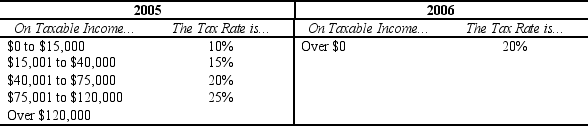 -Refer to Table 12-13.Suppose one goal of the tax system was to achieve vertical equity.While people may disagree about what is "equitable," based on the marginal tax rates given for the two years,which of the following statements is true?
 (Multiple Choice)
4.9/5 (73)
(73) Table 12-2
Consider the tax rates shown in the table below.
 -Refer to Table 12-2.If Max has taxable income of $227,000,his tax liability is
 (Multiple Choice)
5.0/5 (85)
(85) Scenario 12-3.A taxpayer faces the following tax rates on her income:
20 percent of the first $40,000 of her income;
30 percent of all her income above $40,000.
-Refer to Scenario 12-3.At what level of income would the taxpayer's marginal tax rate be 30 percent and her average tax rate be 25 percent?
(Multiple Choice)
4.9/5 (80)
(80) The U.S.federal government collects taxes in a number of ways.Rank the following sources of revenue from the largest to the smallest.
(Multiple Choice)
4.9/5 (82)
(82) From the time of Benjamin Franklin to the present,the percentage of the average American's income that goes to pay taxes
(Multiple Choice)
4.8/5 (78)
(78) Table 12-1
 -Refer to Table 12-1.If Barb has $126,000 in taxable income,her tax liability will be
 (Multiple Choice)
4.9/5 (79)
(79) Deadweight losses and administrative burdens are key factors considered when determining the efficiency of the tax system.
(True/False)
4.9/5 (76)
(76) The public welfare spending category for state and local governments includes
(Multiple Choice)
4.7/5 (82)
(82) A budget surplus occurs when government receipts fall short of government spending.
(True/False)
4.9/5 (73)
(73) Table 12-9
The table below shows the marginal tax rates for an unmarried taxpayer for various levels of taxable income.
 -Refer to Table 12-9.For this tax schedule,what is the marginal tax rate for an invidvidual with $212,000 in taxable income?
 (Multiple Choice)
4.8/5 (73)
(73) According to the benefits principle,it is fair for people to pay taxes based on their ability to shoulder the tax burden.
(True/False)
4.9/5 (66)
(66) Temporary Assistance for Needy Families (TANF)falls into which spending category?
(Multiple Choice)
5.0/5 (87)
(87) 
Filters
- Essay(0)
- Multiple Choice(0)
- Short Answer(0)
- True False(0)
- Matching(0)