



 Chat with AI
Exam 10: Externalities

Exam 1: Ten Principles of Economics281 Questions
Exam 2: Thinking Like an Economist451 Questions
Exam 3: Interdependence and the Gains From Trade353 Questions
Exam 4: The Market Forces of Supply and Demand467 Questions
Exam 5: Elasticity and Its Application409 Questions
Exam 6: Supply, Demand, and Government Policies459 Questions
Exam 7: Consumers, Producers, and the Efficiency of Markets363 Questions
Exam 8: Application: The Costs of Taxation353 Questions
Exam 9: Application: International Trade333 Questions
Exam 10: Externalities352 Questions
Exam 11: Public Goods and Common Resources270 Questions
Exam 12: The Design of the Tax System397 Questions
Exam 13: The Costs of Production434 Questions
Exam 14: Firms in Competitive Markets381 Questions
Exam 15: Monopoly427 Questions
Exam 16: Monopolistic Competition416 Questions
Exam 17: Oligopoly325 Questions
Exam 18: The Markets for the Factors of Production361 Questions
Exam 19: Earnings and Discrimination335 Questions
Exam 20: Income Inequality and Poverty312 Questions
Exam 21: The Theory of Consumer Choice354 Questions
Exam 22: Frontiers of Microeconomics262 Questions
Exam 23: Measuring a Nations Income343 Questions
Exam 24: Measuring the Cost of Living358 Questions
Exam 25: Production and Growth335 Questions
Exam 26: Saving, investment, and the Financial System381 Questions
Exam 27: The Basic Tools of Finance336 Questions
Exam 28: Unemployment533 Questions
Exam 29: The Monetary System366 Questions
Exam 30: Money Growth and Inflation312 Questions
Exam 31: Open-Economy Macroeconomics: Basic Concepts346 Questions
Exam 32: A Macroeconomic Theory of the Open Economy300 Questions
Exam 33: Aggregate Demand and Aggregate Supply386 Questions
Exam 34: The Influence of Monetary and Fiscal Policy on Aggregate Demand334 Questions
Exam 35: The Short-Run Trade-Off Between Inflation and Unemployment306 Questions
Exam 36: Five Debates Over Macroeconomic Policy179 Questions
Select questions type


Table 10-4
The following table shows the total costs for each of four firms (A,B,C,and D)to eliminate units of pollution from their production processes.For example,for Firm A to eliminate one unit of pollution,it would cost $46,and for Firm A to eliminate two units of pollution,it would cost a total of $103.
 -Refer to Table 10-4.If the government charged a fee of $101 per unit of pollution,how many units of pollution would the firms eliminate altogether?
 (Multiple Choice)
4.8/5  (84)
(84) According to the Coase theorem,whatever the initial distribution of rights,the interested parties can bargain to an efficient outcome.
(True/False)
4.7/5 (86)
(86) Honey producers provide a positive externality to orchards because
(Multiple Choice)
4.8/5 (88)
(88) Corrective taxes are more efficient than regulations for keeping the environment clean.
(True/False)
4.8/5 (87)
(87) Figure 10-9 

 -Refer to Figure 10-9,Panel (b)and Panel (c).The overuse of antibiotics leads to the development of antibiotic-resistant diseases.Therefore,the socially optimal quantity of antibiotics is represented by point
 (Multiple Choice)
4.9/5 (75)
(75) Externalities can be corrected by each of the following except
(Multiple Choice)
4.9/5 (90)
(90) A paper plant produces water pollution during the production process.If the government forces the plant to internalize the negative externality,then the
(Multiple Choice)
5.0/5 (75)
(75) Private parties may choose not to solve an externality problem if the transaction costs are large enough.
(True/False)
4.7/5 (79)
(79) According to the Coase theorem,the private market will need government intervention in order to reach an efficient outcome.
(True/False)
4.8/5 (78)
(78) If education produces positive externalities,we would expect
(Multiple Choice)
4.8/5 (68)
(68) Table 10-3
The following table shows the marginal costs for each of four firms (A,B,C,and D)to eliminate units of pollution from their production processes.For example,for Firm A to eliminate one unit of pollution,it would cost $54,and for Firm A to eliminate a second unit of pollution it would cost an additional $67.
 -Refer to Table 10-3.If the government charged a fee of $84 per unit of pollution,how many units of pollution would the firms eliminate altogether?
 (Multiple Choice)
4.8/5 (94)
(94) If the production of computer chips yields greater technology spillovers than the production of potato chips,the government should
(Multiple Choice)
4.8/5 (63)
(63) Figure 10-9
-Refer to Figure 10-9.Which graph represents a market with a positive externality?
-Refer to Figure 10-9.Which graph represents a market with a positive externality? (Multiple Choice)
4.7/5 (78)
(78) Despite the appealing logic of the Coase theorem,private actors often fail to resolve on their own the problems caused by externalities.
(True/False)
4.8/5 (92)
(92) 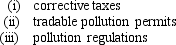
Suppose that smoking creates a negative externality.If the government does not interfere in the cigarette market,then
(Multiple Choice)
4.8/5 (74)
(74) Since externalities tend to keep markets from reaching a socially optimal equilibrium,government action
(Multiple Choice)
4.9/5 (86)
(86) 
Filters
- Essay(0)
- Multiple Choice(0)
- Short Answer(0)
- True False(0)
- Matching(0)