



 Chat with AI
Exam 8: Application: The Costs of Taxation

Exam 1: Ten Principles of Economics281 Questions
Exam 2: Thinking Like an Economist451 Questions
Exam 3: Interdependence and the Gains From Trade353 Questions
Exam 4: The Market Forces of Supply and Demand467 Questions
Exam 5: Elasticity and Its Application409 Questions
Exam 6: Supply, Demand, and Government Policies459 Questions
Exam 7: Consumers, Producers, and the Efficiency of Markets363 Questions
Exam 8: Application: The Costs of Taxation353 Questions
Exam 9: Application: International Trade333 Questions
Exam 10: Externalities352 Questions
Exam 11: Public Goods and Common Resources270 Questions
Exam 12: The Design of the Tax System397 Questions
Exam 13: The Costs of Production434 Questions
Exam 14: Firms in Competitive Markets381 Questions
Exam 15: Monopoly427 Questions
Exam 16: Monopolistic Competition416 Questions
Exam 17: Oligopoly325 Questions
Exam 18: The Markets for the Factors of Production361 Questions
Exam 19: Earnings and Discrimination335 Questions
Exam 20: Income Inequality and Poverty312 Questions
Exam 21: The Theory of Consumer Choice354 Questions
Exam 22: Frontiers of Microeconomics262 Questions
Exam 23: Measuring a Nations Income343 Questions
Exam 24: Measuring the Cost of Living358 Questions
Exam 25: Production and Growth335 Questions
Exam 26: Saving, investment, and the Financial System381 Questions
Exam 27: The Basic Tools of Finance336 Questions
Exam 28: Unemployment533 Questions
Exam 29: The Monetary System366 Questions
Exam 30: Money Growth and Inflation312 Questions
Exam 31: Open-Economy Macroeconomics: Basic Concepts346 Questions
Exam 32: A Macroeconomic Theory of the Open Economy300 Questions
Exam 33: Aggregate Demand and Aggregate Supply386 Questions
Exam 34: The Influence of Monetary and Fiscal Policy on Aggregate Demand334 Questions
Exam 35: The Short-Run Trade-Off Between Inflation and Unemployment306 Questions
Exam 36: Five Debates Over Macroeconomic Policy179 Questions
Select questions type


Figure 8-5
Suppose that the government imposes a tax of P3 - P1.  -Refer to Figure 8-5.After the tax is levied,consumer surplus is represented by area
 (Multiple Choice)
4.9/5  (88)
(88) Suppose a tax of $5 per unit is imposed on a good.The supply curve is a typical upward-sloping straight line,and the demand curve is a typical downward-sloping straight line.The tax decreases consumer surplus by $10,000 and decreases producer surplus by $15,000.The deadweight loss of the tax is $2,500.The tax decreased the equilibrium quantity of the good from
(Multiple Choice)
4.9/5 (73)
(73) A deadweight loss is a consequence of a tax on a good because the tax
(Multiple Choice)
4.8/5 (69)
(69) Figure 8-2
The vertical distance between points A and B represents a tax in the market.  -Refer to Figure 8-2.Total surplus without the tax is
 (Multiple Choice)
4.8/5 (89)
(89) For a good that is taxed,the area on the relevant supply-and-demand graph that represents government's tax revenue is a
(Multiple Choice)
4.8/5 (88)
(88) Figure 8-7
The vertical distance between points A and B represents a tax in the market.  -Refer to Figure 8-7.Suppose a 20th unit of the good were sold by a seller to a buyer.Which of the following statements is correct?
 (Multiple Choice)
5.0/5 (77)
(77) Taxes on labor tend to increase the number of hours that people choose to work.
(True/False)
4.9/5 (74)
(74) Table 8-1
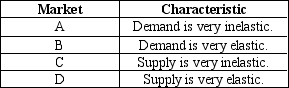 -Refer to Table 8-1.Suppose the government is considering levying a tax in one or more of the markets described in the table.Which of the markets will maximize the deadweight loss(es)from the tax?
 (Multiple Choice)
4.8/5 (80)
(80) One result of a tax,regardless of whether the tax is placed on the buyers or the sellers,is that the
(Multiple Choice)
4.8/5 (70)
(70) Figure 8-3
The vertical distance between points A and C represents a tax in the market.  -Refer to Figure 8-3.The per-unit burden of the tax on sellers is
 (Multiple Choice)
4.8/5 (78)
(78) Figure 8-1  -Refer to Figure 8-1.Suppose the government imposes a tax of P' - P'''.The producer surplus after the tax is measured by the area
 (Multiple Choice)
4.9/5 (74)
(74) Figure 8-1
-Refer to Figure 8-1.Suppose the government imposes a tax of P' - P'''.The deadweight loss due to the tax is measured by the area
-Refer to Figure 8-1.Suppose the government imposes a tax of P' - P'''.The deadweight loss due to the tax is measured by the area (Multiple Choice)
5.0/5 (85)
(85) If a tax did not induce buyers or sellers to change their behavior,it would not cause a deadweight loss.
(True/False)
4.8/5 (79)
(79) Figure 8-3
The vertical distance between points A and C represents a tax in the market.
-Refer to Figure 8-3.Which of the following equations is valid for the tax revenue that the tax provides to the government?
-Refer to Figure 8-3.Which of the following equations is valid for the tax revenue that the tax provides to the government? (Multiple Choice)
4.8/5 (77)
(77) Economists disagree on whether labor taxes cause small or large deadweight losses.This disagreement arises primarily because economists hold different views about
(Multiple Choice)
4.9/5 (86)
(86) Scenario 8-2
Tom mows Stephanie's lawn for $25.Tom's opportunity cost of mowing Stephanie's lawn is $20,and Stephanie's willingness to pay Tom to mow her lawn is $28.
-Refer to Scenario 8-2.If Stephanie hires Tom to mow her lawn,Tom's producer surplus is
(Multiple Choice)
4.9/5 (74)
(74) Figure 8-2
The vertical distance between points A and B represents a tax in the market.
-Refer to Figure 8-2.The loss of producer surplus as a result of the tax is
-Refer to Figure 8-2.The loss of producer surplus as a result of the tax is (Multiple Choice)
4.8/5 (74)
(74) 
Filters
- Essay(0)
- Multiple Choice(0)
- Short Answer(0)
- True False(0)
- Matching(0)