



 Chat with AI
Exam 13: Fiscal Policy

Exam 1: The Nature of Economics347 Questions
Exam 2: Scarcity and the World of Trade-Offs412 Questions
Exam 3: Demand and Supply448 Questions
Exam 4: Extensions of Demand and Supply Analysis399 Questions
Exam 5: Public Spending and Public Choice359 Questions
Exam 6: Funding the Public Sector202 Questions
Exam 7: The Macroeconomy: Unemployment, Inflation, and Deflation412 Questions
Exam 8: Measuring the Economys Performance413 Questions
Exam 9: Global Economic Growth and Development282 Questions
Exam 10: Real GDP and the Price Level in the Long Run290 Questions
Exam 11: Classical and Keynesian Macro Analyses365 Questions
Exam 12: Consumption, Real GDP, and the Multiplier445 Questions
Exam 13: Fiscal Policy273 Questions
Exam 14: Deficit Spending and the Public Debt145 Questions
Exam 15: Money, Banking, and Central Banking517 Questions
Exam 16: Domestic and International Dimensions of Monetary Policy357 Questions
Exam 17: Stabilization in an Integrated World Economy306 Questions
Exam 18: Policies and Prospects for Global Economic Growth216 Questions
Exam 19: Demand and Supply Elasticity413 Questions
Exam 20: Consumer Choice458 Questions
Exam 21: Rents, Profits, and the Financial Environment of Business445 Questions
Exam 22: The Firm: Cost and Output Determination387 Questions
Exam 23: Perfect Competition431 Questions
Exam 24: Monopoly386 Questions
Exam 25: Monopolistic Competition309 Questions
Exam 26: Oligopoly and Strategic Behavior306 Questions
Exam 27: Regulation and Antitrust Policy in a Globalized Economy309 Questions
Exam 28: The Labor Market: Demand, Supply and Outsourcing376 Questions
Exam 29: Unions and Labor Market Monopoly Power318 Questions
Exam 30: Income, Poverty, and Health Care302 Questions
Exam 31: Environmental Economics300 Questions
Exam 32: Comparative Advantage and the Open Economy314 Questions
Exam 33: Exchange Rates and the Balance of Payments300 Questions
Select questions type


If there is a deliberate change in taxes and spending, it is called
(Multiple Choice)
4.8/5  (70)
(70) A problem with using fiscal policy to fine-tune the economy is that
(Multiple Choice)
5.0/5 (83)
(83) 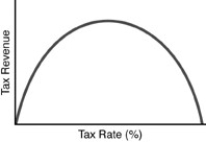 -Consider the above figure. This curve suggests that as the government raises the tax rate, a point will eventually be reached at which the revenues that are collected will
 (Multiple Choice)
4.9/5 (66)
(66) In the traditional Keynesian model, an increase in taxes leads to all of the following EXCEPT
(Multiple Choice)
4.8/5 (76)
(76) A direct expenditure offset occurs when an increase in government spending
(Multiple Choice)
4.8/5 (70)
(70) The notion that a decline in tax rates and other incentives will spur individuals and firms to increase productivity is typically referred to as
(Multiple Choice)
4.8/5 (83)
(83) "Expansionary fiscal policy is always 100 percent effective when the short-run aggregate supply curve is horizontal." Is this statement true?
(Multiple Choice)
4.8/5 (61)
(61) In Country Z, the government simultaneously increases its expenditures by $25 billion and increases taxes by $25 billion. If the MPS is equal to 0.2, the government's action ________ real GDP by ________.
(Multiple Choice)
4.9/5 (93)
(93) Suppose the economy has a high level of unemployment. This would imply
(Multiple Choice)
4.8/5 (89)
(89)  -Refer to the above figure. Suppose the relevant aggregate demand curve is
 . If the government wants to use discretionary fiscal policy to close the existing gap, it should
-Refer to the above figure. Suppose the relevant aggregate demand curve is . If the government wants to use discretionary fiscal policy to close the existing gap, it should (Multiple Choice)
4.9/5 (73)
(73) In 2009, Congress passed a bill that involved government spending increases and tax cuts with the purpose of stimulating the U.S. economy. This policy is an example of
(Multiple Choice)
4.8/5 (80)
(80) The proposition that decreases in taxes that raise the government budget deficit has no effect on aggregate demand is called the
(Multiple Choice)
4.7/5 (89)
(89) To the extent that the political process of moving legislation through Congress is slow,
(Multiple Choice)
4.9/5 (80)
(80) When television commentators refer to "tax and spend" policy, they are referring to
(Multiple Choice)
4.7/5 (93)
(93) In January 2009, the President submitted a bill to Congress that was designed to stimulate the economy and increase employment. The legislation was passed in March 2009, and the spending occurred from June 2009 to September 2010. Consequently,
(Multiple Choice)
4.8/5 (77)
(77) The theory that government borrowing may function like an increase in taxes, that is, reducing current consumption and business expenditures, was formulated by
(Multiple Choice)
4.8/5 (86)
(86) 
Filters
- Essay(0)
- Multiple Choice(0)
- Short Answer(0)
- True False(0)
- Matching(0)