



 Chat with AI
Exam 13: Fiscal Policy

Exam 1: The Nature of Economics347 Questions
Exam 2: Scarcity and the World of Trade-Offs412 Questions
Exam 3: Demand and Supply448 Questions
Exam 4: Extensions of Demand and Supply Analysis399 Questions
Exam 5: Public Spending and Public Choice359 Questions
Exam 6: Funding the Public Sector202 Questions
Exam 7: The Macroeconomy: Unemployment, Inflation, and Deflation412 Questions
Exam 8: Measuring the Economys Performance413 Questions
Exam 9: Global Economic Growth and Development282 Questions
Exam 10: Real GDP and the Price Level in the Long Run290 Questions
Exam 11: Classical and Keynesian Macro Analyses365 Questions
Exam 12: Consumption, Real GDP, and the Multiplier445 Questions
Exam 13: Fiscal Policy273 Questions
Exam 14: Deficit Spending and the Public Debt145 Questions
Exam 15: Money, Banking, and Central Banking517 Questions
Exam 16: Domestic and International Dimensions of Monetary Policy357 Questions
Exam 17: Stabilization in an Integrated World Economy306 Questions
Exam 18: Policies and Prospects for Global Economic Growth216 Questions
Exam 19: Demand and Supply Elasticity413 Questions
Exam 20: Consumer Choice458 Questions
Exam 21: Rents, Profits, and the Financial Environment of Business445 Questions
Exam 22: The Firm: Cost and Output Determination387 Questions
Exam 23: Perfect Competition431 Questions
Exam 24: Monopoly386 Questions
Exam 25: Monopolistic Competition309 Questions
Exam 26: Oligopoly and Strategic Behavior306 Questions
Exam 27: Regulation and Antitrust Policy in a Globalized Economy309 Questions
Exam 28: The Labor Market: Demand, Supply and Outsourcing376 Questions
Exam 29: Unions and Labor Market Monopoly Power318 Questions
Exam 30: Income, Poverty, and Health Care302 Questions
Exam 31: Environmental Economics300 Questions
Exam 32: Comparative Advantage and the Open Economy314 Questions
Exam 33: Exchange Rates and the Balance of Payments300 Questions
Select questions type


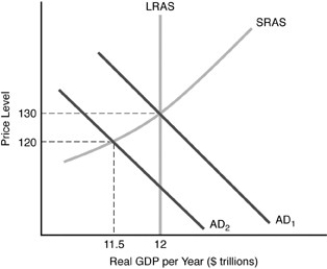 -Refer to the above figure. If the relevant aggregate demand curve is
 , what is the current economic situation?
-Refer to the above figure. If the relevant aggregate demand curve is , what is the current economic situation? (Multiple Choice)
4.8/5  (79)
(79) The amount of time that elapses between the implementation of a policy and the results of that policy is
(Multiple Choice)
4.9/5 (80)
(80) Supply-side economics focuses attention on how fiscal policy might be used to
(Multiple Choice)
4.9/5 (75)
(75) If the government increases spending and there is a complete direct expenditure offset, then
(Multiple Choice)
4.8/5 (76)
(76) Government-provided unemployment insurance is an example of
(Multiple Choice)
4.9/5 (92)
(92) The traditional Keynesian approach to fiscal policy assumes
(Multiple Choice)
4.7/5 (80)
(80) According to the traditional Keynesian approach, if the government increases taxes, then
(Multiple Choice)
4.8/5 (83)
(83) When data on the economy requires some time to gather and interpret, we have a(n)
(Multiple Choice)
4.8/5 (72)
(72) Keynes believed that the way to prevent recessions and depressions was to
(Multiple Choice)
4.7/5 (90)
(90) In the traditional Keynesian model, an increase in current taxes
(Multiple Choice)
4.7/5 (76)
(76) What are the automatic stabilizers the United States has in place, and how do they function differently from discretionary fiscal policy?
(Essay)
4.8/5 (82)
(82) An increase in government spending that is not financed by an increase in taxes will cause which of the following?
(Multiple Choice)
4.8/5 (84)
(84) Which of the following actions could be undertaken if the government wants to reduce an inflationary gap?
(Multiple Choice)
4.8/5 (81)
(81) Which of the following would shift the aggregate demand curve to the right?
(Multiple Choice)
4.7/5 (72)
(72)  -Refer to the above figure. Suppose that the economy starts at
 . If the government reduces taxes, then the economy goes to
 , but then falls back to
 . This is an example of
-Refer to the above figure. Suppose that the economy starts at . If the government reduces taxes, then the economy goes to , but then falls back to . This is an example of (Multiple Choice)
5.0/5 (81)
(81) 
Filters
- Essay(0)
- Multiple Choice(0)
- Short Answer(0)
- True False(0)
- Matching(0)