



 Chat with AI
Exam 13: Fiscal Policy

Exam 1: The Nature of Economics347 Questions
Exam 2: Scarcity and the World of Trade-Offs412 Questions
Exam 3: Demand and Supply448 Questions
Exam 4: Extensions of Demand and Supply Analysis399 Questions
Exam 5: Public Spending and Public Choice359 Questions
Exam 6: Funding the Public Sector202 Questions
Exam 7: The Macroeconomy: Unemployment, Inflation, and Deflation412 Questions
Exam 8: Measuring the Economys Performance413 Questions
Exam 9: Global Economic Growth and Development282 Questions
Exam 10: Real GDP and the Price Level in the Long Run290 Questions
Exam 11: Classical and Keynesian Macro Analyses365 Questions
Exam 12: Consumption, Real GDP, and the Multiplier445 Questions
Exam 13: Fiscal Policy273 Questions
Exam 14: Deficit Spending and the Public Debt145 Questions
Exam 15: Money, Banking, and Central Banking517 Questions
Exam 16: Domestic and International Dimensions of Monetary Policy357 Questions
Exam 17: Stabilization in an Integrated World Economy306 Questions
Exam 18: Policies and Prospects for Global Economic Growth216 Questions
Exam 19: Demand and Supply Elasticity413 Questions
Exam 20: Consumer Choice458 Questions
Exam 21: Rents, Profits, and the Financial Environment of Business445 Questions
Exam 22: The Firm: Cost and Output Determination387 Questions
Exam 23: Perfect Competition431 Questions
Exam 24: Monopoly386 Questions
Exam 25: Monopolistic Competition309 Questions
Exam 26: Oligopoly and Strategic Behavior306 Questions
Exam 27: Regulation and Antitrust Policy in a Globalized Economy309 Questions
Exam 28: The Labor Market: Demand, Supply and Outsourcing376 Questions
Exam 29: Unions and Labor Market Monopoly Power318 Questions
Exam 30: Income, Poverty, and Health Care302 Questions
Exam 31: Environmental Economics300 Questions
Exam 32: Comparative Advantage and the Open Economy314 Questions
Exam 33: Exchange Rates and the Balance of Payments300 Questions
Select questions type


According to the traditional Keynesian approach, a tax cut raises aggregate demand because
(Multiple Choice)
4.8/5  (76)
(76) All of the following are automatic fiscal stabilizers EXCEPT
(Multiple Choice)
4.9/5 (69)
(69) The amount of time it takes Congress to debate the size of a tax cut is known as the
(Multiple Choice)
4.8/5 (82)
(82) Three candidates for political office disagree over the benefits of enlarging the federal budget deficit. Candidate C says the stimulation package is needed to increase employment and real GDP; Candidate D says it will only cause higher prices; and Candidate F says it will have no effect on either real GDP or the price level. How do the three candidates differ with respect to the condition of the economy and the effects of fiscal policy?
(Multiple Choice)
4.8/5 (84)
(84) 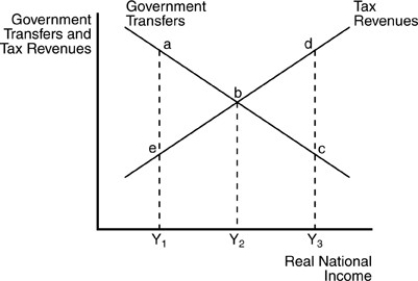 -Refer to the above figure. As the real national income expands from Y2 to Y3,
 (Multiple Choice)
4.7/5 (70)
(70) Which of the following might be considered an automatic fiscal stabilizer?
(Multiple Choice)
4.9/5 (70)
(70)  -Refer to the above figure. Suppose that the economy initially is operating along AD1. If the government seeks to close the recessionary gap by raising government spending without any change in taxation, which moves the aggregate demand curve from
 to
 , then to
 . Which of the following scenarios is true?
-Refer to the above figure. Suppose that the economy initially is operating along AD1. If the government seeks to close the recessionary gap by raising government spending without any change in taxation, which moves the aggregate demand curve from to , then to . Which of the following scenarios is true? (Multiple Choice)
4.9/5 (77)
(77) To the extent that the Ricardian equivalence theorem is true, which of the conditions below will hold?
(Multiple Choice)
4.9/5 (83)
(83) Whenever government spending is a substitute for private spending
(Multiple Choice)
4.9/5 (78)
(78) Suppose the economy is experiencing a recessionary gap at the current level of GDP. Which of the following fiscal policy actions would be most appropriate given this recessionary gap?
(Multiple Choice)
4.9/5 (69)
(69) In the traditional Keynesian model, an increase in government spending raises total planned real expenditures by more than the original increase in government spending because
(Multiple Choice)
4.9/5 (82)
(82) A recession begins in July but government policy makers do not reach a consensus that a recession had in fact begun until October. This is an example of a(n)
(Multiple Choice)
5.0/5 (76)
(76) A government proposal to increase marginal tax rates on the wealthiest 2 percent of U.S. residents is supposed to generate an additional $100 billion in tax revenues. It is likely that
(Multiple Choice)
4.7/5 (82)
(82) If the price level is fixed, then an increase in government spending will lead to
(Multiple Choice)
4.8/5 (74)
(74) The supporters of a proposal to increase marginal taxes on those earning over $200,000 a year say this change would generate $100 billion in new tax revenues. A supply-side economist would argue that the actual revenue raised will be
(Multiple Choice)
4.9/5 (67)
(67) 
Filters
- Essay(0)
- Multiple Choice(0)
- Short Answer(0)
- True False(0)
- Matching(0)