



 Chat with AI
Exam 13: Fiscal Policy

Exam 1: The Nature of Economics347 Questions
Exam 2: Scarcity and the World of Trade-Offs412 Questions
Exam 3: Demand and Supply448 Questions
Exam 4: Extensions of Demand and Supply Analysis399 Questions
Exam 5: Public Spending and Public Choice359 Questions
Exam 6: Funding the Public Sector202 Questions
Exam 7: The Macroeconomy: Unemployment, Inflation, and Deflation412 Questions
Exam 8: Measuring the Economys Performance413 Questions
Exam 9: Global Economic Growth and Development282 Questions
Exam 10: Real GDP and the Price Level in the Long Run290 Questions
Exam 11: Classical and Keynesian Macro Analyses365 Questions
Exam 12: Consumption, Real GDP, and the Multiplier445 Questions
Exam 13: Fiscal Policy273 Questions
Exam 14: Deficit Spending and the Public Debt145 Questions
Exam 15: Money, Banking, and Central Banking517 Questions
Exam 16: Domestic and International Dimensions of Monetary Policy357 Questions
Exam 17: Stabilization in an Integrated World Economy306 Questions
Exam 18: Policies and Prospects for Global Economic Growth216 Questions
Exam 19: Demand and Supply Elasticity413 Questions
Exam 20: Consumer Choice458 Questions
Exam 21: Rents, Profits, and the Financial Environment of Business445 Questions
Exam 22: The Firm: Cost and Output Determination387 Questions
Exam 23: Perfect Competition431 Questions
Exam 24: Monopoly386 Questions
Exam 25: Monopolistic Competition309 Questions
Exam 26: Oligopoly and Strategic Behavior306 Questions
Exam 27: Regulation and Antitrust Policy in a Globalized Economy309 Questions
Exam 28: The Labor Market: Demand, Supply and Outsourcing376 Questions
Exam 29: Unions and Labor Market Monopoly Power318 Questions
Exam 30: Income, Poverty, and Health Care302 Questions
Exam 31: Environmental Economics300 Questions
Exam 32: Comparative Advantage and the Open Economy314 Questions
Exam 33: Exchange Rates and the Balance of Payments300 Questions
Select questions type


 -Refer to the above figure. Suppose that the economy was originally at point A, and then it reached point C by means of a fiscal policy action. Which of the following is correct?
 (Multiple Choice)
4.8/5  (83)
(83) According to the Ricardian equivalence theorem, budget deficits resulting from tax cuts
(Multiple Choice)
4.9/5 (85)
(85) Using graphs, explain how indirect crowding out can occur when the government increases spending in an attempt to stimulate the economy.
(Essay)
4.8/5 (75)
(75) Which of the following conditions describes a recessionary gap?
(Multiple Choice)
5.0/5 (84)
(84) Which one of the following is true about the effects of fiscal policy?
(Multiple Choice)
4.8/5 (88)
(88) The changing of government expenditures or taxes to achieve national economic goals is
(Multiple Choice)
4.8/5 (82)
(82) In the traditional Keynesian model, an increase in government spending
(Multiple Choice)
4.9/5 (66)
(66) When fiscal policy is used, time lags are variable and last anywhere from
(Multiple Choice)
4.8/5 (79)
(79) When the government cuts taxes or increases government spending
(Multiple Choice)
4.8/5 (78)
(78) The traditional Keynesian approach to fiscal policy assumes that
(Multiple Choice)
4.7/5 (81)
(81) Fiscal policy during periods of relatively low unemployment and low inflation have
(Multiple Choice)
4.7/5 (82)
(82) The government has decided to give every person in the U.S. a $5 coupon that they can use at the grocery store to purchase their choice of cheese. We would expect this policy to lead to
(Multiple Choice)
4.9/5 (80)
(80) 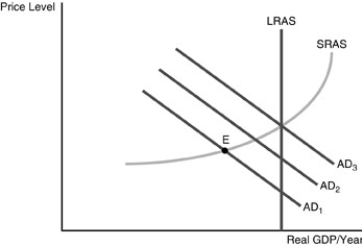 -Refer to the above figure. If the economy is at E and the government wants to increase aggregate demand to
 , but the increase in spending only shifts the aggregate demand curve to
 , then
-Refer to the above figure. If the economy is at E and the government wants to increase aggregate demand to , but the increase in spending only shifts the aggregate demand curve to , then (Multiple Choice)
4.8/5 (91)
(91) 
Filters
- Essay(0)
- Multiple Choice(0)
- Short Answer(0)
- True False(0)
- Matching(0)